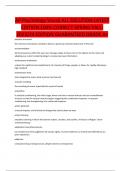
AP Psychology Vocab ALL SOLUTION LATEST EDITION 100% CORRECT SPRING FALL-2023/24 EDITION GUARANTEED GRADE A+
absolute threshold the minimum stimulation needed to detect a particular stimulus 50 percent of the time accommodation (1) the process by which the eye's lens changes shape to focus near or far objects on the retina. (2) adapting our current understandings to incorporate new information achievement motivation a desire for significant accomplishment; for mastery of things, people, or ideas; for rapidly attaining a high standard achievement tests tests designed to assess what a person has learned acoustic encoding the encoding of sound, especially the sound of words acquisition in classical conditioning, the initial stage, when one links a neutral stimulus and an unconditioned stimulus so that the neutral stimulus begins triggering the conditioned response. In operant conditioning, the strengthening of a reinforced response action potential a neural impulse; a brief electrical sharge that travels down an axon active listening empathic listening in which the listener echoes, restates, and clarifies. A feature of Rogers' client-centered therapy adaptation-level phenomenon our tendency to form judgments (of sounds, lights, income) relative to a neutral level defined by our prior experience addiction compulsive drug craving and use, despite adverse consequences adolescence the transition period from childhood to adulthood, extending from puberty to independence adrenal glands a pair of endocrine glands that sit just above the kidneys and secrete hormones (epinephrine and norepinephrine) that help arouse the body in times of stress aerobic exercise sustained exercise that increases heart and lung fitness; may also alleviate depression and anxiety aggression physical or verbal behavior intended to hurt someone algorithm a methodical, logical rule or procedure that guarantees solving a particular problem. Contrasts with the usually speedier - but also more error-prone - use of heuristics alpha waves relatively slow brain waves of a relaxed, awake state altruism unselfish regard for the welfare of others amnesia the loss of memory amphetamines drugs that stimulate neural activity, causing speeded-up functions and associated energy and mood changes amygdala two lima bean-sized neural clusters in the limbic system, linked to emotion anorexia nervosa an eating disorder in which a person diets and becomes significantly (15 percent or more) underweight, yet, still feeling fat, continues to starve antianxiety drugs drugs used to control anxiety and agitation antidepressant drugs drugs used to treat depression; also increasingly prescribed for anxiety. Different types work by altering the availability of various neurotransmitters antipsychotic drugs drugs used to treat schizophrenia and other forms of severe thought disorder antisocial personality disorder a personality disorder in which the person exhibits a lack of conscience for wrong-doing, even toward friends and family members. May be aggressive and ruthless or a clever con artist anxiety disorders psychological disorders characterized by distressing, persistant anxiety or maladaptive behaviors that reduce anxiety aphasia inpairment of language, usually caused by left hemisphere damage either to Broca's area (imparing speaking) or to the Wernicke's area (imparing understanding) applied research scientific study that aims to solve practical problems aptitude tests tests designed to predict a person's future performance assimilation interpreting our new experience in terms of our existing schemas association areas areas of the cerebral cortext that are not involved in primary motor or sensory functions; rather, they are involved in higher mental functions such as learning, remembering, thinking, and speaking associative learning learning that certain events occur together. The events may be two stimuli or a response and its consequences attatchment an emotional tie with another person; shown in young children by their seeking closeness to the caregiver and showing distress on seperation ADHD a psychological disorder marked by the appearance by age 7 of one or more of the three key symptoms extreme inattention, hyperactivity, and impulsivity attitude feelings, often influenced by our beliefs, that predispose us to respond in a perticular way to objects, people, and events attribution theory the theory that we explain someone's behavior by crediting either the situation of the person's disposition audition the sense or act of hearing autism a disorder that appears in childhood and is marked by deficient communication, social interaction, and understanding of others' states of mind automatic processing unconscious encoding of incidental information, such as space, time, and frequency, and of well-learned information, such as word meanings autonomic nervous system the part of the peripheral nervous system that controls the glands that the muscles of the internal organs. Its sympathetic division arouses; its parasympathetic division calms availability heuristic estimating the likelihood of events based on their availability in memory; if instances come readily to mind, we presume such events are common aversive conditioning a type of counterconditioning that associates an unpleasant state (such as nausea) with an unwanted behavior (such as drinking) axon the extension of a neuron, ending in branching terminal fibers, through which messages pass to other neurons or to muscles or glands babbling stage beginning at about 4 months, the stage of speech development in which the infant spontaneously utters various sounds at first unrelated to household language barbituarates drugs that depress the activity of the centeral nervous system, reducing anxiety but imparing memory and judgment basal metabolic rate the body's resting rate of energy expenditure CONTINUED..
Document information
- Uploaded on
- October 5, 2023
- Number of pages
- 50
- Written in
- 2023/2024
- Type
- Exam (elaborations)
- Contains
- Questions & answers