NREMT ADVANCED-EMT QUESTIONS WITH CORRECT ANSWERS
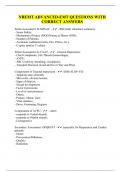
Initial Assessment: B-SMNAC - - BSI (body substance isolation); - Scene Safety; - Mechanism of Injury (MOI)/Nature of Illness (NOI); - Number of Patients; - Assistance (additional units, Fire, Police, etc.); - C-spine (and/or C-collar) Initial Assessment: G-CAAT - - General Impression; - Chief Complaints, Life Threats (hemorrhage); - AVPU; - ABC's (airway, breathing, circulation); - Transport Decision (Load and Go or Stay and Play) Components of General Impression - ASSS-FLOP-VD: - Apparent state of health; - Skin color, obvious lesions; - Signs of distress; - Sexual development; - Facial expressions; - Level of consciousness; - Odors; - Posture, Motor, Gait; - Vital statistics; - Dress, Grooming, Hygiene Components of AVPU - - Alert; - responds to Verbal stimuli; - responds to Painful stimuli; - Unresponsive Secondary Assessment: OPQRST-I - especially for Respiratory and Cardiac patients: - Onset; - Provocation/Palliation; - Quality; - Radiation; - Scale/Severity; - Time; - Interventions What is OPQRST? - a mnemonic for remembering the questions to ask when assessing the patient's chief complaint or major symptoms Onset - - When and how did the symptom begin? - Ask the patient if the onset was sudden or gradual. - Also determine if the onset was associated with a particular activity. Provocation/palliation: - - What makes the symptom worse? - What makes the symptom better? Quality - How would you describe the pain? Radiation - - Where do you feel the pain?; - Where does the pain go? Scale/Severity - - On a scale from 0 to 10, with 10 being the worst. - How bad is the symptom? Time - - Determine if the symptom has been present for minutes, hours, days, weeks, months, or years; - The length of time the symptoms are present is important to document Secondary Assessment: SAMPLE - - Signs and Symptoms (history of present issues); - Allergies; - Medications; - Past Medical History, Pertinent Negatives; - Last Oral Intake; - Events (leading to present: trauma or medical) Secondary Assessment: V-FITD - - Vital Signs, baseline (VS); - Focused Physical Exam (performed); - Interventions (RX's per medical direction, etc.); - Transport (re-evaluate decision); - Detailed Physical Exam (verbalized); Order of Initial Assessment - - B-SMNAC; - G-CAAT; Order of Secondary Assessment - - OPQRST-I; - SAMPLE; - V-FITD S1 - "Lub" Caused by the closing of the Mitral (Bicuspid) and Tricuspid atrioventricular valves. S2 - "Dub" Caused by blood closing the semilunar valves (aortic and pulmonic). S3 - "Ta" Oft referred to as the galloping heart, caused by blood sloshing around in a compliant left ventricle. S4 - A rare noise in the middle of "lub," caused by a failing left ventricle and best heard in the cardiac apex. Ta-LUB-dub, ta-LUB-dub Septum - 2 Sub Types - Separates the two halves of the heart. Interatrial and Interventricular NSAID - Nonsteroidal Anti-inflammatory Drug Antipyretic Agent - Inhibits Prostaglandins Acts on hypothalamus, heat regulation center. Vasodilation & Sweating Platelet Inhibitor - Prevents formation of thromboxane A2 Decreased Afterload Effects - Decreased Arteriole Pressure = Decreased Aortic Pressure = Left Ventricle Works Better Decreased Preload Effects - 1. Venous Dilation = Decreased Preload = Decreased Heart Size 2. Decreased Heart Size = Increased Blood Flow to Coronary and Collateral Vessels = Myocardial Perfusion is Improved A parasympatholytic drug blocks the effects of the parasympathetic nervous system by? - Binding to receptors and blocking the release of acetylcholine. Sympathetic Nervous System - Other Name - Adrenergic Nervous System Medications typically administered via the subcutaneous route? - Insulin Epinephrine Which of the following is NOT a form of liquid drug? - Capsule Which of the following physiologic responses would you expect to occur following administration of a drug that possesses alpha-1 (α1) properties? - Peripheral Vasoconstriction The function of a drug or the particular action of a drug on an organism is called: - Mechanism of Action Cushing's Reflex (Define) - Attempt by the body to compensate for a decline in cerebral perfusion by increasing the mean arteriole pressure. Cushing's Triad - SxS of Increased Intracranial Pressure Increased Systolic Pressure Widened Pulse Pressure Decreased Pulse and Respiratory Rate PAT: Pediatric Assessment Triangle - General Appearance Work of Breathing Circulation to the Skin TICLS - Tone Interactiveness Consolability (Agitable) Look (Gaze)
Written for
- Institution
- NREMT
- Course
- NREMT
Document information
- Uploaded on
- October 5, 2023
- Number of pages
- 39
- Written in
- 2023/2024
- Type
- Exam (elaborations)
- Contains
- Questions & answers
Subjects
- nremt
-
nremt advanced emt questions

Also available in package deal