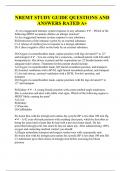
NREMT STUDY GUIDE QUESTIONS AND ANSWERS RATED A+
A) An exaggerated immune system response to any substance - Which of the following MOST accurately defines an allergic reaction? A) An exaggerated immune system response to any substance B) Destruction of the immune system by an external substance C) A release of erythrocytes in response to a foreign substance D) A direct negative effect on the body by an external substance D) Oxygen via nonrebreather mask, supine position with legs elevated 6" to 12" and transport - You are caring for a conscious, confused patient with left-sided hemiparalysis. His airway is patent and his respirations are 22 breaths/minute with adequate tidal volume. Treatment for this patient should include: A) Oxygen via nonrebreather mask, left lateral recumbent position, and transport. B) Assisted ventilation with a BVM, right lateral recumbent position, and transport C) An oral airway, assisted ventilation with a BVM, Fowler's position, and transport D) Oxygen via nonrebreather mask, supine postition with the legs elevated 6" to 12" and transport B) Kidney - A young female presents with costovertebral angle tenderness. She is conscious and alert with stable vital signs. Which of the following organs is MOST likely causing her pain? A) Liver B) Kidney C) Pancreas D) Gallbladder B) Assist him with his nitroglycerin unless his systolic BP is less than 100 mm Hg - A 62 year-old male presents with crushing chest pain, which he describes as being the same kind of pain that he had with a previous heart attack. He has prescribed nitroglycerin, but states he has not taken any. After administering 100% oxygen and contacting medical control you should: A) Begin immediate transport and request rendezvous with a paramedic unit. B) Assist him with his nitroglycerin unless his systolic BP is less than 100 mm HG C) Administer up to three doses of nitroglycerin before assessing his blood pressure D) Administer the nitroglycerin unless he has taken Viagra within the past 72 hours A) Assess for the presence of a brachial pulse - You receive a call to a local daycare center for an unconscious 8-month-old infant. Upon arrival, you perform an assessment and determine that the infant is not breathing. After delivering two rescue breaths, you should: A) Assess for the presence of a brachial pulse. B) Begin chest compressions and request backup C) Immediately transport the child to the hospital D) Assess for a carotid pulse for 10 to 15 seconds D) Rocky mountain spotted fever - You are dispatched to a residence for a young female who is "sick" The patient complains of a rash to her lower extremities and truncal area. Your assessment reveals a small, painful blister on her inner thigh. As your partner is taking the patient's vital signs, she states that she and her family returned from a camping trip 2 days ago. On the bass of this patient's presentation, you should suspect: A) Lyme disease B) An allergic reaction C) Exposure to poison ivy D) Rocky mountain spotted fever A) Transport the child immediately and have the parents meet you at the hospital - You arrive at the scene of a motor vehicle versus pedestrian accident. The patient, a 13-year-old male, is unconscious and has multiple injuries. As you are treating the child, a law enforcement officer advises you that the child's parents will be at the scene in approximately 15 minutes. What should you do? A) Transport the child immediately and have the parents meet you at the hospital B) Treat the child at the scene and wait for the parents to arrive and give consent C) Begin transport at once and have the parents meet you en route to the hospital D) Withhold treatment until the parents arrive and give you consent for treatment
Written for
- Institution
- NREMT
- Course
- NREMT
Document information
- Uploaded on
- October 4, 2023
- Number of pages
- 17
- Written in
- 2023/2024
- Type
- Exam (elaborations)
- Contains
- Questions & answers
Subjects
- nremt study guide
-
nremt study guide questions and answers

Also available in package deal