

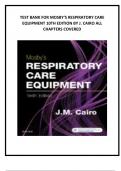
TEST BANK FOR MOSBY'S RESPIRATORY CARE EQUIPMENT 10TH EDITION BY J. CAIRO ALL CHAPTERS COVERED.
Chapter 01: Basic Physics for the Respiratory Therapist MULTIPLE CHOICE 1. Power is a measure of which of the following? a. Mechanical energy b. Gravitational potential energy c. The rate at which work is being performed d. The rate at which atoms and molecules move ANS: C Power is a measure of the rate at which work is being performed. The formula P = W/J, where W = watts and 1 watt is equal to 1 J/s, expresses this. Joules are the international standard for expressing energy and work. PTS: 1 REF: Page 8 2. When effort produces a change in the position of matter: a. work is performed. b. it is known as a joule. c. mechanical power is created. d. the law of the conservation of energy is being used. ANS: A Work is performed only when effort or outside forces produce a change in the position of matter. PTS: 1 REF: Page 8 3. The unit used to express the force of 1 newton (N) acting on a 1-kilogram (kg) object to move it 1 meter (m) is which of the following? a. Watt c. Kilowatt b. Joule d. Kinetic energy ANS: B One joule is equal to the force of 1 N acting on 1 kg. A watt is equivalent to 1 J/s. A kilowatt is simply 1000 W. Kinetic energy is energy an object possesses when it is in motion. PTS: 1 REF: Page 8 4. Power is expressed in which of the following units? a. Newtons c. Ohms b. Joules d. Watts ANS: D Power is a measure of the rate at which work is being performed. Energy and work are measured in joules. One joule is the force of 1 N acting on a 1-kg object to move it 1 m. Ohms is the resistance an electrical circuit possesses. PTS: 1 REF: Page 8 5. Four horsepower (hp) is equal to how many kilowatts (kW)? a. 5.36 c. 2984 b. 2.98 d. 186.5 ANS: B 1 hp = 0.746 kW. 1 hp/0.746 = 4 hp/X. X = 4 0.476 = 2.98 kW. PTS: 1 REF: Page 8 6. The energy that an object possesses when it is in motion is called: a. sound. c. thermal. b. kinetic. d. potential. ANS: B Kinetic energy is the energy an object possesses when it stays in motion. Potential energy is stored energy, and it exists in many forms such as thermal energy or sound waves. PTS: 1 REF: Page 9 7. If the velocity of an object is reduced by half, its kinetic energy will be which of the following? a. Reduced to one eighth c. Reduced twofold b. Increased twofold d. Not changed ANS: A Kinetic energy = (mass of object square of velocity it is traveling, or mv2 ) or KE = (V V). If the velocity is reduced by half, then KE = ( V V), or ( ) = reduction. PTS: 1 REF: Page 10 8. Energy that is stored in an object is called which of the following? a. Kinetic c. Chemical b. Potential d. Mechanical ANS: B Energy that is stored or possessed by an object because of its position is called potential energy. Mechanical energy can be divided into either kinetic energy or potential energy. Chemical potential energy often refers to the bonds in petroleum oils that, if broken, can be converted to kinetic energy. PTS: 1 REF: Page 10 9. The potential energy of a compressed spring is known as which of the following? a. Gravitational c. Inelastic b. Chemical d. Elastic ANS: D The potential energy stored in a compressed spring is called elastic potential energy. This energy is released when the spring is allowed to uncoil. Gravitational potential energy is the energy an object possesses if it is held above any surface, energy that the object’s weight gains as it falls. Chemical potential energy resides in the chemical bonds of the atoms that make up the object. Inelastic potential energy would not apply once the spring is compressed. PTS: 1 REF: Page 10 10. The energy stored in heating oil is known as which of the following? a. Elastic c. Chemical b. Atomic d. Gravitational ANS: C Petroleum reserves of coal, oil, and gas represent chemical potential energy by virtue of the chemical bond that must be broken to release energy. Heating oil potential energy has chemical-to-chemical bonds. Atomic energy involves two processes—fission (splitting atoms) and fusion (joining two atoms). PTS: 1 REF: Page 8 11. The kinetic theory holds that: a. all matter is composed of tiny particles. b. elements combine in fixed proportions to form molecules. c. the energy that an object gains as it falls is a result of gravity. d. atoms and molecules that make up matter are in constant motion. ANS: D Kinetic energy is the energy an object possesses while in motion. PTS: 1 REF: Page 9 12. Which is the correct order for increasing size? a. Atoms, molecules, mixtures, compounds, elements b. Atoms, elements, molecules, compounds, mixtures c. Elements, atoms, molecules, compounds, mixtures d. Atoms, elements, mixtures, molecules, compounds ANS: B All matter, whether in gas, liquid, or solid form, is made up of atoms that can combine to form elements; the elements can then combine to form molecules. Molecules can combine to form compounds. Combining compounds makes a mixture. PTS: 1 REF: Page 10 13. Atoms and molecules arranged in an orderly fashion are called: a. Solids c. Crystalline b. Mixtures d. Amorphous ANS: C Crystalline solids are highly organized structures whose atoms and molecules are arranged in a lattice configuration. Amorphous solids have atoms and molecules that are less rigidly arranged. PTS: 1 REF: Page 10 14. The most potential energy is contained by which state of matter? a. Gases c. Liquids b. Solids d. Mixtures ANS: B Of all states of matter, solids contain the most potential energy; solids are followed by liquids and then gases. PTS: 1 REF: Page 11 15. Which of the following are amorphous solids? 1. Iron 2. Glass 3. Plastic 4. Margarine a. 1 c. 2 and 4 b. 1 and 3 d. 2, 3, and 4 ANS: D Glass and margarine are always considered amorphous solids. Plastic usually shows flexibility, which implies that it has amorphous features, so it should be considered amorphous. Iron, however, has well-organized atoms in a crystalline arrangement. PTS: 1 REF: Page 10 16. Supercooled liquids are also known as which of the following? a. Elements c. Crystalline solids b. Compounds d. Amorphous solids ANS: D Amorphous solids are sometimes called supercooled liquids. Elements and compounds alone can combine to form either crystalline or amorphous solids. PTS: 1 REF: Page 10 17. The least amount of kinetic energy is possessed by which one of the following? a. Air c. Water b. Iron d. Plastic ANS: B Of the three states of matter, solids possess the least amount of kinetic energy. The bonds holding their atoms together limit the mobility of the particles that make up the solid. PTS: 1 REF: Page 11 18. Incompressible substances that are able to maintain their volume and shape are called: a. gases. c. liquids. b. solids. d. compounds. ANS: B Solids are characterized as incompressible substances that can maintain their volume and shape. Gases and liquids do not maintain their volume and shape as well as solids do. PTS: 1 REF: Page 11 19. The weakest cohesive forces between constituent particles are present in which of the following? a. Water c. Hydrogen b. Plastic d. Liquid oxygen ANS: C Gases have extremely weak or no cohesive forces between their atoms. Hydrogen is the only gas among the four choices. PTS: 1 REF: Page 11 20. A cylinder of compressed gas contains 1500 psig at 70° F; the cylinder is heated to 120° F. Which of the following effects will occur as a result of the temperature change? 1. There will be increased kinetic activity in the contents of the cylinder 2. The volume of gas in the cylinder will increase 3. The pressure indicated on the pressure gauge will increase. a. 1 only c. 1 and 3 b. 1 and 2 d. 2 and 3 ANS: C The increased temperature will increase the kinetic activity of the molecules which make up the gas. Charles law states that pressure and temperature are directly proportional. An increase in temperature will increase the pressure. Chapter 01: Basic Physics for the Respiratory Therapist MULTIPLE CHOICE 1. Power is a measure of which of the following? a. Mechanical energy b. Gravitational potential energy c. The rate at which work is being performed d. The rate at which atoms and molecules move ANS: C Power is a measure of the rate at which work is being performed. The formula P = W/J, where W = watts and 1 watt is equal to 1 J/s, expresses this. Joules are the international standard for expressing energy and work. PTS: 1 REF: Page 8 2. When effort produces a change in the position of matter: a. work is performed. b. it is known as a joule. c. mechanical power is created. d. the law of the conservation of energy is being used. ANS: A Work is performed only when effort or outside forces produce a change in the position of matter. PTS: 1 REF: Page 8 3. The unit used to express the force of 1 newton (N) acting on a 1-kilogram (kg) object to move it 1 meter (m) is which of the following? a. Watt c. Kilowatt b. Joule d. Kinetic energy ANS: B One joule is equal to the force of 1 N acting on 1 kg. A watt is equivalent to 1 J/s. A kilowatt is simply 1000 W. Kinetic energy is energy an object possesses when it is in motion. PTS: 1 REF: Page 8 4. Power is expressed in which of the following units? a. Newtons c. Ohms b. Joules d. Watts ANS: D Power is a measure of the rate at which work is being performed. Energy and work are measured in joules. One joule is the force of 1 N acting on a 1-kg object to move it 1 m. Ohms is the resistance an electrical circuit possesses. PTS: 1 REF: Page 8 5. Four horsepower (hp) is equal to how many kilowatts (kW)? a. 5.36 c. 2984 b. 2.98 d. 186.5 ANS: B 1 hp = 0.746 kW. 1 hp/0.746 = 4 hp/X. X = 4 0.476 = 2.98 kW. PTS: 1 REF: Page 8 6. The energy that an object possesses when it is in motion is called: a. sound. c. thermal. b. kinetic. d. potential. ANS: B Kinetic energy is the energy an object possesses when it stays in motion. Potential energy is stored energy, and it exists in many forms such as thermal energy or sound waves. PTS: 1 REF: Page 9 7. If the velocity of an object is reduced by half, its kinetic energy will be which of the following? a. Reduced to one eighth c. Reduced twofold b. Increased twofold d. Not changed ANS: A Kinetic energy = (mass of object square of velocity it is traveling, or mv2 ) or KE = (V V). If the velocity is reduced by half, then KE = ( V V), or ( ) = reduction. PTS: 1 REF: Page 10 8. Energy that is stored in an object is called which of the following? a. Kinetic c. Chemical b. Potential d. Mechanical ANS: B Energy that is stored or possessed by an object because of its position is called potential energy. Mechanical energy can be divided into either kinetic energy or potential energy. Chemical potential energy often refers to the bonds in petroleum oils that, if broken, can be converted to kinetic energy. PTS: 1 REF: Page 10 9. The potential energy of a compressed spring is known as which of the following? a. Gravitational c. Inelastic b. Chemical d. Elastic ANS: D The potential energy stored in a compressed spring is called elastic potential energy. This energy is released when the spring is allowed to uncoil. Gravitational potential energy is the energy an object possesses if it is held above any surface, energy that the object’s weight gains as it falls. Chemical potential energy resides in the chemical bonds of the atoms that make up the object. Inelastic potential energy would not apply once the spring is compressed. PTS: 1 REF: Page 10 10. The energy stored in heating oil is known as which of the following? a. Elastic c. Chemical b. Atomic d. Gravitational ANS: C Petroleum reserves of coal, oil, and gas represent chemical potential energy by virtue of the chemical bond that must be broken to release energy. Heating oil potential energy has chemical-to-chemical bonds. Atomic energy involves two processes—fission (splitting atoms) and fusion (joining two atoms). PTS: 1 REF: Page 8 11. The kinetic theory holds that: a. all matter is composed of tiny particles. b. elements combine in fixed proportions to form molecules. c. the energy that an object gains as it falls is a result of gravity. d. atoms and molecules that make up matter are in constant motion. ANS: D Kinetic energy is the energy an object possesses while in motion. PTS: 1 REF: Page 9 12. Which is the correct order for increasing size? a. Atoms, molecules, mixtures, compounds, elements b. Atoms, elements, molecules, compounds, mixtures c. Elements, atoms, molecules, compounds, mixtures d. Atoms, elements, mixtures, molecules, compounds ANS: B All matter, whether in gas, liquid, or solid form, is made up of atoms that can combine to form elements; the elements can then combine to form molecules. Molecules can combine to form compounds. Combining compounds makes a mixture. PTS: 1 REF: Page 10 13. Atoms and molecules arranged in an orderly fashion are called: a. Solids c. Crystalline b. Mixtures d. Amorphous ANS: C Crystalline solids are highly organized structures whose atoms and molecules are arranged in a lattice configuration. Amorphous solids have atoms and molecules that are less rigidly arranged. PTS: 1 REF: Page 10 14. The most potential energy is contained by which state of matter? a. Gases c. Liquids b. Solids d. Mixtures ANS: B Of all states of matter, solids contain the most potential energy; solids are followed by liquids and then gases. PTS: 1 REF: Page 11 15. Which of the following are amorphous solids? 1. Iron 2. Glass 3. Plastic 4. Margarine a. 1 c. 2 and 4 b. 1 and 3 d. 2, 3, and 4 ANS: D Glass and margarine are always considered amorphous solids. Plastic usually shows flexibility, which implies that it has amorphous features, so it should be considered amorphous. Iron, however, has well-organized atoms in a crystalline arrangement. PTS: 1 REF: Page 10 16. Supercooled liquids are also known as which of the following? a. Elements c. Crystalline solids b. Compounds d. Amorphous solids ANS: D Amorphous solids are sometimes called supercooled liquids. Elements and compounds alone can combine to form either crystalline or amorphous solids. PTS: 1 REF: Page 10 17. The least amount of kinetic energy is possessed by which one of the following? a. Air c. Water b. Iron d. Plastic ANS: B Of the three states of matter, solids possess the least amount of kinetic energy. The bonds holding their atoms together limit the mobility of the particles that make up the solid. PTS: 1 REF: Page 11 18. Incompressible substances that are able to maintain their volume and shape are called: a. gases. c. liquids. b. solids. d. compounds. ANS: B Solids are characterized as incompressible substances that can maintain their volume and shape. Gases and liquids do not maintain their volume and shape as well as solids do. PTS: 1 REF: Page 11 19. The weakest cohesive forces between constituent particles are present in which of the following? a. Water c. Hydrogen b. Plastic d. Liquid oxygen ANS: C Gases have extremely weak or no cohesive forces between their atoms. Hydrogen is the only gas among the four choices. PTS: 1 REF: Page 11 20. A cylinder of compressed gas contains 1500 psig at 70° F; the cylinder is heated to 120° F. Which of the following effects will occur as a result of the temperature change? 1. There will be increased kinetic activity in the contents of the cylinder 2. The volume of gas in the cylinder will increase 3. The pressure indicated on the pressure gauge will increase. a. 1 only c. 1 and 3 b. 1 and 2 d. 2 and 3 ANS: C The increased temperature will increase the kinetic activity of the molecules which make up the gas. Charles law states that pressure and temperature are directly proportional. An increase in temperature will increase the pressure. Chapter 01: Basic Physics for the Respiratory Therapist MULTIPLE CHOICE 1. Power is a measure of which of the following? a. Mechanical energy b. Gravitational potential energy c. The rate at which work is being performed d. The rate at which atoms and molecules move ANS: C Power is a measure of the rate at which work is being performed. The formula P = W/J, where W = watts and 1 watt is equal to 1 J/s, expresses this. Joules are the international standard for expressing energy and work. PTS: 1 REF: Page 8 2. When effort produces a change in the position of matter: a. work is performed. b. it is known as a joule. c. mechanical power is created. d. the law of the conservation of energy is being used. ANS: A Work is performed only when effort or outside forces produce a change in the position of matter. PTS: 1 REF: Page 8 3. The unit used to express the force of 1 newton (N) acting on a 1-kilogram (kg) object to move it 1 meter (m) is which of the following? a. Watt c. Kilowatt b. Joule d. Kinetic energy ANS: B One joule is equal to the force of 1 N acting on 1 kg. A watt is equivalent to 1 J/s. A kilowatt is simply 1000 W. Kinetic energy is energy an object possesses when it is in motion. PTS: 1 REF: Page 8 4. Power is expressed in which of the following units? a. Newtons c. Ohms b. Joules d. Watts ANS: D Power is a measure of the rate at which work is being performed. Energy and work are measured in joules. One joule is the force of 1 N acting on a 1-kg object to move it 1 m. Ohms is the resistance an electrical circuit possesses. PTS: 1 REF: Page 8 5. Four horsepower (hp) is equal to how many kilowatts (kW)? a. 5.36 c. 2984 b. 2.98 d. 186.5 ANS: B 1 hp = 0.746 kW. 1 hp/0.746 = 4 hp/X. X = 4 0.476 = 2.98 kW. PTS: 1 REF: Page 8 6. The energy that an object possesses when it is in motion is called: a. sound. c. thermal. b. kinetic. d. potential. ANS: B Kinetic energy is the energy an object possesses when it stays in motion. Potential energy is stored energy, and it exists in many forms such as thermal energy or sound waves. PTS: 1 REF: Page 9 7. If the velocity of an object is reduced by half, its kinetic energy will be which of the following? a. Reduced to one eighth c. Reduced twofold b. Increased twofold d. Not changed ANS: A Kinetic energy = (mass of object square of velocity it is traveling, or mv2 ) or KE = (V V). If the velocity is reduced by half, then KE = ( V V), or ( ) = reduction. PTS: 1 REF: Page 10 8. Energy that is stored in an object is called which of the following? a. Kinetic c. Chemical b. Potential d. Mechanical ANS: B Energy that is stored or possessed by an object because of its position is called potential energy. Mechanical energy can be divided into either kinetic energy or potential energy. Chemical potential energy often refers to the bonds in petroleum oils that, if broken, can be converted to kinetic energy. PTS: 1 REF: Page 10 9. The potential energy of a compressed spring is known as which of the following? a. Gravitational c. Inelastic b. Chemical d. Elastic ANS: D The potential energy stored in a compressed spring is called elastic potential energy. This energy is released when the spring is allowed to uncoil. Gravitational potential energy is the energy an object possesses if it is held above any surface, energy that the object’s weight gains as it falls. Chemical potential energy resides in the chemical bonds of the atoms that make up the object. Inelastic potential energy would not apply once the spring is compressed. PTS: 1 REF: Page 10 10. The energy stored in heating oil is known as which of the following? a. Elastic c. Chemical b. Atomic d. Gravitational ANS: C Petroleum reserves of coal, oil, and gas represent chemical potential energy by virtue of the chemical bond that must be broken to release energy. Heating oil potential energy has chemical-to-chemical bonds. Atomic energy involves two processes—fission (splitting atoms) and fusion (joining two atoms). PTS: 1 REF: Page 8 11. The kinetic theory holds that: a. all matter is composed of tiny particles. b. elements combine in fixed proportions to form molecules. c. the energy that an object gains as it falls is a result of gravity. d. atoms and molecules that make up matter are in constant motion. ANS: D Kinetic energy is the energy an object possesses while in motion. PTS: 1 REF: Page 9 12. Which is the correct order for increasing size? a. Atoms, molecules, mixtures, compounds, elements b. Atoms, elements, molecules, compounds, mixtures c. Elements, atoms, molecules, compounds, mixtures d. Atoms, elements, mixtures, molecules, compounds ANS: B All matter, whether in gas, liquid, or solid form, is made up of atoms that can combine to form elements; the elements can then combine to form molecules. Molecules can combine to form compounds. Combining compounds makes a mixture. PTS: 1 REF: Page 10 13. Atoms and molecules arranged in an orderly fashion are called: a. Solids c. Crystalline b. Mixtures d. Amorphous ANS: C Crystalline solids are highly organized structures whose atoms and molecules are arranged in a lattice configuration. Amorphous solids have atoms and molecules that are less rigidly arranged. PTS: 1 REF: Page 10 14. The most potential energy is contained by which state of matter? a. Gases c. Liquids b. Solids d. Mixtures ANS: B Of all states of matter, solids contain the most potential energy; solids are followed by liquids and then gases. PTS: 1 REF: Page 11 15. Which of the following are amorphous solids? 1. Iron 2. Glass 3. Plastic 4. Margarine a. 1 c. 2 and 4 b. 1 and 3 d. 2, 3, and 4 ANS: D Glass and margarine are always considered amorphous solids. Plastic usually shows flexibility, which implies that it has amorphous features, so it should be considered amorphous. Iron, however, has well-organized atoms in a crystalline arrangement. PTS: 1 REF: Page 10 16. Supercooled liquids are also known as which of the following? a. Elements c. Crystalline solids b. Compounds d. Amorphous solids ANS: D Amorphous solids are sometimes called supercooled liquids. Elements and compounds alone can combine to form either crystalline or amorphous solids. PTS: 1 REF: Page 10 17. The least amount of kinetic energy is possessed by which one of the following? a. Air c. Water b. Iron d. Plastic ANS: B Of the three states of matter, solids possess the least amount of kinetic energy. The bonds holding their atoms together limit the mobility of the particles that make up the solid. PTS: 1 REF: Page 11 18. Incompressible substances that are able to maintain their volume and shape are called: a. gases. c. liquids. b. solids. d. compounds. ANS: B Solids are characterized as incompressible substances that can maintain their volume and shape. Gases and liquids do not maintain their volume and shape as well as solids do. PTS: 1 REF: Page 11 19. The weakest cohesive forces between constituent particles are present in which of the following? a. Water c. Hydrogen b. Plastic d. Liquid oxygen ANS: C Gases have extremely weak or no cohesive forces between their atoms. Hydrogen is the only gas among the four choices. PTS: 1 REF: Page 11 20. A cylinder of compressed gas contains 1500 psig at 70° F; the cylinder is heated to 120° F. Which of the following effects will occur as a result of the temperature change? 1. There will be increased kinetic activity in the contents of the cylinder 2. The volume of gas in the cylinder will increase 3. The pressure indicated on the pressure gauge will increase. a. 1 only c. 1 and 3 b. 1 and 2 d. 2 and 3 ANS: C The increased temperature will increase the kinetic activity of the molecules which make up the gas. Charles law states that pressure and temperature are directly proportional. An increase in temperature will increase the pressure. Chapter 01: Basic Physics for the Respiratory Therapist MULTIPLE CHOICE 1. Power is a measure of which of the following? a. Mechanical energy b. Gravitational potential energy c. The rate at which work is being performed d. The rate at which atoms and molecules move ANS: C Power is a measure of the rate at which work is being performed. The formula P = W/J, where W = watts and 1 watt is equal to 1 J/s, expresses this. Joules are the international standard for expressing energy and work. PTS: 1 REF: Page 8 2. When effort produces a change in the position of matter: a. work is performed. b. it is known as a joule. c. mechanical power is created. d. the law of the conservation of energy is being used. ANS: A Work is performed only when effort or outside forces produce a change in the position of matter. PTS: 1 REF: Page 8 3. The unit used to express the force of 1 newton (N) acting on a 1-kilogram (kg) object to move it 1 meter (m) is which of the following? a. Watt c. Kilowatt b. Joule d. Kinetic energy ANS: B One joule is equal to the force of 1 N acting on 1 kg. A watt is equivalent to 1 J/s. A kilowatt is simply 1000 W. Kinetic energy is energy an object possesses when it is in motion. PTS: 1 REF: Page 8 4. Power is expressed in which of the following units? a. Newtons c. Ohms b. Joules d. Watts ANS: D Power is a measure of the rate at which work is being performed. Energy and work are measured in joules. One joule is the force of 1 N acting on a 1-kg object to move it 1 m. Ohms is the resistance an electrical circuit possesses. PTS: 1 REF: Page 8 5. Four horsepower (hp) is equal to how many kilowatts (kW)? a. 5.36 c. 2984 b. 2.98 d. 186.5 ANS: B 1 hp = 0.746 kW. 1 hp/0.746 = 4 hp/X. X = 4 0.476 = 2.98 kW. PTS: 1 REF: Page 8 6. The energy that an object possesses when it is in motion is called: a. sound. c. thermal. b. kinetic. d. potential. ANS: B Kinetic energy is the energy an object possesses when it stays in motion. Potential energy is stored energy, and it exists in many forms such as thermal energy or sound waves. PTS: 1 REF: Page 9 7. If the velocity of an object is reduced by half, its kinetic energy will be which of the following? a. Reduced to one eighth c. Reduced twofold b. Increased twofold d. Not changed ANS: A Kinetic energy = (mass of object square of velocity it is traveling, or mv2 ) or KE = (V V). If the velocity is reduced by half, then KE = ( V V), or ( ) = reduction. PTS: 1 REF: Page 10 8. Energy that is stored in an object is called which of the following? a. Kinetic c. Chemical b. Potential d. Mechanical ANS: B Energy that is stored or possessed by an object because of its position is called potential energy. Mechanical energy can be divided into either kinetic energy or potential energy. Chemical potential energy often refers to the bonds in petroleum oils that, if broken, can be converted to kinetic energy. PTS: 1 REF: Page 10 9. The potential energy of a compressed spring is known as which of the following? a. Gravitational c. Inelastic b. Chemical d. Elastic ANS: D The potential energy stored in a compressed spring is called elastic potential energy. This energy is released when the spring is allowed to uncoil. Gravitational potential energy is the energy an object possesses if it is held above any surface, energy that the object’s weight gains as it falls. Chemical potential energy resides in the chemical bonds of the atoms that make up the object. Inelastic potential energy would not apply once the spring is compressed. PTS: 1 REF: Page 10 10. The energy stored in heating oil is known as which of the following? a. Elastic c. Chemical b. Atomic d. Gravitational ANS: C Petroleum reserves of coal, oil, and gas represent chemical potential energy by virtue of the chemical bond that must be broken to release energy. Heating oil potential energy has chemical-to-chemical bonds. Atomic energy involves two processes—fission (splitting atoms) and fusion (joining two atoms). PTS: 1 REF: Page 8 11. The kinetic theory holds that: a. all matter is composed of tiny particles. b. elements combine in fixed proportions to form molecules. c. the energy that an object gains as it falls is a result of gravity. d. atoms and molecules that make up matter are in constant motion. ANS: D Kinetic energy is the energy an object possesses while in motion. PTS: 1 REF: Page 9 12. Which is the correct order for increasing size? a. Atoms, molecules, mixtures, compounds, elements b. Atoms, elements, molecules, compounds, mixtures c. Elements, atoms, molecules, compounds, mixtures d. Atoms, elements, mixtures, molecules, compounds ANS: B All matter, whether in gas, liquid, or solid form, is made up of atoms that can combine to form elements; the elements can then combine to form molecules. Molecules can combine to form compounds. Combining compounds makes a mixture. PTS: 1 REF: Page 10 13. Atoms and molecules arranged in an orderly fashion are called: a. Solids c. Crystalline b. Mixtures d. Amorphous ANS: C Crystalline solids are highly organized structures whose atoms and molecules are arranged in a lattice configuration. Amorphous solids have atoms and molecules that are less rigidly arranged. PTS: 1 REF: Page 10 14. The most potential energy is contained by which state of matter? a. Gases c. Liquids b. Solids d. Mixtures ANS: B Of all states of matter, solids contain the most potential energy; solids are followed by liquids and then gases. PTS: 1 REF: Page 11 15. Which of the following are amorphous solids? 1. Iron 2. Glass 3. Plastic 4. Margarine a. 1 c. 2 and 4 b. 1 and 3 d. 2, 3, and 4 ANS: D Glass and margarine are always considered amorphous solids. Plastic usually shows flexibility, which implies that it has amorphous features, so it should be considered amorphous. Iron, however, has well-organized atoms in a crystalline arrangement. PTS: 1 REF: Page 10 16. Supercooled liquids are also known as which of the following? a. Elements c. Crystalline solids b. Compounds d. Amorphous solids ANS: D Amorphous solids are sometimes called supercooled liquids. Elements and compounds alone can combine to form either crystalline or amorphous solids. PTS: 1 REF: Page 10 17. The least amount of kinetic energy is possessed by which one of the following? a. Air c. Water b. Iron d. Plastic ANS: B Of the three states of matter, solids possess the least amount of kinetic energy. The bonds holding their atoms together limit the mobility of the particles that make up the solid. PTS: 1 REF: Page 11 18. Incompressible substances that are able to maintain their volume and shape are called: a. gases. c. liquids. b. solids. d. compounds. ANS: B Solids are characterized as incompressible substances that can maintain their volume and shape. Gases and liquids do not maintain their volume and shape as well as solids do. PTS: 1 REF: Page 11 19. The weakest cohesive forces between constituent particles are present in which of the following? a. Water c. Hydrogen b. Plastic d. Liquid oxygen ANS: C Gases have extremely weak or no cohesive forces between their atoms. Hydrogen is the only gas among the four choices. PTS: 1 REF: Page 11 20. A cylinder of compressed gas contains 1500 psig at 70° F; the cylinder is heated to 120° F. Which of the following effects will occur as a result of the temperature change? 1. There will be increased kinetic activity in the contents of the cylinder 2. The volume of gas in the cylinder will increase 3. The pressure indicated on the pressure gauge will increase. a. 1 only c. 1 and 3 b. 1 and 2 d. 2 and 3 ANS: C The increased temperature will increase the kinetic activity of the molecules which make up the gas. Charles law states that pressure and temperature are directly proportional. An increase in temperature will increase the pressure. Chapter 01: Basic Physics for the Respiratory Therapist MULTIPLE CHOICE 1. Power is a measure of which of the following? a. Mechanical energy b. Gravitational potential energy c. The rate at which work is being performed d. The rate at which atoms and molecules move ANS: C Power is a measure of the rate at which work is being performed. The formula P = W/J, where W = watts and 1 watt is equal to 1 J/s, expresses this. Joules are the international standard for expressing energy and work. PTS: 1 REF: Page 8 2. When effort produces a change in the position of matter: a. work is performed. b. it is known as a joule. c. mechanical power is created. d. the law of the conservation of energy is being used. ANS: A Work is performed only when effort or outside forces produce a change in the position of matter. PTS: 1 REF: Page 8 3. The unit used to express the force of 1 newton (N) acting on a 1-kilogram (kg) object to move it 1 meter (m) is which of the following? a. Watt c. Kilowatt b. Joule d. Kinetic energy ANS: B One joule is equal to the force of 1 N acting on 1 kg. A watt is equivalent to 1 J/s. A kilowatt is simply 1000 W. Kinetic energy is energy an object possesses when it is in motion. PTS: 1 REF: Page 8 4. Power is expressed in which of the following units? a. Newtons c. Ohms b. Joules d. Watts ANS: D Power is a measure of the rate at which work is being performed. Energy and work are measured in joules. One joule is the force of 1 N acting on a 1-kg object to move it 1 m. Ohms is the resistance an electrical circuit possesses. PTS: 1 REF: Page 8 5. Four horsepower (hp) is equal to how many kilowatts (kW)? a. 5.36 c. 2984 b. 2.98 d. 186.5 ANS: B 1 hp = 0.746 kW. 1 hp/0.746 = 4 hp/X. X = 4 0.476 = 2.98 kW. PTS: 1 REF: Page 8 6. The energy that an object possesses when it is in motion is called: a. sound. c. thermal. b. kinetic. d. potential. ANS: B Kinetic energy is the energy an object possesses when it stays in motion. Potential energy is stored energy, and it exists in many forms such as thermal energy or sound waves. PTS: 1 REF: Page 9 7. If the velocity of an object is reduced by half, its kinetic energy will be which of the following? a. Reduced to one eighth c. Reduced twofold b. Increased twofold d. Not changed ANS: A Kinetic energy = (mass of object square of velocity it is traveling, or mv2 ) or KE = (V V). If the velocity is reduced by half, then KE = ( V V), or ( ) = reduction. PTS: 1 REF: Page 10 8. Energy that is stored in an object is called which of the following? a. Kinetic c. Chemical b. Potential d. Mechanical ANS: B Energy that is stored or possessed by an object because of its position is called potential energy. Mechanical energy can be divided into either kinetic energy or potential energy. Chemical potential energy often refers to the bonds in petroleum oils that, if broken, can be converted to kinetic energy. PTS: 1 REF: Page 10 9. The potential energy of a compressed spring is known as which of the following? a. Gravitational c. Inelastic b. Chemical d. Elastic ANS: D The potential energy stored in a compressed spring is called elastic potential energy. This energy is released when the spring is allowed to uncoil. Gravitational potential energy is the energy an object possesses if it is held above any surface, energy that the object’s weight gains as it falls. Chemical potential energy resides in the chemical bonds of the atoms that make up the object. Inelastic potential energy would not apply once the spring is compressed. PTS: 1 REF: Page 10 10. The energy stored in heating oil is known as which of the following? a. Elastic c. Chemical b. Atomic d. Gravitational ANS: C Petroleum reserves of coal, oil, and gas represent chemical potential energy by virtue of the chemical bond that must be broken to release energy. Heating oil potential energy has chemical-to-chemical bonds. Atomic energy involves two processes—fission (splitting atoms) and fusion (joining two atoms). PTS: 1 REF: Page 8 11. The kinetic theory holds that: a. all matter is composed of tiny particles. b. elements combine in fixed proportions to form molecules. c. the energy that an object gains as it falls is a result of gravity. d. atoms and molecules that make up matter are in constant motion. ANS: D Kinetic energy is the energy an object possesses while in motion. PTS: 1 REF: Page 9 12. Which is the correct order for increasing size? a. Atoms, molecules, mixtures, compounds, elements b. Atoms, elements, molecules, compounds, mixtures c. Elements, atoms, molecules, compounds, mixtures d. Atoms, elements, mixtures, molecules, compounds ANS: B All matter, whether in gas, liquid, or solid form, is made up of atoms that can combine to form elements; the elements can then combine to form molecules. Molecules can combine to form compounds. Combining compounds makes a mixture. PTS: 1 REF: Page 10 13. Atoms and molecules arranged in an orderly fashion are called: a. Solids c. Crystalline b. Mixtures d. Amorphous ANS: C Crystalline solids are highly organized structures whose atoms and molecules are arranged in a lattice configuration. Amorphous solids have atoms and molecules that are less rigidly arranged. PTS: 1 REF: Page 10 14. The most potential energy is contained by which state of matter? a. Gases c. Liquids b. Solids d. Mixtures ANS: B Of all states of matter, solids contain the most potential energy; solids are followed by liquids and then gases. PTS: 1 REF: Page 11 15. Which of the following are amorphous solids? 1. Iron 2. Glass 3. Plastic 4. Margarine a. 1 c. 2 and 4 b. 1 and 3 d. 2, 3, and 4 ANS: D Glass and margarine are always considered amorphous solids. Plastic usually shows flexibility, which implies that it has amorphous features, so it should be considered amorphous. Iron, however, has well-organized atoms in a crystalline arrangement. PTS: 1 REF: Page 10 16. Supercooled liquids are also known as which of the following? a. Elements c. Crystalline solids b. Compounds d. Amorphous solids ANS: D Amorphous solids are sometimes called supercooled liquids. Elements and compounds alone can combine to form either crystalline or amorphous solids. PTS: 1 REF: Page 10 17. The least amount of kinetic energy is possessed by which one of the following? a. Air c. Water b. Iron d. Plastic ANS: B Of the three states of matter, solids possess the least amount of kinetic energy. The bonds holding their atoms together limit the mobility of the particles that make up the solid. PTS: 1 REF: Page 11 18. Incompressible substances that are able to maintain their volume and shape are called: a. gases. c. liquids. b. solids. d. compounds. ANS: B Solids are characterized as incompressible substances that can maintain their volume and shape. Gases and liquids do not maintain their volume and shape as well as solids do. PTS: 1 REF: Page 11 19. The weakest cohesive forces between constituent particles are present in which of the following? a. Water c. Hydrogen b. Plastic d. Liquid oxygen ANS: C Gases have extremely weak or no cohesive forces between their atoms. Hydrogen is the only gas among the four choices. PTS: 1 REF: Page 11 20. A cylinder of compressed gas contains 1500 psig at 70° F; the cylinder is heated to 120° F. Which of the following effects will occur as a result of the temperature change? 1. There will be increased kinetic activity in the contents of the cylinder 2. The volume of gas in the cylinder will increase 3. The pressure indicated on the pressure gauge will increase. a. 1 only c. 1 and 3 b. 1 and 2 d. 2 and 3 ANS: C The increased temperature will increase the kinetic activity of the molecules which make up the gas. Charles law states that pressure and temperature are directly proportional. An increase in temperature will increase the pressure. Chapter 01: Basic Physics for the Respiratory Therapist MULTIPLE CHOICE 1. Power is a measure of which of the following? a. Mechanical energy b. Gravitational potential energy c. The rate at which work is being performed d. The rate at which atoms and molecules move ANS: C Power is a measure of the rate at which work is being performed. The formula P = W/J, where W = watts and 1 watt is equal to 1 J/s, expresses this. Joules are the international standard for expressing energy and work. PTS: 1 REF: Page 8 2. When effort produces a change in the position of matter: a. work is performed. b. it is known as a joule. c. mechanical power is created. d. the law of the conservation of energy is being used. ANS: A Work is performed only when effort or outside forces produce a change in the position of matter. PTS: 1 REF: Page 8 3. The unit used to express the force of 1 newton (N) acting on a 1-kilogram (kg) object to move it 1 meter (m) is which of the following? a. Watt c. Kilowatt b. Joule d. Kinetic energy ANS: B One joule is equal to the force of 1 N acting on 1 kg. A watt is equivalent to 1 J/s. A kilowatt is simply 1000 W. Kinetic energy is energy an object possesses when it is in motion. PTS: 1 REF: Page 8 4. Power is expressed in which of the following units? a. Newtons c. Ohms b. Joules d. Watts ANS: D Power is a measure of the rate at which work is being performed. Energy and work are measured in joules. One joule is the force of 1 N acting on a 1-kg object to move it 1 m. Ohms is the resistance an electrical circuit possesses. PTS: 1 REF: Page 8 5. Four horsepower (hp) is equal to how many kilowatts (kW)? a. 5.36 c. 2984 b. 2.98 d. 186.5 ANS: B 1 hp = 0.746 kW. 1 hp/0.746 = 4 hp/X. X = 4 0.476 = 2.98 kW. PTS: 1 REF: Page 8 6. The energy that an object possesses when it is in motion is called: a. sound. c. thermal. b. kinetic. d. potential. ANS: B Kinetic energy is the energy an object possesses when it stays in motion. Potential energy is stored energy, and it exists in many forms such as thermal energy or sound waves. PTS: 1 REF: Page 9 7. If the velocity of an object is reduced by half, its kinetic energy will be which of the following? a. Reduced to one eighth c. Reduced twofold b. Increased twofold d. Not changed ANS: A Kinetic energy = (mass of object square of velocity it is traveling, or mv2 ) or KE = (V V). If the velocity is reduced by half, then KE = ( V V), or ( ) = reduction. PTS: 1 REF: Page 10 8. Energy that is stored in an object is called which of the following? a. Kinetic c. Chemical b. Potential d. Mechanical ANS: B Energy that is stored or possessed by an object because of its position is called potential energy. Mechanical energy can be divided into either kinetic energy or potential energy. Chemical potential energy often refers to the bonds in petroleum oils that, if broken, can be converted to kinetic energy. PTS: 1 REF: Page 10 9. The potential energy of a compressed spring is known as which of the following? a. Gravitational c. Inelastic b. Chemical d. Elastic ANS: D The potential energy stored in a compressed spring is called elastic potential energy. This energy is released when the spring is allowed to uncoil. Gravitational potential energy is the energy an object possesses if it is held above any surface, energy that the object’s weight gains as it falls. Chemical potential energy resides in the chemical bonds of the atoms that make up the object. Inelastic potential energy would not apply once the spring is compressed. PTS: 1 REF: Page 10 10. The energy stored in heating oil is known as which of the following? a. Elastic c. Chemical b. Atomic d. Gravitational ANS: C Petroleum reserves of coal, oil, and gas represent chemical potential energy by virtue of the chemical bond that must be broken to release energy. Heating oil potential energy has chemical-to-chemical bonds. Atomic energy involves two processes—fission (splitting atoms) and fusion (joining two atoms). PTS: 1 REF: Page 8 11. The kinetic theory holds that: a. all matter is composed of tiny particles. b. elements combine in fixed proportions to form molecules. c. the energy that an object gains as it falls is a result of gravity. d. atoms and molecules that make up matter are in constant motion. ANS: D Kinetic energy is the energy an object possesses while in motion. PTS: 1 REF: Page 9 12. Which is the correct order for increasing size? a. Atoms, molecules, mixtures, compounds, elements b. Atoms, elements, molecules, compounds, mixtures c. Elements, atoms, molecules, compounds, mixtures d. Atoms, elements, mixtures, molecules, compounds ANS: B All matter, whether in gas, liquid, or solid form, is made up of atoms that can combine to form elements; the elements can then combine to form molecules. Molecules can combine to form compounds. Combining compounds makes a mixture. PTS: 1 REF: Page 10 13. Atoms and molecules arranged in an orderly fashion are called: a. Solids c. Crystalline b. Mixtures d. Amorphous ANS: C Crystalline solids are highly organized structures whose atoms and molecules are arranged in a lattice configuration. Amorphous solids have atoms and molecules that are less rigidly arranged. PTS: 1 REF: Page 10 14. The most potential energy is contained by which state of matter? a. Gases c. Liquids b. Solids d. Mixtures ANS: B Of all states of matter, solids contain the most potential energy; solids are followed by liquids and then gases. PTS: 1 REF: Page 11 15. Which of the following are amorphous solids? 1. Iron 2. Glass 3. Plastic 4. Margarine a. 1 c. 2 and 4 b. 1 and 3 d. 2, 3, and 4 ANS: D Glass and margarine are always considered amorphous solids. Plastic usually shows flexibility, which implies that it has amorphous features, so it should be considered amorphous. Iron, however, has well-organized atoms in a crystalline arrangement. PTS: 1 REF: Page 10 16. Supercooled liquids are also known as which of the following? a. Elements c. Crystalline solids b. Compounds d. Amorphous solids ANS: D Amorphous solids are sometimes called supercooled liquids. Elements and compounds alone can combine to form either crystalline or amorphous solids. PTS: 1 REF: Page 10 17. The least amount of kinetic energy is possessed by which one of the following? a. Air c. Water b. Iron d. Plastic ANS: B Of the three states of matter, solids possess the least amount of kinetic energy. The bonds holding their atoms together limit the mobility of the particles that make up the solid. PTS: 1 REF: Page 11 18. Incompressible substances that are able to maintain their volume and shape are called: a. gases. c. liquids. b. solids. d. compounds. ANS: B Solids are characterized as incompressible substances that can maintain their volume and shape. Gases and liquids do not maintain their volume and shape as well as solids do. PTS: 1 REF: Page 11 19. The weakest cohesive forces between constituent particles are present in which of the following? a. Water c. Hydrogen b. Plastic d. Liquid oxygen ANS: C Gases have extremely weak or no cohesive forces between their atoms. Hydrogen is the only gas among the four choices. PTS: 1 REF: Page 11 20. A cylinder of compressed gas contains 1500 psig at 70° F; the cylinder is heated to 120° F. Which of the following effects will occur as a result of the temperature change? 1. There will be increased kinetic activity in the contents of the cylinder 2. The volume of gas in the cylinder will increase 3. The pressure indicated on the pressure gauge will increase. a. 1 only c. 1 and 3 b. 1 and 2 d. 2 and 3 ANS: C The increased temperature will increase the kinetic activity of the molecules which make up the gas. Charles law states that pressure and temperature are directly proportional. An increase in temperature will increase the pressure. Chapter 01: Basic Physics for the Respiratory Therapist MULTIPLE CHOICE 1. Power is a measure of which of the following? a. Mechanical energy b. Gravitational potential energy c. The rate at which work is being performed d. The rate at which atoms and molecules move ANS: C Power is a measure of the rate at which work is being performed. The formula P = W/J, where W = watts and 1 watt is equal to 1 J/s, expresses this. Joules are the international standard for expressing energy and work. PTS: 1 REF: Page 8 2. When effort produces a change in the position of matter: a. work is performed. b. it is known as a joule. c. mechanical power is created. d. the law of the conservation of energy is being used. ANS: A Work is performed only when effort or outside forces produce a change in the position of matter. PTS: 1 REF: Page 8 3. The unit used to express the force of 1 newton (N) acting on a 1-kilogram (kg) object to move it 1 meter (m) is which of the following? a. Watt c. Kilowatt b. Joule d. Kinetic energy ANS: B One joule is equal to the force of 1 N acting on 1 kg. A watt is equivalent to 1 J/s. A kilowatt is simply 1000 W. Kinetic energy is energy an object possesses when it is in motion. PTS: 1 REF: Page 8 4. Power is expressed in which of the following units? a. Newtons c. Ohms b. Joules d. Watts ANS: D Power is a measure of the rate at which work is being performed. Energy and work are measured in joules. One joule is the force of 1 N acting on a 1-kg object to move it 1 m. Ohms is the resistance an electrical circuit possesses. PTS: 1 REF: Page 8 5. Four horsepower (hp) is equal to how many kilowatts (kW)? a. 5.36 c. 2984 b. 2.98 d. 186.5 ANS: B 1 hp = 0.746 kW. 1 hp/0.746 = 4 hp/X. X = 4 0.476 = 2.98 kW. PTS: 1 REF: Page 8 6. The energy that an object possesses when it is in motion is called: a. sound. c. thermal. b. kinetic. d. potential. ANS: B Kinetic energy is the energy an object possesses when it stays in motion. Potential energy is stored energy, and it exists in many forms such as thermal energy or sound waves. PTS: 1 REF: Page 9 7. If the velocity of an object is reduced by half, its kinetic energy will be which of the following? a. Reduced to one eighth c. Reduced twofold b. Increased twofold d. Not changed ANS: A Kinetic energy = (mass of object square of velocity it is traveling, or mv2 ) or KE = (V V). If the velocity is reduced by half, then KE = ( V V), or ( ) = reduction. PTS: 1 REF: Page 10 8. Energy that is stored in an object is called which of the following? a. Kinetic c. Chemical b. Potential d. Mechanical ANS: B Energy that is stored or possessed by an object because of its position is called potential energy. Mechanical energy can be divided into either kinetic energy or potential energy. Chemical potential energy often refers to the bonds in petroleum oils that, if broken, can be converted to kinetic energy. PTS: 1 REF: Page 10 9. The potential energy of a compressed spring is known as which of the following? a. Gravitational c. Inelastic b. Chemical d. Elastic ANS: D The potential energy stored in a compressed spring is called elastic potential energy. This energy is released when the spring is allowed to uncoil. Gravitational potential energy is the energy an object possesses if it is held above any surface, energy that the object’s weight gains as it falls. Chemical potential energy resides in the chemical bonds of the atoms that make up the object. Inelastic potential energy would not apply once the spring is compressed. PTS: 1 REF: Page 10 10. The energy stored in heating oil is known as which of the following? a. Elastic c. Chemical b. Atomic d. Gravitational ANS: C Petroleum reserves of coal, oil, and gas represent chemical potential energy by virtue of the chemical bond that must be broken to release energy. Heating oil potential energy has chemical-to-chemical bonds. Atomic energy involves two processes—fission (splitting atoms) and fusion (joining two atoms). PTS: 1 REF: Page 8 11. The kinetic theory holds that: a. all matter is composed of tiny particles. b. elements combine in fixed proportions to form molecules. c. the energy that an object gains as it falls is a result of gravity. d. atoms and molecules that make up matter are in constant motion. ANS: D Kinetic energy is the energy an object possesses while in motion. PTS: 1 REF: Page 9 12. Which is the correct order for increasing size? a. Atoms, molecules, mixtures, compounds, elements b. Atoms, elements, molecules, compounds, mixtures c. Elements, atoms, molecules, compounds, mixtures d. Atoms, elements, mixtures, molecules, compounds ANS: B All matter, whether in gas, liquid, or solid form, is made up of atoms that can combine to form elements; the elements can then combine to form molecules. Molecules can combine to form compounds. Combining compounds makes a mixture. PTS: 1 REF: Page 10 13. Atoms and molecules arranged in an orderly fashion are called: a. Solids c. Crystalline b. Mixtures d. Amorphous ANS: C Crystalline solids are highly organized structures whose atoms and molecules are arranged in a lattice configuration. Amorphous solids have atoms and molecules that are less rigidly arranged. PTS: 1 REF: Page 10 14. The most potential energy is contained by which state of matter? a. Gases c. Liquids b. Solids d. Mixtures ANS: B Of all states of matter, solids contain the most potential energy; solids are followed by liquids and then gases. PTS: 1 REF: Page 11 15. Which of the following are amorphous solids? 1. Iron 2. Glass 3. Plastic 4. Margarine a. 1 c. 2 and 4 b. 1 and 3 d. 2, 3, and 4 ANS: D Glass and margarine are always considered amorphous solids. Plastic usually shows flexibility, which implies that it has amorphous features, so it should be considered amorphous. Iron, however, has well-organized atoms in a crystalline arrangement. PTS: 1 REF: Page 10 16. Supercooled liquids are also known as which of the following? a. Elements c. Crystalline solids b. Compounds d. Amorphous solids ANS: D Amorphous solids are sometimes called supercooled liquids. Elements and compounds alone can combine to form either crystalline or amorphous solids. PTS: 1 REF: Page 10 17. The least amount of kinetic energy is possessed by which one of the following? a. Air c. Water b. Iron d. Plastic ANS: B Of the three states of matter, solids possess the least amount of kinetic energy. The bonds holding their atoms together limit the mobility of the particles that make up the solid. PTS: 1 REF: Page 11 18. Incompressible substances that are able to maintain their volume and shape are called: a. gases. c. liquids. b. solids. d. compounds. ANS: B Solids are characterized as incompressible substances that can maintain their volume and shape. Gases and liquids do not maintain their volume and shape as well as solids do. PTS: 1 REF: Page 11 19. The weakest cohesive forces between constituent particles are present in which of the following? a. Water c. Hydrogen b. Plastic d. Liquid oxygen ANS: C Gases have extremely weak or no cohesive forces between their atoms. Hydrogen is the only gas among the four choices. PTS: 1 REF: Page 11 20. A cylinder of compressed gas contains 1500 psig at 70° F; the cylinder is heated to 120° F. Which of the following effects will occur as a result of the temperature change? 1. There will be increased kinetic activity in the contents of the cylinder 2. The volume of gas in the cylinder will increase 3. The pressure indicated on the pressure gauge will increase. a. 1 only c. 1 and 3 b. 1 and 2 d. 2 and 3 ANS: C The increased temperature will increase the kinetic activity of the molecules which make up the gas. Charles law states that pressure and temperature are directly proportional. An increase in temperature will increase the pressure. Chapter 01: Basic Physics for the Respiratory Therapist MULTIPLE CHOICE 1. Power is a measure of which of the following? a. Mechanical energy b. Gravitational potential energy c. The rate at which work is being performed d. The rate at which atoms and molecules move ANS: C Power is a measure of the rate at which work is being performed. The formula P = W/J, where W = watts and 1 watt is equal to 1 J/s, expresses this. Joules are the international standard for expressing energy and work. PTS: 1 REF: Page 8 2. When effort produces a change in the position of matter: a. work is performed. b. it is known as a joule. c. mechanical power is created. d. the law of the conservation of energy is being used. ANS: A Work is performed only when effort or outside forces produce a change in the position of matter. PTS: 1 REF: Page 8 3. The unit used to express the force of 1 newton (N) acting on a 1-kilogram (kg) object to move it 1 meter (m) is which of the following? a. Watt c. Kilowatt b. Joule d. Kinetic energy ANS: B One joule is equal to the force of 1 N acting on 1 kg. A watt is equivalent to 1 J/s. A kilowatt is simply 1000 W. Kinetic energy is energy an object possesses when it is in motion. PTS: 1 REF: Page 8 4. Power is expressed in which of the following units? a. Newtons c. Ohms b. Joules d. Watts ANS: D Power is a measure of the rate at which work is being performed. Energy and work are measured in joules. One joule is the force of 1 N acting on a 1-kg object to move it 1 m. Ohms is the resistance an electrical circuit possesses. PTS: 1 REF: Page 8 5. Four horsepower (hp) is equal to how many kilowatts (kW)? a. 5.36 c. 2984 b. 2.98 d. 186.5 ANS: B 1 hp = 0.746 kW. 1 hp/0.746 = 4 hp/X. X = 4 0.476 = 2.98 kW. PTS: 1 REF: Page 8 6. The energy that an object possesses when it is in motion is called: a. sound. c. thermal. b. kinetic. d. potential. ANS: B Kinetic energy is the energy an object possesses when it stays in motion. Potential energy is stored energy, and it exists in many forms such as thermal energy or sound waves. PTS: 1 REF: Page 9 7. If the velocity of an object is reduced by half, its kinetic energy will be which of the following? a. Reduced to one eighth c. Reduced twofold b. Increased twofold d. Not changed ANS: A Kinetic energy = (mass of object square of velocity it is traveling, or mv2 ) or KE = (V V). If the velocity is reduced by half, then KE = ( V V), or ( ) = reduction. PTS: 1 REF: Page 10 8. Energy that is stored in an object is called which of the following? a. Kinetic c. Chemical b. Potential d. Mechanical ANS: B Energy that is stored or possessed by an object because of its position is called potential energy. Mechanical energy can be divided into either kinetic energy or potential energy. Chemical potential energy often refers to the bonds in petroleum oils that, if broken, can be converted to kinetic energy. PTS: 1 REF: Page 10 9. The potential energy of a compressed spring is known as which of the following? a. Gravitational c. Inelastic b. Chemical d. Elastic ANS: D The potential energy stored in a compressed spring is called elastic potential energy. This energy is released when the spring is allowed to uncoil. Gravitational potential energy is the energy an object possesses if it is held above any surface, energy that the object’s weight gains as it falls. Chemical potential energy resides in the chemical bonds of the atoms that make up the object. Inelastic potential energy would not apply once the spring is compressed. PTS: 1 REF: Page 10 10. The energy stored in heating oil is known as which of the following? a. Elastic c. Chemical b. Atomic d. Gravitational ANS: C Petroleum reserves of coal, oil, and gas represent chemical potential energy by virtue of the chemical bond that must be broken to release energy. Heating oil potential energy has chemical-to-chemical bonds. Atomic energy involves two processes—fission (splitting atoms) and fusion (joining two atoms). PTS: 1 REF: Page 8 11. The kinetic theory holds that: a. all matter is composed of tiny particles. b. elements combine in fixed proportions to form molecules. c. the energy that an object gains as it falls is a result of gravity. d. atoms and molecules that make up matter are in constant motion. ANS: D Kinetic energy is the energy an object possesses while in motion. PTS: 1 REF: Page 9 12. Which is the correct order for increasing size? a. Atoms, molecules, mixtures, compounds, elements b. Atoms, elements, molecules, compounds, mixtures c. Elements, atoms, molecules, compounds, mixtures d. Atoms, elements, mixtures, molecules, compounds ANS: B All matter, whether in gas, liquid, or solid form, is made up of atoms that can combine to form elements; the elements can then combine to form molecules. Molecules can combine to form compounds. Combining compounds makes a mixture. PTS: 1 REF: Page 10 13. Atoms and molecules arranged in an orderly fashion are called: a. Solids c. Crystalline b. Mixtures d. Amorphous ANS: C Crystalline solids are highly organized structures whose atoms and molecules are arranged in a lattice configuration. Amorphous solids have atoms and molecules that are less rigidly arranged. PTS: 1 REF: Page 10 14. The most potential energy is contained by which state of matter? a. Gases c. Liquids b. Solids d. Mixtures ANS: B Of all states of matter, solids contain the most potential energy; solids are followed by liquids and then gases. PTS: 1 REF: Page 11 15. Which of the following are amorphous solids? 1. Iron 2. Glass 3. Plastic 4. Margarine a. 1 c. 2 and 4 b. 1 and 3 d. 2, 3, and 4 ANS: D Glass and margarine are always considered amorphous solids. Plastic usually shows flexibility, which implies that it has amorphous features, so it should be considered amorphous. Iron, however, has well-organized atoms in a crystalline arrangement. PTS: 1 REF: Page 10 16. Supercooled liquids are also known as which of the following? a. Elements c. Crystalline solids b. Compounds d. Amorphous solids ANS: D Amorphous solids are sometimes called supercooled liquids. Elements and compounds alone can combine to form either crystalline or amorphous solids. PTS: 1 REF: Page 10 17. The least amount of kinetic energy is possessed by which one of the following? a. Air c. Water b. Iron d. Plastic ANS: B Of the three states of matter, solids possess the least amount of kinetic energy. The bonds holding their atoms together limit the mobility of the particles that make up the solid. PTS: 1 REF: Page 11 18. Incompressible substances that are able to maintain their volume and shape are called: a. gases. c. liquids. b. solids. d. compounds. ANS: B Solids are characterized as incompressible substances that can maintain their volume and shape. Gases and liquids do not maintain their volume and shape as well as solids do. PTS: 1 REF: Page 11 19. The weakest cohesive forces between constituent particles are present in which of the following? a. Water c. Hydrogen b. Plastic d. Liquid oxygen ANS: C Gases have extremely weak or no cohesive forces between their atoms. Hydrogen is the only gas among the four choices. PTS: 1 REF: Page 11 20. A cylinder of compressed gas contains 1500 psig at 70° F; the cylinder is heated to 120° F. Which of the following effects will occur as a result of the temperature change? 1. There will be increased kinetic activity in the contents of the cylinder 2. The volume of gas in the cylinder will increase 3. The pressure indicated on the pressure gauge will increase. a. 1 only c. 1 and 3 b. 1 and 2 d. 2 and 3 ANS: C The increased temperature will increase the kinetic activity of the molecules which make up the gas. Charles law states that pressure and temperature are directly proportional. An increase in temperature will increase the pressure. Chapter 01: Basic Physics for the Respiratory Therapist MULTIPLE CHOICE 1. Power is a measure of which of the following? a. Mechanical energy b. Gravitational potential energy c. The rate at which work is being performed d. The rate at which atoms and molecules move ANS: C Power is a measure of the rate at which work is being performed. The formula P = W/J, where W = watts and 1 watt is equal to 1 J/s, expresses this. Joules are the international standard for expressing energy and work. PTS: 1 REF: Page 8 2. When effort produces a change in the position of matter: a. work is performed. b. it is known as a joule. c. mechanical power is created. d. the law of the conservation of energy is being used. ANS: A Work is performed only when effort or outside forces produce a change in the position of matter. PTS: 1 REF: Page 8 3. The unit used to express the force of 1 newton (N) acting on a 1-kilogram (kg) object to move it 1 meter (m) is which of the following? a. Watt c. Kilowatt b. Joule d. Kinetic energy ANS: B One joule is equal to the force of 1 N acting on 1 kg. A watt is equivalent to 1 J/s. A kilowatt is simply 1000 W. Kinetic energy is energy an object possesses when it is in motion. PTS: 1 REF: Page 8 4. Power is expressed in which of the following units? a. Newtons c. Ohms b. Joules d. Watts ANS: D Power is a measure of the rate at which work is being performed. Energy and work are measured in joules. One joule is the force of 1 N acting on a 1-kg object to move it 1 m. Ohms is the resistance an electrical circuit possesses. PTS: 1 REF: Page 8 5. Four horsepower (hp) is equal to how many kilowa
Document information
- Uploaded on
- September 30, 2023
- Number of pages
- 334
- Written in
- 2023/2024
- Type
- Exam (elaborations)
- Contains
- Questions & answers


