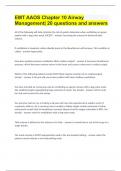
EMT AAOS Chapter 10 Airway Management| 20 questions and answers.
All of the following will help minimize the risk of gastric distension when ventilating an apneic patient with a bag-valve mask, EXCEPT: increasing the amount of delivered tidal volume. If ventilation is impaired, carbon dioxide levels in the bloodstream will increase. This condition is called: hypercarbia. How does positive-pressure ventilation affect cardiac output? It increases intrathoracic pressure, which decreases venous return to the heart and causes a decrease in cardiac output. Which of the following patients would MOST likely require insertion of an oropharyngeal airway? A 40-year-old unconcious patient with slow, shallow respirations. You have inserted an oral airway and are ventilating an apneic woman with a bag-valve mask. She suddenly begins regurgitating large amounts of vomit. You should: roll her onto her side and remove the oral airway. You and your partner are a treating a 66-year-old man who experienced a sudden onset of respiratory distress. He is conscious but is unable to follow simple verbal commands. Further assessment reveals that his breathing is severely labored and his oxygen saturation is 80%. You should: assist his ventilations with a bag-valve mask. Tidal volume is defined as the volume of air that: is moved into or out of the lungs in a single breath. The nasal cannula is MOST appropriately used in the pre-hospital setting: when the patient cannot tolerate a non-rebreathing mask. The purpose of the pin-indexing system for compressed gas cylinders is to: ensure that the correct regulator is used for the cylinder. The _____ cartilage is a firm ring that forms the inferior part of the larynx. cricoid The 37-year old male has an apparent foreign body airway obstruction. He is conscious and alert and is coughing forcefully. His skin is pink, warm, and moist. The MOST appropriate treatment for this patient includes: encouraging him to cough and transporting. The MOST serious complication associated with using a nasopharyngeal airway in a patient with trauma to the head or face is: penetrating the cranium. Oxygen toxicity is a condition in which: cellular tissue damage occurs from excessive oxygen levels in the blood. The actual exchange of oxygen and carbon dioxide occurs in the: alveolar sacs. In the presence of oxygen, the cells convert glucose into energy through a process called: aerobic metabolism Which of the following would NOT cause a decrease in tidal volume? Deep respirations CPAP is indicated for patients who: have pulmonary edema and can follow verbal commands. The jaw-thrust maneuver is used to open the airway of patients with suspected: cervical spine injuries. Hypoxia is MOST accurately defined as: inadequate oxygen to the tissues and cells. An adult at rest should have a respiratory rate that ranges between: 12 and 20 breaths/min.
Written for
- Institution
-
Chamberlain College Of Nursng
- Course
-
Emt aaos
Document information
- Uploaded on
- September 29, 2023
- Number of pages
- 3
- Written in
- 2023/2024
- Type
- Exam (elaborations)
- Contains
- Questions & answers
Subjects
- emt aaos
-
emt aaos chapter 10 airway management 20 questions

Also available in package deal