

100% satisfaction guarantee Immediately available after payment Both online and in PDF No strings attached 4.2 TrustPilot
logo-home
Exam (elaborations)

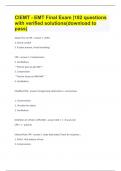
CIEMT - EMT Final Exam |182 questions with verified solutions(download to pass)

Rating
-
Sold
-
Pages
42
Grade
A+
Uploaded on
29-09-2023
Written in
2023/2024

Steps Prior to CPR 1. AVPU 2. Check carotid! 3. If pulse present, check breathing! CPR 1. Compressions 2. Ventilations *Partner goes to get AED* 3. Compression *Partner drops an OPA/NPA* 4. Ventilations Modified CPR Foreign body obstruction + unconscious 1. Compressions 2. Visualize for object 3. Ventilations Definition of a Peds in CPR/AED AED = 1 - 8 years old CPR = 1 - puberty Infants/Peds CPR 1. Baby baby baby! Check for response... 2. AVPU - flick bottom of foot 3. Compressions 4. Ventilations Two person rescuer = two thumbs encircling hands (15:2) One person rescuer = two parallel fingers, baby laying on the floor, sniffing position (30:2) Foreign Body Obstruction in Peds 1. Five backblows 2. Visualize 3. Five compressions Shockable Rhythms 1. Ventricular fibrillation 2. Ventricular tachycardia (pulseless) Kubler-Ross (Stages of the Grieving Process) 1. Denial 2. Anger 3. Bargaining 4. Depression 5. Acceptance Sympathetic Response (Fight or Flight) 1. Increased respirations 2. Increased pulse 3. Increased b.p. 4. Cool, pale, and diaphoretic 5. Dilated pupils 6. Tense muscles 7. Increased blood glucose levels 8. Perspiration 9. Decreased circulation to the GI tract Neuro-endocrine response How are glucose levels maintained in the body? Pancreas, glucagon, liver, RELEASE GLYCOGEN STORES, increased blood glucose levels General Adaptation Syndrome (GAS) 1. Alarm 2. Resistance 3. Recovery or exhaustion Components of the CISM System Defusing = informal meeting Briefing = formal meeting Hepatitis - inflammation of the liver - blood transmittance S/S: 1. Weakness 2. Fatigue 3. Fever 4. Weight loss 5. JAUNDICE Meningitis - direct contact with respiratory secretions S/S: 1. Nuchal rigidity 2. Photophobia Tuberculosis (TB) S/S: 1. Productive cough 2. Bloody sputum MUST WEAR A HEPA/N95 mask! Scope of Practice What you can do (defined by state law - aka state EMS agency) Duty to Act Legal duty to act begins once... 1. An ambulance responds to a call OR 2. Treatment is initiated Negligence 1. Duty to Act 2. Breech of Duty 3. Damages 4. Proximal Cause Forcible Restraints 1. 5150 Hold 2. Authorization Required Emancipated Minors 1. Married 2. Pregnant 3. Living independently Assault vs. Battery Assault = placing a person in fear or immediate bodily harm Battery = unlawfully touching a person Child vs. Elder Abuse Protocol Verbal Report = ASAP Written Report = within 36 hrs (children); within 2 working days (elderly) Definitive Signs of Death 1. Decapitation, evisceration, incineration 2. Rigor mortis 3. Dependent lividity (pooling of blood) 4. Putrefaction Names for Flexion and Extension Flexion = decordicate Extension = decerebrate Left Lateral Position - aka Recumbant/Recovery - used for vomiting patient's - AIRWAY problem Reverse Trendelenburg's Position - lift head of backboard - used for ICP Fowler's Position - used for RESPIRATORY DISTRESS - sitting upward position Left Lateral Trendelenburg - emergency child birth - hips elevated upon head Breathing Process: Inhalation - active process - diaphragm contracts downward - intercostal muscles contract outward - pressure decreases in lungs Breathing Process: Exhalation - passive process - diaphragm relaxes upward - intercostal muscles relaxes downward - increase pressure in lungs Functions of the Regions of the Brain Frontal = behavior + emotion Parietal = touch + sensation Temporal = hearing + speech Occipital = vision Cerebellum = fine motor movement + balance Brain Stem = control centers Control Centers (Brain Stem) 1. Cardiac (baroreceptors - measure blood pressure) 2. Respiratory (primary chemoreceptors - measure CO2 levels) 3. Reticular Activating Center (sleep or awake) 4. Vasomotor Electrolytes 1. Na+ 2. Ca2+ 3. K+ 4. Bicarbonate Perfusion Triangle Heart Function = pump Blood Vessels = container Blood = content Hypovolemic Shock - loss of fluid within the body (whole blood) 1. Control bleeding 2. Shock Position 3. Oxygen Metabolic (Non-hemmoragic) Hypovolemic Shock - losing water and electrolytes - vomiting, diarrhea 1. Oxygen 2. Shock Position 3. Blanket Neurogenic Shock - trauma to the spine (poor vessel function = affecting control) - dilation of blood vessels (vasomotor function interrupted) S/S: 1. Two-toned patient! 2. Above the site = cool, pale, diaphoretic 3. Below injury site = flushed + warm Treatment: 1. Oxygen 2. Spinal Immboliziation 3. Blanket 4. If C3-C5 is injured, use BVM! Septic Shock - systemic infection - dilation of vessels to deal with infection S/S: 1. Altered 2. Flushed 3. Warm Treatment: 1. Oxygen 2. Fowler's Position 3. Blanket 4. If pulmonary edema, use BVM! Anaphylactic Shock - allergic overreaction - body release MAST CELLS = which EXPLODE and release Histamines and Leukotryines (tell blood vessels to dilate and become leaky) S/S: 1. Urticaria 2. Wheezing 3. Flushed 4. Low b.p. (< 90) Treatment: 1. Epipen! 0.3 mg adults / 0.15 mg children - powerful, peripheral vasoconstrictior - bronchial dilatior - increases heart rate Psychogenic Shock - syncope = momentary loss of blood to brain - check for trauma! (if patient had fallen...) Treatment: 1. Oxygen 2. Blanket 3. Shock Position (if needed!) 4. Check for trauma Cardiogenic Shock - huge MI - left side = pulmonary edema - right side = pitting/pedal/dependent edema Treatment: 1. Oxygen 2. Fowler's (left side) 3. Position of Comfort (right side) 4. Blanket Obstructive Shock 1. Pulmonary embolism - blockage and diffusion cannot happen = shock 2. Cardiac Tamponade - Beck's Triad (muffled heart sounds, narrowing pulse pressure, jvd) 3. Tension Pneumothorax - absent lung sounds Progression of Shock Compensated Shock Decompensated Shock Irreversible Shock Types of Impact Primary = vehicle + something else Secondary = passenger + inside of car Tertiary = internal organs + body cavity Types of Vehicular Collisions Frontal = most common Lateral = most deadly, aortic sheering Rear-end = whiplash Rollovers = ejection Spin/rotational Head-on vs. Angular Collision Head-on = stops object's forward motion while rider continues Angular = injuries to lower extremities Falls 15 feet or three times the patient's height 1. Surface hit 2. What they hit 3. Physical condition of the patient Blast Injuries Primary = blast wind/pressure wave Secondary = flying debris Tertiary = patient displacement Quarternary = collapse building Cushing's Triad - indicates ICP - autonomic NS responses lower the heart rate to off set high b.p. 1. Hypertension 2. Bradycardia 3. Tachypnea Intracranial Bleeding Epidural = super fast Intracerebral = fast Subdural = slow Fracture, Sprains, and Strains Fracture = bone broken Sprains = ligaments tearing Strains = muscle tearing Types of Fractures 1. Greenstick Fracture = incomplete, in peds 2. Comminuted 3. Pathologic 4. Epiphyseal 5. Spiral 6. Transverse Rules of Splinting 1. CMS before and after 2. Almost always splint in position found (unless angulated or no distal CMS) 3. Never strap or tape over an injury or uninjured joint 4. The strap should be long enough to extend past the two nearest uninjured joints, both proximal and distal to the site of injury How much time can the body go without blood? 4-6 mins = brain 45 mins = kidneys 2 hrs = muscle Types of Bleeding Arterial = spurts, bright red Venous = dark red, no spurts Capillary = oozes Types of Blood Clotting Meds ASA (Aspirin) = platelet inhibitor Heparin = blood tinner TPA = tissue plasmitic activator

Show more Read less


Whoops! We can’t load your doc right now. Try again or contact support.

Document information

Uploaded on
September 29, 2023
Number of pages
42
Written in
2023/2024
Type
Exam (elaborations)
Contains
Questions & answers

Content preview

CIEMT - EMT Final Exam |182 questions with verified solutions(download to pass)
Steps Prior to CPR - answer 1. AVPU
2. Check carotid!
3. If pulse present, check breathing!
CPR - answer 1. Compressions
2. Ventilations **Partner goes to get AED**
3. Compression **Partner drops an OPA/NPA**
4. Ventilations
Modified CPR - answer Foreign body obstruction + unconscious
1. Compressions
2. Visualize for object
3. Ventilations
Definition of a Peds in CPR/AED - answer AED = 1 - 8 years old
CPR = 1 - puberty
Infants/Peds CPR - answer 1. Baby baby baby! Check for response...
2. AVPU - flick bottom of foot
3. Compressions 4. Ventilations Two person rescuer = two thumbs encircling hands (15:2)
One person rescuer = two parallel fingers, baby laying on the floor, sniffing position (30:2)
Foreign Body Obstruction in Peds - answer 1. Five backblows
2. Visualize
3. Five compressions
Shockable Rhythms - answer 1. Ventricular fibrillation 2. Ventricular tachycardia (pulseless)
Kubler-Ross (Stages of the Grieving Process) - answer 1. Denial
2. Anger
3. Bargaining
4. Depression
5. Acceptance
Sympathetic Response (Fight or Flight) - answer 1. Increased respirations
2. Increased pulse
3. Increased b.p.
4. Cool, pale, and diaphoretic 5. Dilated pupils 6. Tense muscles
7. Increased blood glucose levels
8. Perspiration
9. Decreased circulation to the GI tract Neuro-endocrine response
How are glucose levels maintained in the body? - answer Pancreas, glucagon, liver, RELEASE GLYCOGEN STORES, increased blood glucose levels
General Adaptation Syndrome (GAS) - answer 1. Alarm
2. Resistance
3. Recovery or exhaustion
Components of the CISM System - answer Defusing = informal meeting
Briefing = formal meeting
Hepatitis - answer - inflammation of the liver
- blood transmittance S/S:
1. Weakness
2. Fatigue
3. Fever
4. Weight loss
5. JAUNDICE
Meningitis - answer - direct contact with respiratory secretions S/S: 1. Nuchal rigidity 2. Photophobia
Tuberculosis (TB) - answer S/S:
1. Productive cough
2. Bloody sputum
MUST WEAR A HEPA/N95 mask!
Scope of Practice - answer What you can do (defined by state law - aka state EMS agency)
Duty to Act - answer Legal duty to act begins once...
1. An ambulance responds to a call
OR 2. Treatment is initiated
Negligence - answer 1. Duty to Act
2. Breech of Duty
3. Damages
4. Proximal Cause
Forcible Restraints - answer 1. 5150 Hold
2. Authorization Required
Emancipated Minors - answer 1. Married
2. Pregnant
3. Living independently

Get to know the seller

Seller avatar
Reputation scores are based on the amount of documents a seller has sold for a fee and the reviews they have received for those documents. There are three levels: Bronze, Silver and Gold. The better the reputation, the more your can rely on the quality of the sellers work.
BRAINBOOSTERS Chamberlain College Of Nursing
View profile
Follow You need to be logged in order to follow users or courses
Sold
631
Member since
2 year
Number of followers
249
Documents
22450
Last sold
5 hours ago

In this page you will find all documents , flashcards and package deals offered by seller BRAINBOOSTERS

4.5

338 reviews

5
263
4
29
3
21
2
5
1
20

Recently viewed by you

Why students choose Stuvia

Created by fellow students, verified by reviews

Quality you can trust: written by students who passed their tests and reviewed by others who've used these notes.

Didn't get what you expected? Choose another document

No worries! You can instantly pick a different document that better fits what you're looking for.

Pay as you like, start learning right away

No subscription, no commitments. Pay the way you're used to via credit card and download your PDF document instantly.

Student with book image

“Bought, downloaded, and aced it. It really can be that simple.”

Alisha Student

Frequently asked questions

