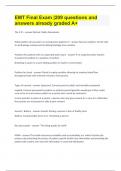
EMT Final Exam |209 questions and answers already graded A+.
The 3 R's Retreat, Radio, Reevaluate What position do you place an unresponsive patient in? Recover position: On the side to aid drainage and prevent breathing blockage from vomitus. Positions for patients with no suspected spine injury If no suspected spine injuries transport the patient in a position of comfort. Breathing is easier in a semi-sitting position or fowler or semi fowler. Position for shock Placed in supine position allowing for maximu blood flow throughout body with minimal resistance from gravity. Types of consent Expressed: Consent given by adults and mentally competent Implied: Consent presumed by patient or patients parent/gaurdian would give if they could, such as for an unconscious patient or a parent who cannot be contacted. In loco parentis: In place of a parent, a person who may give consent for a care of a child when the parents are not present or able to give consent Assault / Battery Assault: Placing a person in fear of bodily harm Battery: Causing bodily harm to or restraining a person Res Ipsa Loquitr "The thing speaks for itself" HIPAA The health insurance portability and accountability act, which includes the privacy rule protecting the privacy of patient specific health care information and providing the patient with control over how this information is used and distributed. Anatomic Position and terms -A person standing, facing forward, with palms forward -proximal: closer to the torso -distal: farther away from the torso -Medial: towards the midline -lateral: to the side away from the midline -bilateral: both sides -Anterior: the front of the body or body part -Posterior: the back of the body or part -Superior: toward the head -Inferior: away from the head Musculoskeletal system Bones and skeletal muscles that support and protect the body -Muscle: tissues that can contract to allow movement of a body part -Ligament: Tissues that connects bone to bone -Tendon: tissue that connect muscle to bone. The divisions of the spine Cervical 1-7 Thoracic 1-12 Lumbar 1-5 Sacrum 5 Coccyx 4 33 total Anatomy of the Heart Has 4 chambers: two upper chambers called atria and two lower called ventricles -Right atrium: The venae cavae or superior and inferior vena cava are two large veins that return blood to the heart. Recevies blood and sends it to the right ventricle - Right ventricle: Receives blood from right atrium and pumps blood to the lungss via pulmonary arteries. Low oxygen and has waste carbon dioxide. While in lungs carbon dioxide is excreted and oxygen is obtained. Oxygen rich blood is returned to the left atrium via pumonary veins. -Left Atrium: recevies oxygen rich blood and sends to the let ventricle. -Left ventricle: receives oxygen rich blood and pumps blood into the aorta (largest artery) for distribution to the entire body. -Arteries Away Types of arteries Carotid artery: in the neck Femoral: in the thigh between the abdomen and the groin Brachial: Medial of the Upper arm Radial: Found on the thumb side of the wrist Posterior tibial: Palpated on the posterior aspect of the medial maleolus Dorsalis pedis: On top of the foot lateral to the large tendon of the big toe Hypoperfusion (Shock) Inability of the body to adequately circulate blood to the body's cells to supply them with oxygen and nutrients. -Life threatening -Also called Shock Tidal Volume Minute Volume Tidal: Volume of air moved in one cycle of breathing Minute: Amount of air breathed in during respiration multiplied by the number of breaths per minute Chemoreceptors Chemical sensors in the brain and blood vessels that identify changing levels of oxygen and carbon dioxide. Stroke Volume Cardiac Output Stroke: the amount of blood ejected from the heart in one contraction Cardiac Output: The amount of blood ejected from the heart in one minute (Heart rate x stroke volume) Different Types of Shock Hypovolemic: Low blood volume -From cardiovascular system blood loss or dehydration Distributive: Blood vessel tone is lost -Anaphylaxis or sepsis and cause lower pressure, Hypoperfusion is the result Cardiogenic: Heart fails in its ability to pump blood. MI or trauma can lead to a dysrhtthmia or a mechanical problem such as damage to the heart. Hypoperfusion occurs Obstructive: Tension pneumothorax or pulmonary embolism Hypoperfusion occurs Signs of shock -Slight mental status changes including anxiety and feeling of impending doom -Increased heart rate -Increased respiratory rate -Delayed caplarry refill time -PALE skin that is COOL and MOIST to touch (Diaphoresis) -Sweating However, cardiogenic shock may not allow the heart rate to increase and septic shock may not allow blood vessels to constrict. Compensating for Shock Decompensated shoc (Hypotensive shock): Compensatory mechanisms were not successful -Decreased BP -Altered MS -If not rapidly reversed it will lead to irreversible shock and organs begin to die LIFESPAN Infancy (Birth to 1 year) -Nose breather -Diaphram breather -HR 140-160 -RR 40-60 drops to 30-40 after birth -S BP 70 to 90 at 1 year Toddler (12-36 months) -HR 80-130 -RR 20-30 -S BP 70-100 Preschool (3-5) -HR 80-120 -RR 20-30 -S BP 80-110 mmhg School age (6-12) -HR 70-110 -RR 20-30 -S BP 80-120mmg Adolescence (13-18) -HR 55-105 -RR 12-20 -S BP 80-120mmhg Early Adulthood (19-40) -HR 70 -RR 16-20 -BP 120/80mmhg Middle Adulthood (41-60) Same stats High cholesterol Late Adulthood (61-...) Head tilt chin lift No trauma suspected Jaw Thrust When trauma is suspected Only recommended airway procedure for injury Oropharyngeal Measure from corner of patients mouth to tip of the earlobe Insert 180 for skills test Nasopharyngeal Measure from the patients nostril to the tip of the earlobe or the angle of the jaw Hypoxia Insufficiency of oxygen in the body's tissues Respiratory distress Failure arrest Distress: Increased work of breathing, a sensation of shortness of breath -Oxygen via nonrebreather or nasal Failure: Reduction of breathing to the point where oxygen intake is not sufficient to support life -Assisted ventilations via BVM or FROPVD Arrest: when breathing completely stops -Artificial ventilations at 10-12 for adult and 20 for child or infant Diaphoretic Sweaty Cyanosis A blue or gray color resulting from lack of oxygen in the body Hypoxia scenarios A patient trapped in fire A patient has emphysema( lung disease) that decreases the efficiency of the transfer of oxygen between atmospher and the body Overdose on a drug with depressing effect on respiratory system A patient has a heart attack Oxygen Cylinders Filled with oxygen at psi -D is 350liters -E is 625 liters -M is 3000 -G is 5300 -H is 6900 Safe residual pressure is 200 psi Tested every 5 years Pressure regulator between 30-70 psi Oxygen Delivery Devices Nonrebreather mask -12-15 liters per min -80-90% Nasal Cannula -1-6 liters per min -24-44% Partial rebreather mask -9-10 -40-60 Venturi mask -up to 15 -24-60 Tracheostomy mask -8-10 -set up to deliver varying oxygen %s When considering the breathing process, the movement of gases to and from the alveoli is called: Ventilation is the movement of gases to and from the alveoli. A 62-year-old woman has fallen and complains of pain in her leg. She states that she has sustained a previous acetabulum fracture. In which of the following anatomic regions would that previous fracture have taken place? The acetabulum refers to the socket of the hip joint. It is commonly damaged in what is referred to as a hip fracture. If a patient's blood pressure and heart rate rapidly slowed and her blood vessels dilated, you should suspect increased stimulation of: The parasympathetic nervous system produces a "feed or breed" response when engaged. Its effects include a decrease in heart rate and blood pressure; a dilation of blood vessels; and the diversion of blood to the gastrointestinal and reproductive systems. The sympathetic nervous system produces a "fight or flight" response and is associated with increased heart rate and blood pressure as well as vasoconstriction. Although the peripheral nervous system plays a role in both these responses, sympathetic and parasympathetic are truly autonomic nervous system functions. Which of the following organs is divided into three parts: the duodenum, the jejunum, and the ileum? The small intestine is divided into three parts: the duodenum, the jejunum, and the ileum. It receives food from the stomach and retrieves nutrients before passing it along to the large intestine. A Type 1 diabetic patient lacks the hormone insulin. Which of the following organs would be responsible for the onset of this disease? The pancreas is responsible for creating the hormone insulin. When a diabetic patient lacks this hormone, it is usually due to a failure of the pancreas to create it. The spleen filters blood and removers old red blood cells. The liver also filters the blood and removes toxins. The gallbladder produces and stores bile to aid digestion. The innermost layer of skin is called the: The innermost layer of the skin is the subcutaneous layer. The dermis is the middle layer and the epidermis is the outermost layer. There is no such layer as the subdermis.
Written for
- Institution
-
Lindsey Wilson College
- Course
-
EMT AAOS
Document information
- Uploaded on
- September 29, 2023
- Number of pages
- 43
- Written in
- 2023/2024
- Type
- Exam (elaborations)
- Contains
- Questions & answers
Subjects

Also available in package deal