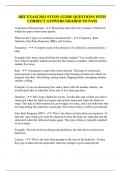
RBT EXAM 2021 STUDY GUIDE QUESTIONS WITH CORRECT ANSWERS GRADED TO PASS
Continuous Measurement - Measuring each and every instance of behavior within the entire observation period. What are the 5 types of continuous measurement? - Frequency, Rate, Duration, Inter Rate Response (IRR), and Latency. Frequency - A simple count of the instances of a behavior, represented by a tally. Example; how many times did John hit another student? You would tally every time John hit another student and present the count as a number. John hit another student five times. Rate - A frequency count with a time element. This type of continuous measurement is an important measurement when looking at behaviors which are frequent and short, like hitting, raising hands, flapping hands, disrupting another student, yelling. Example; if you are measuring how many times John hit another student, you would report this as John hits at the rate of five times per hour. Duration - How long a Behavior occurs. To take this type of data you start a stopwatch when the behavior begins and end the stopwatch when the behavior stops. This data is often reported as an average over time, and is for behaviors that are long lasting like tantrums, social play, how long it takes a child to get dressed. Inter Rate Response (IRT) - This is the observed time between responses. To take this type of data you start the stopwatch when the behavior ends and stop the stopwatch when the behavior begins again. This type of data is typically reported as an average. Example; The time between doing math problems, the time between prosocial behaviors. Latency - This is the time from prompt to the start of the behavior. To take this type of data start the stopwatch when the prompt is given and stop the stopwatch when the behavior starts. You might want to take this type of data when there is a delay between the prompts and when the behavior occurs. Example; The time from a prompt to get dressed to a person getting dressed, the time from the instruction to begin a math problem to the response. Discontinuous Measurement - These measurement procedures are classified as samples of the target behavior, but they do not measure every instance of a behavior within the entire observation period. These types of measurement procedures are used when it is too time-consuming to take continuous measurement data. What are the 3 types of Discontinuous Measurement? - Partial interval, whole interval, and momentary time sampling. Partial Interval - A type of discontinuous measurement that records the presence or absence of a behavior during a brief interval of time. Intervals are marked as positive if the target behavior occurred at any time during the interval, and negative if the target behavior did not occur during the entire interval. Example; take an interval of 30 seconds and look for hand flapping behavior. You would mark a positive if the hand flapping behavior occurred at any point during the 30 second intervals, and a negative if it did not. Whole interval - A discontinuous measurement procedure that records the presence or absence of a behavior during the whole interval. Intervals are marked as a positive if the target behavior occurred during the entire interval, and a negative if the target behavior stopped at any time during the interval. Example; if you are doing a 30 second intervals and measuring hand flapping behavior, you would mark it positive if the hand flapping behavior occurred during the entire 30 seconds, or negative if the hand flapping behavior stopped at any point in time during those 30 seconds. Momentary Time Sampling - A discontinuous measurement procedure that records the presence or absence of a behavior at the very end of an interval. Intervals are marked as a positive if the target behavior occurred at the end of the interval, or a negative when the target behavior does not occur at the end of the interval. This procedure is best to do for many clients at the same time. Example; if a teacher is trying to measure task engagement for a group of students during a 30 second interval, if the teacher looked up at the students at the 28 second mark she would mark a positive for those students who are engaged in their tasks at that point in time and a negative for those students who were not engaged in their task when she looked up. Regardless of if they were the entire time. Permanent Product procedures - This type of recording is not recording behaviors, but recording the products that the behavior produces. Example; you could record how many questions a student answered on a worksheet by simply looking at the worksheet after and counting the problems completed. Similarly, you could see a clean room as a result of the child cleaning their room and you would record their behavior as a positive because the end result is a clean room. Provide examples of permanent product recordings? - 1) How many items were placed on a shelf 2) how much homework was completed 3) how many bracelets were constructed 4) how many dishes were clean 5) how many scratches a person has. *this is valid because these are all an after product of a behavior occurring. How would summarize different types of data? (Frequency, duration, IRT, latency, and interval data) - 1) frequency is summarized as rate over sessions. 2) duration is summarized as total duration over one session. 3) IRT is summarized as an average. 4)Latency is summarized as a average latency to response 5) interval data is summarized as percent intervals with occurrence List some rules for graphing data? (5?) - 1) label the horizontal axis (x) with sessions or days 2) label the vertical axis (y) with the type of measurement you are using 3) graph one data point for every session 4) draw vertical phase line to separate phases of treatment 5) use a legend or written names with arrows to label the different behaviors if more than one behavior is depicted on the same graph How should you describe behaviors? - You should always describe behavior in observable and measurable terms. This should be thorough enough and complete that any person could read it and understand what the behavior is and begin collecting data on the behavior even if they weren't there to see it happen. Example; instead of saying a child was aggressive or angry, you could say the client was hitting and pinching. Preference assessment - A set of procedures used to determine if one or more stimuli may function to increase the rate of a specific behavior or behaviors when delivered following the occurrence of that behavior. Trying to determine which reinforcers are the most effective.
Written for
- Institution
- Rbt
- Course
- Rbt
Document information
- Uploaded on
- September 28, 2023
- Number of pages
- 17
- Written in
- 2023/2024
- Type
- Exam (elaborations)
- Contains
- Questions & answers
Subjects
- rbt exam 2021 study guide
- rbt exam 2021
- rbt
-
rbt exam 2021 study guide questions with answers

Also available in package deal