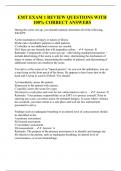
EMT Exam 1 Review Questions WITH 100% CORRECT ANSWERS
During the scene size-up, you should routinely determine all of the following, EXCEPT: A) the mechanism of injury or nature of illness. B) the ratio of pediatric patients to adult patients. C) whether or not additional resources are needed. D) if there are any hazards that will jeopardize safety. - Answer: B Rationale: Components of the scene size-up—after taking standard precautions—include determining if the scene is safe for entry, determining the mechanism of injury or nature of illness, determining the number of patients, and determining if additional resources are needed at the scene. You arrive at the scene of an "injured person." As you exit the ambulance, you see a man lying on the front porch of his house. He appears to have been shot in the head and is lying in a pool of blood. You should: A) immediately assess the patient. B) proceed to the patient with caution. C) quickly assess the scene for a gun. D) retreat to a safe place and wait for law enforcement to arrive. - Answer: D Rationale: Your primary responsibility as an EMT is to protect yourself. Prior to entering any scene, you must assess for potential dangers. In cases where violence has occurred, you must retreat to a safe place and wait for law enforcement personnel to arrive. Findings such as inadequate breathing or an altered level of consciousness should be identified in the: A) primary assessment. B) focused assessment. C) secondary assessment. D) reassessment. - Answer: A Rationale: The purpose of the primary assessment is to identify and manage any life threats to the patient, such as inadequate breathing, an altered level of consciousness, or severe hemorrhage. Which of the following would you NOT detect while determining your initial general impression of a patient? A) Cyanosis B) Gurgling respirations C) Severe bleeding D) Rapid heart rate - Answer: D Rationale: The initial general impression is what you first notice as you approach the patient, but before physical contact with the patient is made. It is what you see, hear, or smell. A rapid heart rate (tachycardia) would not be detected until you actually perform the entire primary assessment; you cannot see, hear, or smell tachycardia. Your primary assessment of an elderly woman who fell reveals an altered level of consciousness and a large hematoma to her forehead. After protecting her spine and administering oxygen, you should: A) reassess your interventions. B) perform a rapid exam. C) transport the patient D) immediately. perform a focused assessment of her head. - Answer: B Rationale: If any life-threatening problems are discovered in the primary assessment, they should be addressed immediately. The EMT should then perform a rapid exam to look for other potentially life-threatening injuries or conditions. A semiconscious patient pushes your hand away when you pinch his earlobe. You should describe his level of consciousness as: A) alert. B) unresponsive. C) responsive to painful stimuli. D) responsive to verbal stimuli. - Answer: C Rationale: Semiconscious patients are not alert, nor are they unresponsive. The fact that the patient pushes your hand away when you pinch his earlobe indicates that he is responsive to painful stimuli. If he opens his eyes or responds when you speak to him, he would be described as being responsive to verbal stimuli. Assessment of an unconscious patient's breathing begins by: A) inserting an oral airway. B) manually positioning the head. C) assessing respiratory rate and depth. D) clearing the mouth with suction as needed. - Answer: B Rationale: You cannot assess or treat an unconscious patient's breathing until the airway is patent—that is, open and free of obstructions. Manually open the patient's airway (eg, head tilt-chin lift, jaw-thrust), use suction as needed to clear the airway of blood or other liquids, insert an airway adjunct to assist in maintaining airway patency, and then assess the patient's respiratory effort. Your 12-year-old patient can speak only two or three words without pausing to take a breath. He has a serious breathing problem known as: A) nasal flaring. B) two- to three-word dyspnea. C) labored breathing. D) shallow respirations. - Answer: B Rationale: Two- to three-word dyspnea is a severe breathing problem in which a patient can speak only two to three words at a time without pausing to take a breath. How should you determine the pulse in an unresponsive 8-year-old patient? A) Palpate the radial pulse at the wrist. B) Palpate the brachial pulse inside the upper arm. C) Palpate the radial pulse with your thumb. D) Palpate the carotid pulse in the neck. - Answer: D Rationale: In unresponsive patients older than 1 year, you should palpate the carotid pulse in the neck. If you cannot palpate a pulse in an unresponsive patient, begin CPR. When assessing your patient's pain, he says it started in his chest but has spread to his legs. This is an example of what part of the OPQRST mnemonic? A) Onset B) Quality C) Region/radiation D) Severity - Answer: C
Written for
- Institution
- EMT
- Course
- EMT
Document information
- Uploaded on
- September 28, 2023
- Number of pages
- 15
- Written in
- 2023/2024
- Type
- Exam (elaborations)
- Contains
- Questions & answers
Subjects
- emt exam 1 review
- emt
-
emt exam 1 review questions

Also available in package deal