

WGU C211 - Competency 2 exam questions and answers
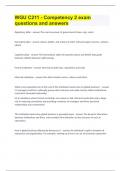
Regulatory pillar The coercive power of governments (laws, regs, rules) Normative pillar Values, beliefs, and actions of other relevant players (norms, cultures, ethics) Cognitive pillar The internalized, taken-for-granted values and beliefs that guide behavior. (beliefs between right/wrong) Formal institution One that include laws, regulations and rules Informal institution One that includes norms, cultures and ethics What core propositions lie at the root of the institution based view on global business? (1) managers and firms rationally pursue their interests and make choices within institutional constraints (bounded rationality) (2) in situations where formal constraints are unclear or fail, informal constraints play a larger role in reducing uncertainty and providing constancy to managers and firms (personal relationships and connections) The institution based view global business is grounded upon The dynamic interaction between institutions and firms, and considers firm behaviors as the outcome of such an interaction. How is global business affected by democracy? An individual's right to freedom of expression and organization. For example, starting up a firm is an act of economic expression How is global business affected by totalitarianism? These countries often experience wars, riots, protests, chaos, and breakdowns, which result in higher political risk. Democracy Citizens elect representatives to govern the country on their behalf. Totalitarianism One person or party exercises absolute political control over the population. Civil law Law that uses comprehensive statutes and codes as a primary means to form legal judgments. Common law Law shaped by precedents and traditions from previous judicial decisions. Theocratic law A legal system based on religious teachings. How do civil, common and theocratic laws compare? Relative to civil law, common law has more flexibility because judges have to resolve specific disputes based on their interpretation of the law. Civil law has less flexibility because judges only have the power to apply the law. Property right The legal rights to use an economic resource and to derive income and benefits from it. Can be used as collateral for starting a firm; not as common in developing countries, therefore hindering economic growth. Intellectual property right Rights associated with the ownership. They primarily include rights associated with patents, copyrights, and trademarks. Market economy One that is characterized by the "invisible hand" of market forces-all factors of production should be privately owned. Command economy One that is defined by a government taking all factors of production to be government-owned or state-owned, and all supply, demand, and pricing are planned by the government. Mixed economy One has elements of both a market economy and a command economy. It boils down to the relative distribution of market forces versus command forces. How do institutions reduce uncertainty? Establish "rules of the game" that economic
Document information
- Uploaded on
- September 26, 2023
- Number of pages
- 3
- Written in
- 2023/2024
- Type
- Exam (elaborations)
- Contains
- Questions & answers


