Scsc 301 Exam 4 Questions With Complete Solutions
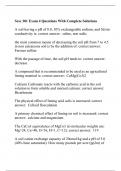
A soil having a pH of 8.0, 10% exchangeable sodium, and 5d/sm conductivity is: correct answer: saline, non sodic the most common means of decreasing the soil pH from 7 to 4.5 in non calcareous soil is by the addition of: correct answer: Ferrous sulfate With the passage of time, the soil pH tends to: correct answer: decrease A compound that is recommended to be used as an agricultural liming material is: correct answer: CaMg(Co3)2 Calcium Carbonate reacts with the carbonic acid in the soil solution to form soluble and ionized calcium: correct answer: Bicarbonate The physical effect of liming acid soils is increased: correct answer: Colloid flocculation A primary chemical effect of liming on soil is increased: correct answer: calcium and magnesium The CaCo3 equivalence of MgCo3 is) molecular weights are: Mg=24, Ca=40, O=16, H=1, C=12): correct answer: 119 A soil cation exchange capacity of 20cmol/kg and a pH of 5.0 (40% base saturation). How many pounds per acre (pp2m) of 100 ECCE calcium carbonate would be required to raise the pH to 6.5 (75% base saturation). correct answer: 7000 Th most common method of agricultural limestone application to soils is: correct answer: Bulk Spreading A sod producer received a soil test turf recommended to apply agricultural limestone to his turf farm. The best time to apply the limestone is: correct answer: Three months prior to spring greenup Calculate the effective calcium carbonate equivalent for calcitic limestone that is 95% pure with 90% passing through the 8 mesh sieve and 70% passing through the 60 mesh sieve. correct answer: 76% Soil organic matter is the dominant soil source of correct answer: nitrogen The conversion of ammonium into nitrate is a process called: correct answer: Nitrification When residues having a C/N ratio greater than 40:1 are added to warm, moist soils, nitrate concentrations decrease due to: correct answer: Immobilization Swine manure was surface applied onto a warm, moist, well drained, silt loam soil with a pH of 6. The soil tested 15ppm Nh4+ two days after application and 1ppm NH4+, three weeks later. The most likely process that occurred was: correct answer: loss of NH3 to volatilization The genus of bacteria responsible for symbiotic fixation of nitrogen in soils is: correct answer: Rhizobium Several applications of nitrogen during the growing season are most often recommended to minimize: correct answer: Leaching losses
Written for
- Institution
-
Texas A&M University
- Course
-
Scsc 301
Document information
- Uploaded on
- September 25, 2023
- Number of pages
- 5
- Written in
- 2023/2024
- Type
- Exam (elaborations)
- Contains
- Questions & answers
Subjects
-
scsc 301 exam 4 questions with complete solutions

Also available in package deal