ONCC Practice Tests (OCN - Oncologic Emergencies) Solved 100%
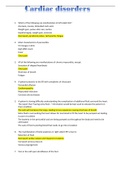
Which of the following cancers is associated with the development of disseminated intravascular coagulation? Mucin-secreting adenocarcinoma of the breast Nonhyperdiploid variant multiple myeloma Primary peritoneal carcinoma Acral lentiginous melanoma - Answer Mucin-secreting adenocarcinoma of the breast Answer: The incidence of disseminated intravascular coagulation is associated mostly with mucin-secreting adenocarcinomas of the prostate, lung, and breast. Reference: Kaplan, M. (Ed.). (2013). Understanding and managing oncologic emergencies: A resource for nurses (2nd ed.). Pittsburgh, PA: Oncology Nursing Society, p. 69. Which of the following is released into the bloodstream in the event of tumor lysis syndrome? Uric acid Sodium Magnesium Calcium - Answer Uric acid Answer: Tumor lysis syndrome is a massive, sudden release of cellular contents in to the bloodstream resulting in elevated uric acid levels. Reference: Kaplan, M. (Ed.). (2013). Understanding and managing oncologic emergencies: A resource for nurses (2nd ed.). Pittsburgh, PA: Oncology Nursing Society, p. 440. Which of the following classes of medication will most significantly increase the risk for the development of a cytokine-release syndrome reaction? Monoclonal antibodies Taxanes Platinum compounds Anthracyclines - Answer Monoclonal antibodies Answer: Monoclonal antibodies can cause cytokine-release syndrome. Reference: Newton, S., Hickey, M., & Marrs, J. (2017). Mosby's oncology nursing advisor: A comprehensive guide to clinical practice (2nd ed.). St. Louis, MO: Elsevier Mosby, p. 243. When a suspected extravasation occurs during the administration of a vesicant, the nurse must first: stop the administration of medication and fluids. remove the peripheral IV or central venous access device. aspirate the remaining vesicant from the IV tubing. notify the healthcare provider. - Answer stop the administration of medication and fluids. Answer: The first step the nurse should take when an extravasation occurs is stopping the infusion. Reference: Newton, S., Hickey, M., & Marrs, J. (2017). Mosby's oncology nursing advisor: A comprehensive guide to clinical practice (2nd ed.). St. Louis, MO: Elsevier Mosby, p. 217. Which of the following interventions should the nurse perform for a patient who is at risk for increased intracranial pressure? Assessing the patient's gag reflex Limiting suctioning to less than 30 seconds Keeping the patient's bed in the high Fowler's position Positioning pillows to hyperextend the neck - Answer Assessing the patient's gag reflex Answer: Increased intracranial pressure can impair the gag reflex thus affecting the patient's ability to eat and drink independently. Reference: Kaplan, M. (Ed.). (2013). Understanding and managing oncologic emergencies: A resource for nurses (2nd ed.). Pittsburgh, PA: Oncology Nursing Society, p. 185(t). A dexrazoxane infusion shows efficacy for treating the extravasation of: an anthracycline. a nitrosourea. an alkylating agent.
Written for
- Institution
- OCN
- Course
- OCN
Document information
- Uploaded on
- September 21, 2023
- Number of pages
- 9
- Written in
- 2023/2024
- Type
- Exam (elaborations)
- Contains
- Questions & answers
Subjects
- ocn stuvia
-
oncc practice tests ocn oncologic emergencies
-
which of the following cancers is associated with

Also available in package deal