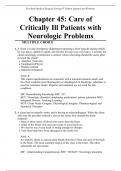
Chapter 45: Care of Critically Ill Patients with Neurologic Problems Test Bank Medical Surgical Nursing 9th Edition Ignatavicius Workman
Test Bank Medical Surgical Nursing 9th Edition Ignatavicius Workman MULTIPLE CHOICE 1. A client is in the emergency department reporting a brief episode during which he was dizzy, unable to speak, and felt like his legs were very heavy. Currently the clients neurologic examination is normal. About what drug should the nurse plan to teach the client? a. Alteplase (Activase) b. Clopidogrel (Plavix) c. Heparin sodium d. Mannitol (Osmitrol) ANS: B This clients manifestations are consistent with a transient ischemic attack, and the client would be prescribed aspirin or clopidogrel on discharge. Alteplase is used for ischemic stroke. Heparin and mannitol are not used for this condition. DIF: Remembering/Knowledge REF: 927 KEY: Neurologic disorders| antiplatelet medications| patient education MSC: Integrated Process: Teaching/Learning NOT: Client Needs Category: Physiological Integrity: Pharmacological and Parenteral Therapies 2. A client had an embolic stroke and is having an echocardiogram. When the client asks why the provider ordered a test on my heart, how should the nurse respond? a. Most of these types of blood clots come from the heart. b. Some of the blood clots may have gone to your heart too. c. We need to see if your heart is strong enough for therapy. d. Your heart may have been damaged in the stroke too. ANS: A An embolic stroke is caused when blood clots travel from one area of the body to the brain. The most common source of the clots is the heart. The other statements are inaccurate. DIF: Understanding/Comprehension REF: 928 KEY: Neurologic disorders| stroke| patient education MSC: Integrated Process: Teaching/Learning NOT: Client Needs Category: Physiological Integrity: Physiological Adaptation 3. A nurse receives a report on a client who had a left-sided stroke and has homonymous hemianopsia. What action by the nurse is most appropriate for this client? a. Assess for bladder retention and/or incontinence. b. Listen to the clients lungs after eating or drinking. c. Prop the clients right side up when sitting in a chair. d. Rotate the clients meal tray when the client stops eating. ANS: D This condition is blindness on the same side of both eyes. The client must turn his or her head to see the entire visual field. The client may not see all the food on the tray, so the nurse rotates it so uneaten food is now within the visual field. This condition is not related to bladder function, difficulty swallowing, or lack of trunk control. DIF: Applying/Application REF: 933 KEY: Neurologic disorders| stroke| visual disorders MSC: Integrated Process: Nursing Process: Implementation NOT: Client Needs Category: Physiological Integrity: Basic Care and Comfort 4. A client with a stroke is being evaluated for fibrinolytic therapy. What information from the client or family is most important for the nurse to obtain? a. Loss of bladder control b. Other medical conditions c. Progression of symptoms d. Time of symptom onset
Written for
- Institution
- Medical surgical nursing
- Course
- Medical surgical nursing
Document information
- Uploaded on
- September 20, 2023
- Number of pages
- 20
- Written in
- 2023/2024
- Type
- Exam (elaborations)
- Contains
- Questions & answers
Subjects
- chapter 45
- neurologic problems
-
care of critically ill patients with neurologic pr
-
test bank medical surgical nursing
-
9th edition ignatavicius workman

Also available in package deal