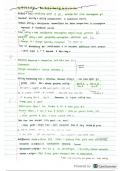
Phylum Chordata I
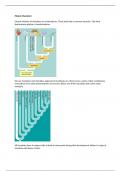
Closest relatives of chordates are echinoderms. These both had a common ancestor. The third
deuterstome phylum is hemichordates.
We are chordates and chordates appeared in Cambrian era. There were a series of key evolutionary
innovations from early deuterostomes to humans. Below are all the sub phyla that come under
chordata.
All chordates have 4 unique traits at least at some point during their development. Below is a type of
chordate with these 4 traits.
, Notochord is a longitudinal flexible rod that’s located between the nerve cord and digestive tube. It's
made of large fluid filled cells encased in stiff fibrous tissue. Provides support and a flexible structure
for muscles to work against. Its not the same as a vertebral column which replaces notochord in
higher vertebrates.
Dorsal nerve cord develops by the invagination of the dorsal ectoderm. The hollow nerve cord
develops into a CNS.
Pharyngeal slits are slits in the pharynx which allow water to exit the body without going through the
digestive tract. Its used for filter feeding in primitive chordates. Also modified for gas exchange in
lower vetebrates (gills).
Post anal tail is muscular and extends beyond anus. Non chordates have digestive tracts that extends
throughout the body. It provides a propelling force in aquatic species.
Chordates have undergone segmentation multiple times.
Examples of earliest known chordates are Pikaia and Cathaymyrus. They were 3.5 - 5cm long.
CHORDATA SUB PHYLA
Urochordata (sea squirts, tunicates): sessile filter feeders. Only has pharyngeal slits. Their larvae
have nerve cords, notochords and a tail. These disappear quickly during metamorphosis.
Cephalochordata (lancelets): they're plankton feeders which are burrowed in sand. Anterior tip of
nerve cord is swollen (brain).
Closest relatives of chordates are echinoderms. These both had a common ancestor. The third
deuterstome phylum is hemichordates.
We are chordates and chordates appeared in Cambrian era. There were a series of key evolutionary
innovations from early deuterostomes to humans. Below are all the sub phyla that come under
chordata.
All chordates have 4 unique traits at least at some point during their development. Below is a type of
chordate with these 4 traits.
, Notochord is a longitudinal flexible rod that’s located between the nerve cord and digestive tube. It's
made of large fluid filled cells encased in stiff fibrous tissue. Provides support and a flexible structure
for muscles to work against. Its not the same as a vertebral column which replaces notochord in
higher vertebrates.
Dorsal nerve cord develops by the invagination of the dorsal ectoderm. The hollow nerve cord
develops into a CNS.
Pharyngeal slits are slits in the pharynx which allow water to exit the body without going through the
digestive tract. Its used for filter feeding in primitive chordates. Also modified for gas exchange in
lower vetebrates (gills).
Post anal tail is muscular and extends beyond anus. Non chordates have digestive tracts that extends
throughout the body. It provides a propelling force in aquatic species.
Chordates have undergone segmentation multiple times.
Examples of earliest known chordates are Pikaia and Cathaymyrus. They were 3.5 - 5cm long.
CHORDATA SUB PHYLA
Urochordata (sea squirts, tunicates): sessile filter feeders. Only has pharyngeal slits. Their larvae
have nerve cords, notochords and a tail. These disappear quickly during metamorphosis.
Cephalochordata (lancelets): they're plankton feeders which are burrowed in sand. Anterior tip of
nerve cord is swollen (brain).