SIE Exam Definitions 2023/24
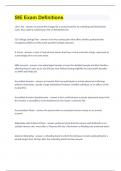
12b-1 fee an annual fee charged by a mutual fund for its marketing and distribution costs. Also called a maintenance fee or distribution fee. 529 College Savings Plan A tax-free savings plan that offers families professionally managed portfolios to help meet specified college expenses. A shares a class of mutual fund shares that have a front-end sales charge, expressed as a percentage of its net asset value. ABLE account a tax-advantaged savings account for disabled people and their families, allowing them to save up to $15,000 per year without losing eligibility for such public benefits as SNAP and Medicaid. Accredited Investor an investor that may participate in private placement offerings without restrictions, usually a large institutional investor, wealthy individual, or an officer of the issuing firm. Accredited Investor Questionnaire a form confirming to a private placement issuer that the investor is accredited, to be maintained in the issuer's customer file. Accumulation Phase the period when an annuitant invests money in an annuity account. Adjustable-rate Preferred Stock preferred stock that ties returns and dividends to an outside interest rate, most often a Treasury bill rate. Also known as floating-rate preferred stock. Advance Refunding a refunding bond in which the old issue remains outstanding for a period longer than 90 days after the refunding bond has been issued. Advisor-sold Plan a 529 college savings plan offered through an authorized investment firm that provides investment advice and more investment options, and comes with higher fees than a direct-sold plan offered by the state. Affiliate a person that directly or indirectly controls, is controlled by, or is under common control with another person. Agency Securities securities issued by government-sponsored agencies, such as Fannie Mae and Freddie Mac, but not backed by the full faith and credit of the U.S. government. Agency Transaction a transaction where a firm acts as broker, serving as an agent or go-between for the buyer and the seller. All-or-none (AON) Commitment a form of underwriting where the underwriter must sell all the shares in the offering within a specified time or the offering is voided. Alternative Minimum Tax (AMT) bond a private activity bond that qualifies for tax-exempt status but is subject to paying the alternative minimum tax. Also known as a qualified private activity bond. Compare with public purpose bond and private activity bond (PAB). American Depository Receipt (ADR) a certificate issued by the U.S. bank for the purpose of trading a specified number of shares of a foreign corporation in the U.S. stock market. American-style Option an option that can be exercised at any time prior to and including the exercise date. Also called an American option. An interest a descriptor used to indicate that a bond's purchase price will include its quoted (clean) price plus any accrued interest since the last payment date. Annuitant an individual entitled to receive benefits or payments from an annuity contract. Annuities contracts sold by an insurance company used to provide steady income to individuals after retirement, often until death. Annuitization Phase the period when an annuitant starts to receive payments from an annuity. Anticipation Notes municipal notes that are issued in advance of, or in anticipation of, an expected source of income. Arbitrage a riskless transaction in which an investor profits from buying and selling the same product for different prices at the same time in different locations. Ask Price also known as just the "ask," the price at which a market maker is willing to sell a security. Asset-backed Security a debt security backed by a pool of financial assets, such as automobile loans, credit card debt, or home equity loans. Assignment a transfer of ownership in a security or other property that gives a recipient the rights held by the previous owner. Associated Person an individual engaged in the investment banking or securities business who is registered with FINRA. At The Money a phrase indicating an options position whose exercise today would result in neither a gain nor a loss. Auction Market a securities exchange for trading securities at a physical location where buyers make bids and sellers make offers facilitated by a single market maker. Auction Rate Securities (ARS) long-term investments whose interest rates or dividend payments reset at frequent intervals by auctions, typically every 7, 14, 28, or 35 years. Authorized Shares the shares that a corporation is authorized to issue. Automatic Stabilizers government programs whose expenditures automatically fluctuate counter to the economic cycle. B Shares a class of mutual fund shares that have a deferred or back-end sales charge that declines over time and a higher annual expense than A shares. Back-end Load a sales charge that customers are charged after they redeem the shares. Also called back-end sales charges. Backing Away the failure of a broker-dealer to honor a firm quote. Balance of Payments an accounting of a country's international transactions, such as exports and imports and capital inflows and outflows. Balloon Maturity a serial bond in which one maturity, usually the last one, contains a disproportionately large amount of the principal. Bank Secrecy Act of 1970 (BSA) an act of congress that requires financial institutions in the United States to assist U.S. government agencies in detecting and preventing money laundering. Bankers' Acceptance (BA) a short-term credit instrument issued by a business for the purchase or sale of goods, drawn on and guaranteed by a bank. Basis Point one hundredth of a percentage point, the smallest increment of change in a bond's yield. Bearer Bond a bond certificate with attached coupons that is owned by whoever holds it, rather than by a registered owner. Bearish a belief that the value of a particular security or the market in general will decline. Bearish Strategy a trading strategy that is employed when an investor believes the price of a security will decline. Beneficial Interest the contractual right to receive an interest in the benefits of an asset that is owned by another party. Beneficial Owner one who has the benefits of owning a stock but whose title is held for reasons of safety or convenience "in street name" by that person's broker. Beneficiary a person designated to receive the assets of a life insurance policy or trust upon the account owner's death or the maturity of the contract. Best Execution a legal requirement that brokers provide the most favorable terms of execution for their customers given the existing market. Best-efforts Commitment an agreement by which an underwriter agrees to make its best efforts to sell as much of an issuer's securities offering as it can. Bid an offer to buy a security at a specific price and time. Bid Price the price at which a market maker or other investor is willing to buy a security. Bid-ask Spread the difference between the price at which investors are willing to buy an asset and the price at which investors are willing to sell it. Blend Funds mutual funds of equity securities that are a blend of growth stocks and value stocks. Bond a debt instrument created to raise capital by which the issuer promises to repay by a specified future date and also to pay periodic interest along the way. Bond Funds mutual funds composed of bonds and other debt instruments. Also known as fixed-income funds. Bond Indenture a legal document filed with the SEC that specifies the terms and conditions of a corporate bond issue. Bond Mutual Fund Volatility Rating a description of the sensitivity of a bond fund to changes in market conditions or the economy. Bond Point One percent of a bond's par value. Book Manager the managing underwriter for a securities issue. Book Runner the managing underwriter for a securities issue. Book-entry Bonds a bond whose ownership is recorded by computer at a central depository but for which no certificate is issued. Breakeven Point the price point where the buyer of an option will not experience a gain or a loss. Breaking the Buck a decline in the share price of a money market fund below $1. Breakpoint the amount of a mutual fund's purchase beyond which an investor will receive a discount on the front-end sales charge.
Written for
- Institution
-
Columbia University
- Course
-
FINRA SIE
Document information
- Uploaded on
- September 15, 2023
- Number of pages
- 59
- Written in
- 2023/2024
- Type
- Exam (elaborations)
- Contains
- Questions & answers
Subjects

Also available in package deal