

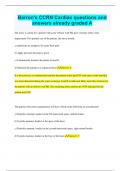
Barron's CCRN Cardiac questions and answers already graded A
Barron's CCRN Cardiac questions and answers already graded A The nurse is caring for a patient with acute inferior wall MI, post-coronary artery stent deployment. For optimal care of the patient, the nurse should: a) administer an analgesic for acute back pain b) Apply pressure dressing to groin c) Continuously monitor the patient in lead II d) Maintain the patient in a supine position Answer: C It is best practice to continuously monitor the patient status post PCI with stent, in the lead that was most abnormal during the acute occlusion. Lead II would most likely meet this criterion for the patient with an inferior wall MI. The remaining interventions are NOT indicated for the patient post PCI. The patient with aortic regurgitation will have which of the following on auscultation? a) Diastolic murmur, loudest at the 5th intercostal space, midclavicular b) Systolic murmur, loudest at the apex of the heart c) Diastolic murmur, loudest at the second intercostal space, right sternal border d) Systolic murmur, loudest at the base of the heart Answer: C Aortic insufficiency (regurgitation) is backflow of blood during the time the aortic valve should be closed. When is the aortic valve closed? During diastole — therefore it is a diastolic murmur. The aortic area of auscultation is at the base of the heart, second intercostal space, right sternal border. Cardiogenic shock secondary to left ventricular failure will generally result in: a) Decreased afterload b) narrow pulse pressure c) decreased preload d) Widening pulse pressure Answer: B The systolic pressure decreases due to a drop in cardiac output; however, the diastolic pressure either stays the same or increases due to a compensatory increase of the systemic vascular resistance. The remaining choices are not found in cardiogenic shock. The patient was admitted with acute inferior wall STEMI; the physician advises the nurse to monitor the patient for signs of right ventricular (RV) infarction. Which of the following are signs of RV infarction? a) S2 heart sounds, lung crackles b) Hypotension, flat neck veins c) Hypertension, systolic murmur d)
Document information
- Uploaded on
- September 15, 2023
- Number of pages
- 34
- Written in
- 2023/2024
- Type
- Exam (elaborations)
- Contains
- Questions & answers


