Chapter 10: Coordinated product and
supply chain design
1. General framework
2. Interaction between the two chains
− Fisher’s concept of innovative and functional products
− Functional products characterized by:
• Slow technology clock speed, low product variety, and typically low profit margins
− Innovative products characterized by:
• Fast technology clock speed and short product life cycle, high product variety, and
relatively high margins
− Each requires a different supply chain strategy
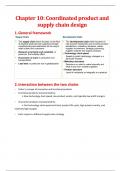
, − Development chain has to deal with the differing level of demand uncertainty
− Box A focus on push strategy, supply chain efficiency and high inventory turns
− Box B focus on responsiveness, on pull strategy as well as modular product architecture
− Box C focus on push sc emphasizing efficiency or cost reduction
− Box D focus on push-pull, reduce lead time
3. Design for logistics overview
− Product and process design that help to control logistics costs and increase service levels
− Economic packaging and transportation
− Concurrent and parallel processing
− Standardization
3.1 Economic packaging and transportation
− Design products so that they can be efficiently packed and stored
− Design products to efficiently utilize retail space
− Products that can be packed more compactly are cheaper to transport, particularly if
delivery trucks "cube out" before they "weigh out."
− Final packaging…
• Delay until as late as possible
• Repackaging at the cross-docking point is common for many products
supply chain design
1. General framework
2. Interaction between the two chains
− Fisher’s concept of innovative and functional products
− Functional products characterized by:
• Slow technology clock speed, low product variety, and typically low profit margins
− Innovative products characterized by:
• Fast technology clock speed and short product life cycle, high product variety, and
relatively high margins
− Each requires a different supply chain strategy
, − Development chain has to deal with the differing level of demand uncertainty
− Box A focus on push strategy, supply chain efficiency and high inventory turns
− Box B focus on responsiveness, on pull strategy as well as modular product architecture
− Box C focus on push sc emphasizing efficiency or cost reduction
− Box D focus on push-pull, reduce lead time
3. Design for logistics overview
− Product and process design that help to control logistics costs and increase service levels
− Economic packaging and transportation
− Concurrent and parallel processing
− Standardization
3.1 Economic packaging and transportation
− Design products so that they can be efficiently packed and stored
− Design products to efficiently utilize retail space
− Products that can be packed more compactly are cheaper to transport, particularly if
delivery trucks "cube out" before they "weigh out."
− Final packaging…
• Delay until as late as possible
• Repackaging at the cross-docking point is common for many products