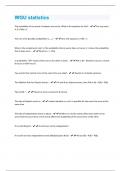
WGU statistics | 57 Questions and Answers(A+ Solution guide)
The probability of any event is between one and o. What is the equation for this? - For any event A, 0 ≤ P(A) ≤ 1. The sum of all possible probabilities is___? - One, the equation is :P(S) = 1 What is the complement rule? or the probability that an event does not occur is 1 minus the probability that it does occur. - P(not A) = 1 - P(A) In probability, "OR" means either one or the other or both. - P(A or B) = P(event A occurs or event B occurs or both occur) Two events that cannot occur at the same time are called - disjoint or mutually exclusive The Addition Rule for Disjoint Events: - If A and B are disjoint events, then P(A or B) = P(A) + P(B). P(A and B) = - P(event A occurs and event B occurs) The idea of disjoint events is - is about whether or not it is possible for the events to occur at the same time The idea of independent events is about - whether or not the events affect each other in the sense that the occurrence of one event affects the probability of the occurrence of the other If A and B Disjoint - A and B can not be indepentdent If A and B are two independent events (Multiplication Rule) - P(A and B) = P(A) * P(B).if A, B and C are three independent events, - P(A and B and C) = P(A) * P(B) * P(C) The Complement Rule, - P(A) = 1 - P(not A), P(L) = 1 - P(not L) = 1 - P(not O1 and not O2 and not O3 and not O4 and not O5 and not O6 and not O7 and not O8 and not O9 and not O10). - Applying the Multiplication rule:Now, using the multiplication rule, = 1 - (.56 * .56 * .56 * .56 * .56 * .56 * .56 * .56 * .56 * .56) = 1 - .003 = .997. P(at least one person chosen has blood type O) - P((O and O) or (O and not O) or (not O and O)) = (.44 * .44) + (.44 * .56) + (.56 * .44) = .6864. If A and B are disjoint events - - P(A and B)= 0 The General Addition Rule states that for any two events, - P(A or B) = P(A) + P(B) - P(A and B) When each of two outcomes has two possible values (yes/no), - there are four possible combinations altogether, which correspond to the four possible outcomes. How do we build a two-way table of probabilities? -Horizontally, A, not A and total, Vertically, B. not B and total
Written for
- Institution
- WGU statistics
- Course
- WGU statistics
Document information
- Uploaded on
- September 10, 2023
- Number of pages
- 9
- Written in
- 2023/2024
- Type
- Exam (elaborations)
- Contains
- Questions & answers
Subjects

Also available in package deal