Population and Sustainability Revision Notes
Population Size
Population Growth Curve
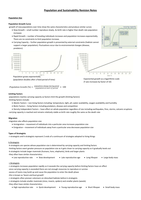
-growth of new populations over time show the same characteristics and produce similar curves
Slow Growth – small number reproduce slowly. As birth rate is higher than death rate population
increases
Rapid Growth – number of breeding individuals increases and population increases exponentially.
There are no constraints to limit population increase.
Carrying Capacity – further population growth is prevented by external constraints (habitat cannot
support a larger population). Fluctuations occur due to environmental changes (disease,
predators)
Population grows exponentially
(population doubles after a fixed period of time) Exponential growth as a logarithmic scale
(Y axis increases by factor of 10)
𝑝𝑜𝑝𝑢𝑎𝑙𝑡𝑖𝑜𝑛 𝑐ℎ𝑎𝑛𝑔𝑒 𝑑𝑢𝑟𝑖𝑛𝑔 𝑝𝑒𝑖𝑜𝑑
-Population Growth (%) = × 100
𝑝𝑜𝑝𝑢𝑙𝑎𝑡𝑖𝑜𝑛 𝑎𝑡 𝑠𝑡𝑎𝑟𝑡 𝑜𝑓 𝑝𝑒𝑟𝑖𝑜𝑑
Limiting Factors
-populations reaches carrying capacity as factors limit the growth (limiting factors)
-limiting factors include:
Abiotic Factors – non-living factors including: temperature, light, pH, water availability, oxygen availability and humidity
Biotic Factors – living factors including predators, disease and competition
Density Independent Factors – have effect on whole population regardless of size including earthquakes, fires, storms, volcanic eruptions
-carrying capacity is reached and remains relatively stable as birth rate roughly the same as the death rate
Migration
-migration also affects population size:
Immigration – movement of individuals into a particular area increases population size
Emigration – movement of individuals away from a particular area decreases population size
Types of Strategists
-r-strategists and k-strategists represent 2 ends of a continuum of strategies adopted to living things
k-Strategists
-k-strategists are species whose population size is determined by carrying capacity and limiting factors
-limiting factors exert greater pressure on population size as it gets closer to carrying capacity so it gradually levels out
-k-strategists include larger mammals (humans, lions, elephants), birds and larger plants
-they often have similar characteristics:
Low reproductive rate Slow development Late reproductive age Long lifespan Large body mass
r-Strategists
-r-strategists increases population rapidly so it exceeds the carrying capacity before limiting factors have an effect
-once carrying capacity is exceeded there are not enough resources to reproduce or survive
-excess of toxins may build up and cause the population to enter the death phase
-this is known as ‘boom and bust growth’
-r-strategists often pioneer colonisers on disturbed habitats before k-strategists
-r-strategists include smaller mammals (mice, insects, spiders) and smaller plants (weeds)
-they often have similar characteristics:
High reproductive rate Quick development Young reproductive age Short lifespan Small body mass
Population Size
Population Growth Curve
-growth of new populations over time show the same characteristics and produce similar curves
Slow Growth – small number reproduce slowly. As birth rate is higher than death rate population
increases
Rapid Growth – number of breeding individuals increases and population increases exponentially.
There are no constraints to limit population increase.
Carrying Capacity – further population growth is prevented by external constraints (habitat cannot
support a larger population). Fluctuations occur due to environmental changes (disease,
predators)
Population grows exponentially
(population doubles after a fixed period of time) Exponential growth as a logarithmic scale
(Y axis increases by factor of 10)
𝑝𝑜𝑝𝑢𝑎𝑙𝑡𝑖𝑜𝑛 𝑐ℎ𝑎𝑛𝑔𝑒 𝑑𝑢𝑟𝑖𝑛𝑔 𝑝𝑒𝑖𝑜𝑑
-Population Growth (%) = × 100
𝑝𝑜𝑝𝑢𝑙𝑎𝑡𝑖𝑜𝑛 𝑎𝑡 𝑠𝑡𝑎𝑟𝑡 𝑜𝑓 𝑝𝑒𝑟𝑖𝑜𝑑
Limiting Factors
-populations reaches carrying capacity as factors limit the growth (limiting factors)
-limiting factors include:
Abiotic Factors – non-living factors including: temperature, light, pH, water availability, oxygen availability and humidity
Biotic Factors – living factors including predators, disease and competition
Density Independent Factors – have effect on whole population regardless of size including earthquakes, fires, storms, volcanic eruptions
-carrying capacity is reached and remains relatively stable as birth rate roughly the same as the death rate
Migration
-migration also affects population size:
Immigration – movement of individuals into a particular area increases population size
Emigration – movement of individuals away from a particular area decreases population size
Types of Strategists
-r-strategists and k-strategists represent 2 ends of a continuum of strategies adopted to living things
k-Strategists
-k-strategists are species whose population size is determined by carrying capacity and limiting factors
-limiting factors exert greater pressure on population size as it gets closer to carrying capacity so it gradually levels out
-k-strategists include larger mammals (humans, lions, elephants), birds and larger plants
-they often have similar characteristics:
Low reproductive rate Slow development Late reproductive age Long lifespan Large body mass
r-Strategists
-r-strategists increases population rapidly so it exceeds the carrying capacity before limiting factors have an effect
-once carrying capacity is exceeded there are not enough resources to reproduce or survive
-excess of toxins may build up and cause the population to enter the death phase
-this is known as ‘boom and bust growth’
-r-strategists often pioneer colonisers on disturbed habitats before k-strategists
-r-strategists include smaller mammals (mice, insects, spiders) and smaller plants (weeds)
-they often have similar characteristics:
High reproductive rate Quick development Young reproductive age Short lifespan Small body mass