Respiration Revision Notes
Importance of Respiration
Respiration
-potential energy is stored in complex organic molecules which releases energy used to resynthesize ATP from ADP + P i
-ATP can be hydrolysed, releasing energy to drive biological processes such as protein synthesis, active transport, cell division
Role of Adenosine Triphosphate
-made from
Adenine (nitrogenous base)
Ribose (5 Carbon Sugar)
3 x Phosphate Groups
-universal energy currency of living cells
-intermediary compound releasing energy in small packets (when phosphate bonds are broken)
-broken down by hydrolysis (ATP → ADP + Pi)
-resynthesized by condensation (ADP + Pi → ATP)
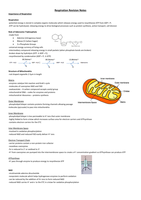
Structure of Mitochondria
-rod shaped organelle 2-5μm in length
Matrix
-enzymes catalyse link reaction and Kreb’s cycle
-molecules of coenzymes NAD and FAD
-oxaloacetate – 4 carbon compound accepts acetyl group
-mitochondrial DNA – codes for enzymes and proteins
-mitochondrial ribosomes – proteins synthesis
Outer Membrane
-phospholipid bilayer contains proteins forming channels allowing passage
molecules (pyruvate) to pass into mitochondria
Inner Membrane
-phospholipid bilayer is less permeable to H+ ions that outer membrane
-highly folded to form cristae which increases surface area for electron carriers and ATPsynthase
-contains electron carriers for the ETC
Inter Membrane Space
-involved in oxidative phosphorylation
-reduced NAD and reduced FAD easily deliver H+ ions
Electron Transport Chain
-carrier proteins contain a non-protein iron cofactor
-reoxidises coenzymes
-Fe is reduced to 2+ or oxidised to 3+
-H+ from coenzymes are pumped into the intermembrane space to create a H+ concentration gradient so ATPsynthase can produce ATP
ATPsynthase
-H+ pass through enzyme to produce energy to resynthesize ATP
NAD
-nicotinamide adenine dinucleotide
-nonprotein molecule which helps hydrogenase enzymes to perform oxidation
-can be reduced by the addition of H+ ions to form reduced NAD
-reduced NAD carries H+ and e- to the ETC in cristae for oxidative phosphorylation
Importance of Respiration
Respiration
-potential energy is stored in complex organic molecules which releases energy used to resynthesize ATP from ADP + P i
-ATP can be hydrolysed, releasing energy to drive biological processes such as protein synthesis, active transport, cell division
Role of Adenosine Triphosphate
-made from
Adenine (nitrogenous base)
Ribose (5 Carbon Sugar)
3 x Phosphate Groups
-universal energy currency of living cells
-intermediary compound releasing energy in small packets (when phosphate bonds are broken)
-broken down by hydrolysis (ATP → ADP + Pi)
-resynthesized by condensation (ADP + Pi → ATP)
Structure of Mitochondria
-rod shaped organelle 2-5μm in length
Matrix
-enzymes catalyse link reaction and Kreb’s cycle
-molecules of coenzymes NAD and FAD
-oxaloacetate – 4 carbon compound accepts acetyl group
-mitochondrial DNA – codes for enzymes and proteins
-mitochondrial ribosomes – proteins synthesis
Outer Membrane
-phospholipid bilayer contains proteins forming channels allowing passage
molecules (pyruvate) to pass into mitochondria
Inner Membrane
-phospholipid bilayer is less permeable to H+ ions that outer membrane
-highly folded to form cristae which increases surface area for electron carriers and ATPsynthase
-contains electron carriers for the ETC
Inter Membrane Space
-involved in oxidative phosphorylation
-reduced NAD and reduced FAD easily deliver H+ ions
Electron Transport Chain
-carrier proteins contain a non-protein iron cofactor
-reoxidises coenzymes
-Fe is reduced to 2+ or oxidised to 3+
-H+ from coenzymes are pumped into the intermembrane space to create a H+ concentration gradient so ATPsynthase can produce ATP
ATPsynthase
-H+ pass through enzyme to produce energy to resynthesize ATP
NAD
-nicotinamide adenine dinucleotide
-nonprotein molecule which helps hydrogenase enzymes to perform oxidation
-can be reduced by the addition of H+ ions to form reduced NAD
-reduced NAD carries H+ and e- to the ETC in cristae for oxidative phosphorylation