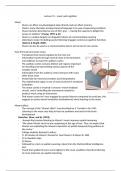
Lecture 15 – music and cognition
Music;
- Music can affect are physiological state directly and can effect memory.
- Used in many therapies and goes beyond language in its way of expressing emotions.
- Music has been described as one of life’s joys, “…having the capacity to delight the
senses or intellect” (Young, 1999; p.41)
- Music is a unique (largely non-linguistic) device of communicating meaning
- Listening to music (including passive listening) engages numerous cognitive functions
(Zatorre & Mcgill, 2005).
- Music can also be used as a communication device and so has its own syntax.
How the brain processes music;
- Transduced into neural impulses by the inner ear
- Information travels through several relays in the brainstem
and midbrain to reach the auditory cortex
- The auditory cortex contains distinct sub-regions important
for decoding and representing various aspects of the
complex sound
- Information from the auditory cortex interacts with many
other brain areas
- frontal lobe for memory formation and interpretation.
- The orbitofrontal region is one of many involved in emotional
evaluation.
- The motor cortex is involved in sensory–motor feedback
circuits, and in controlling the movements needed to
produce music using an instrument.
- Find motor cortex isn’t very engaged to passive listeners compared to musicians, this
suggests an active mental simulation (embodiment) when listening to the music.
Mozart effect;
- The concept of the "Mozart effect" was described by A. Tomatis in his 1991:
Listening to the music may help to heal ear problems and assist in the brain
development
Rauscher, Shaw, and Ky (1993);
- showed that passive listening to Mozart’s music improves spatial reasoning.
- “We chose Mozart since he was composing at the age of four. Thus, we expect that
Mozart was exploiting the inherent repertoire of spatial-temporal firing patterns in
the cortex.”
- College students listened to either:
- 1) 10 minutes of Mozart’s Sonata for Two Pianos in D Major (K. 448)
- 2) A relaxation tape
- 3) Silence
- Followed by a test on spatial reasoning, taken from the Stanford-Binet intelligence
test.
- Found that spatial IQ scores were highest in the music condition, therefore listening
to music improves you spatial reasoning.
, Interpretation of the study;
- Listening to Mozart “warms-up” neural cortices involved during spatial cognition and
problem solving (Rauscher et al., 1993)
- The regularity, repetition, or recurrence is important...recurrent temporal features of
the music map on to the temporal features of spatial processing in the brain
- Initial interpretation of Mozart effect is based on Trion model of cortical
organization.
Trion model;
- The Trion Model = a mathematical model of cortical synchronization.
- Cortical column = a group of vertically arranged neurons that share
perceptual tuning for any given receptive field (Horton & Adams, 2005).
- Trion = an idealized structure representing a group of neurons (Shaw, et
al., 1986).
- The Trion Model hypothesizes the existence of close links – as
exemplified by identical cortical activity – between domains that have
no obvious connection.
- Music acts as a sort of “pre-language” of the brain, certain kinds of
music (such as Mozart’s) might facilitate brain function
- A person who has just calculated a large number of sums will have their neurons
“primed” for that activity, so that they will do better at a similar task than someone
whose brain isn’t similarly “warmed up” (Priming)
- “Warmed-up” area of the brain which is stimulated by complex music is co-located
with are of brain used in spatial- reasoning tasks.
Supporting evidence;
- Increased EEG coherence (Rauscher, Shaw & Ky 1995)
- Increased gamma activity associated with unitization and binding of information
(Spydell & Sheer, 1982)
- Increased correlation of neurophysiologic activity in the temporal and left frontal
cortexes (Sarnthein et al., 1997)
- fMRI data – dorsal prefrontal cortex, occipital cortex, bilateral superior parietal
cortex (e.g. Cacciafesta et al. 2010) > These sub-serve spatial temporal abilities
- Increased spatio-temporal ability after piano lessons (Rideout et al., 1996)
- Rodent studies which compared maze learning after exposure to Mozart vs Other
music, White noise and silence (e.g. Rauscher et al. 1998).
EEG studies, Jaušovec & Habe (2004);
- Twenty individuals completed a simple visual attention task, then Mozart's sonata K.
448. Found enhanced cortical coherence when listening to music.
Key points from EEG studies;
- Oscillations in the gamma band play a crucial role in music perception; therefore,
may have a key role in enhancing spatial reasoning.
- Listening to a certain type of music (e.g. Mozart) may increase the coupling between
specific brain areas thus facilitating the selection and ‘binding’ of pertinent aspects
of sensory stimulus into a perceived whole.
- If this pattern of cortical activity coincides with the pattern needed for task
completion, an increase in task performance could be the result.
Music;
- Music can affect are physiological state directly and can effect memory.
- Used in many therapies and goes beyond language in its way of expressing emotions.
- Music has been described as one of life’s joys, “…having the capacity to delight the
senses or intellect” (Young, 1999; p.41)
- Music is a unique (largely non-linguistic) device of communicating meaning
- Listening to music (including passive listening) engages numerous cognitive functions
(Zatorre & Mcgill, 2005).
- Music can also be used as a communication device and so has its own syntax.
How the brain processes music;
- Transduced into neural impulses by the inner ear
- Information travels through several relays in the brainstem
and midbrain to reach the auditory cortex
- The auditory cortex contains distinct sub-regions important
for decoding and representing various aspects of the
complex sound
- Information from the auditory cortex interacts with many
other brain areas
- frontal lobe for memory formation and interpretation.
- The orbitofrontal region is one of many involved in emotional
evaluation.
- The motor cortex is involved in sensory–motor feedback
circuits, and in controlling the movements needed to
produce music using an instrument.
- Find motor cortex isn’t very engaged to passive listeners compared to musicians, this
suggests an active mental simulation (embodiment) when listening to the music.
Mozart effect;
- The concept of the "Mozart effect" was described by A. Tomatis in his 1991:
Listening to the music may help to heal ear problems and assist in the brain
development
Rauscher, Shaw, and Ky (1993);
- showed that passive listening to Mozart’s music improves spatial reasoning.
- “We chose Mozart since he was composing at the age of four. Thus, we expect that
Mozart was exploiting the inherent repertoire of spatial-temporal firing patterns in
the cortex.”
- College students listened to either:
- 1) 10 minutes of Mozart’s Sonata for Two Pianos in D Major (K. 448)
- 2) A relaxation tape
- 3) Silence
- Followed by a test on spatial reasoning, taken from the Stanford-Binet intelligence
test.
- Found that spatial IQ scores were highest in the music condition, therefore listening
to music improves you spatial reasoning.
, Interpretation of the study;
- Listening to Mozart “warms-up” neural cortices involved during spatial cognition and
problem solving (Rauscher et al., 1993)
- The regularity, repetition, or recurrence is important...recurrent temporal features of
the music map on to the temporal features of spatial processing in the brain
- Initial interpretation of Mozart effect is based on Trion model of cortical
organization.
Trion model;
- The Trion Model = a mathematical model of cortical synchronization.
- Cortical column = a group of vertically arranged neurons that share
perceptual tuning for any given receptive field (Horton & Adams, 2005).
- Trion = an idealized structure representing a group of neurons (Shaw, et
al., 1986).
- The Trion Model hypothesizes the existence of close links – as
exemplified by identical cortical activity – between domains that have
no obvious connection.
- Music acts as a sort of “pre-language” of the brain, certain kinds of
music (such as Mozart’s) might facilitate brain function
- A person who has just calculated a large number of sums will have their neurons
“primed” for that activity, so that they will do better at a similar task than someone
whose brain isn’t similarly “warmed up” (Priming)
- “Warmed-up” area of the brain which is stimulated by complex music is co-located
with are of brain used in spatial- reasoning tasks.
Supporting evidence;
- Increased EEG coherence (Rauscher, Shaw & Ky 1995)
- Increased gamma activity associated with unitization and binding of information
(Spydell & Sheer, 1982)
- Increased correlation of neurophysiologic activity in the temporal and left frontal
cortexes (Sarnthein et al., 1997)
- fMRI data – dorsal prefrontal cortex, occipital cortex, bilateral superior parietal
cortex (e.g. Cacciafesta et al. 2010) > These sub-serve spatial temporal abilities
- Increased spatio-temporal ability after piano lessons (Rideout et al., 1996)
- Rodent studies which compared maze learning after exposure to Mozart vs Other
music, White noise and silence (e.g. Rauscher et al. 1998).
EEG studies, Jaušovec & Habe (2004);
- Twenty individuals completed a simple visual attention task, then Mozart's sonata K.
448. Found enhanced cortical coherence when listening to music.
Key points from EEG studies;
- Oscillations in the gamma band play a crucial role in music perception; therefore,
may have a key role in enhancing spatial reasoning.
- Listening to a certain type of music (e.g. Mozart) may increase the coupling between
specific brain areas thus facilitating the selection and ‘binding’ of pertinent aspects
of sensory stimulus into a perceived whole.
- If this pattern of cortical activity coincides with the pattern needed for task
completion, an increase in task performance could be the result.