
Pathophysiology Chapter 5- Test Bank Verified answers
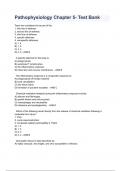
Pathophysiology Chapter 5- Test Bank Tears are considered to be part of the: 1. first line of defense. 2. second line of defense. 3. third line of defense. 4. specific defenses. 5. nonspecific defenses. A) 1, 4 B) 1, 5 C) 3, 4 D) 2, 5 - ANS B A specific defense for the body is: A) phagocytosis. B) sensitized T lymphocytes. C) the inflammatory response. D) intact skin and mucous membranes. - ANS B The inflammatory response is a nonspecific response to: A) phagocytosis of foreign material. B) local vasodilation. C) any tissue injury. D) formation of purulent exudates. - ANS C Chemical mediators released during the inflammatory response include: A) albumin and fibrinogen. B) growth factors and cell enzymes. C) macrophages and neutrophils. D) histamine and prostaglandins. - ANS D Which of the following result directly from the release of chemical mediators following a moderate burn injury? 1. Pain 2. Local vasoconstriction 3. Increased capillary permeability 4. Pallor A) 1, 2 B) 1, 3 C) 2, 3 D) 2, 4 - ANS B Granulation tissue is best described as: A) highly vascular, very fragile, and very susceptible to infection. B) an erosion through the wall of viscera, leading to complications. C) a type of adhesion with no vascularization. D) a form of stenosis, in a duct, that is extremely tough and resists attack by microbes. - ANS A Edema associated with inflammation results directly from: A) increased fluid and protein in the interstitial compartment. B) increased phagocytes in the affected area. C) decreased capillary permeability. D) general vasoconstriction. - ANS A The warmth and redness related to the inflammatory response results from: A) increased interstitial fluid. B) production of complement. C) a large number of white blood cells (WBCs) entering the area. D) increased blood flow into the area. - ANS D
Document information
- Uploaded on
- September 4, 2023
- Number of pages
- 22
- Written in
- 2023/2024
- Type
- Exam (elaborations)
- Contains
- Questions & answers


