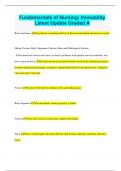
Fundamentals of Nursing: Immobility Latest Update Graded A
Fundamentals of Nursing: Immobility Latest Update Graded A Body mechanics Describe the coordinated efforts of the musculoskeletal and nervous system. Define: Posture, Body Alignment, Friction, Shear and Pathological Fracture - Think about how friction and shear can lead to problems with patients who are immobile, and how to prevent those. Friction and shear can lead to blood vessels in the underlying tissue to become stretched and damaged, resulting in impeded blood flow to the deep tissues. Ultimately *pressure ulcers* develop. Posture Position of the body in relation to the surrounding space Body alignment The individual's center of gravity is stable. Friction Force that occurs in a direction to oppose movement. Shear Force exerted against the skin while the skin remains stationary and body structures move. Pathological Fracture Fractures resulting from weakened bone tissue; frequently caused by osteoporosis or neoplasms Joints Connections between bones - cartilaginous, fibrous, and synovial. Ligaments Aid joint flexibility and support. Tendons Connect muscle to bone. Cartilages Nonvascular and support connective tissue. Skeletal muscles Contract and relax are the working elements of movement. Nervous system Regulates movement and posture. Describe how the following pathological abnormalities affect mobility. a. Postural b. Muscle
Written for
- Institution
- Fundamentals of Nursing: Immobility
- Course
- Fundamentals of Nursing: Immobility
Document information
- Uploaded on
- September 1, 2023
- Number of pages
- 22
- Written in
- 2023/2024
- Type
- Exam (elaborations)
- Contains
- Questions & answers
Subjects
-
fundamentals of nursing immobility latest update

Also available in package deal