IICRC S500 Water Mitigation Exam
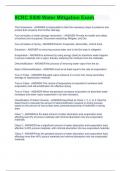
The homeowner - ANSWER-is responsible to take the necessary steps to preserve and protect their property from further damage Four principles of water damage restoration: - ANSWER-Provide for health and safety of workers and occupants; Document everything; Mitigate, and Dry Four principles of drying - ANSWER-Extract, Evaporate, dehumidify, control temp Extraction - ANSWER-is removing excess water and is the first step in mitigation Evaporation - ANSWER-is achieved by using energy (heat) to transform water trapped in porous materials into a vapor, thereby releasing the moisture from the materials. Dehumidification - ANSWER-the process of removing water vapor from the air. Rate of Dehumidification - ANSWER-must be at least equal to the rate of evaporation. True or False - ANSWER-Elevated vapor pressure in a room Can cause secondary damage to hygroscopic materials True or False - ANSWER-The control of temperature is important to enhance both evaporation and dehumidification for effective drying True or False - ANSWER-When temperature increases evaporation of absorbed water increases and water vapor suspended in air also increases. Classification of Water Intrusion - ANSWER-described as Class 1, 2, 3, or 4. Must be determined to calculate the amount of dehumidification required in drying process, based on the amount of wet surface area, permeance/porosity of materials in drying area. Class 1 - ANSWER-is the least amount of water absorption and evaporation load, affecting less 5% of porous materials with minimal absorption into low evaporation materials. Class 2 - ANSWER-has a significant amount of water absorption and evaporation load, affection 5-40% porous materials, with minimal absorption into low evaporated materials Class 3 - ANSWER-has the greatest amount of water absorption and evaporation load, affecting more than 40% porous materials and minimal absorption into low evaporated materials
Document information
- Uploaded on
- August 30, 2023
- Number of pages
- 8
- Written in
- 2023/2024
- Type
- Exam (elaborations)
- Contains
- Questions & answers