NREMT Practice Questions
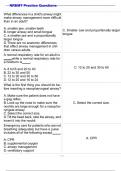
What differences in a child's airway might make airway management more difficult than in an adult? A. smaller jaw, smaller teeth B. longer airway and small tongue C. a smaller jaw and a proportionally larger tongue D.There are no anatomic differences that affect airway management in chil- dren versus adults. A normal respiratory rate for an adult is while a normal respiratory rate for a newborn is . A. 8 to16 and 20 to 40 B. 22 to 30 and 50 C. 12 to 20 and 30 to 60 D. 12 to 20 and 16 to 24 What is the first thing you should do be- fore inserting a nasopharyngeal airway? A. Make sure the patient does not have a gag reflex. B. Look up the nose to make sure the nostrils are large enough for a nasopha- ryngeal airway. C. Select the correct size. D.Tilt the head back, lube the airway, and insert it into the nostril. Emergency care for patients who are not breathing adequately but have a pulse includes all of the following except . A. CPR B. supplemental oxygen C. airway management D. ventilatory support C. Smaller Jaw and proportionally larger tongue C. 12 to 20 and 30 to 60 C. Select the correct size. A. CPR NREMT Practice Questions 2 / 34 You arrive on scene to find a young woman who is having trouble talking. She has hives and is starting to gasp for air. Her friend says she was just stung by a bee.Your immediate actions should include all of the following except . A. assess the bee sting for signs of an infection B. administer epinephrine (If your state and local EMS protocols allow) C. provide airway support D. administer supplemental oxygen You're called to a home and find an unre- sponsive male. Family members said he "passed out."You assess the scene to be safe. The next thing you should do is: A. Get a blood pressure to determine if it's too low and may have caused him to pass out. B. Get a temperature to determine if he has heat stroke. C. Check the patient's blood sugar; he might be a diabetic. D.Simultaneously check for a pulse and breathing. Wheezing can be described as . A. wet, crackling sound B. a high-pitched whistling sound C. loud snoring sound D. tiny popping sound You're responding to a call for a 44 year-old woman who is complaining A. assess the bee sting for signs of an infection D. Simultaneously check for a pulse and breathing. B. a high-pitched whistling sound Wheezing is produced by narrowing or obstruction of the lower airways, which often causes a high-pitched, whistling sound as the air travels through the nar- rowed space.
Written for
- Institution
- NREMT - Nationally Registered Emergency Medical Technician
- Course
- NREMT - Nationally Registered Emergency Medical Technician
Document information
- Uploaded on
- August 27, 2023
- Number of pages
- 34
- Written in
- 2023/2024
- Type
- Exam (elaborations)
- Contains
- Questions & answers

Also available in package deal