Anesthesiology Chapter Review Questions with complete solutions 100% verified.
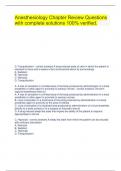
Anesthesiology Chapter Review Questions with complete solutions 100% verified. D. Tranquilization - correct answers.A drug-induced state of calm in which the patient is reluctant to move and is aware of but unconcerned about its surroundings. A. Sedation B. Hypnosis C. Narcosis D. Tranquilization A. A loss of sensation in a limited area of the body produced by administration of a local anesthetic or other agent in proximity to sensory nerves - correct answers.The term regional anesthesia refers to: A. A loss of sensation in a limited area of the body produced by administration of a local anesthetic or other agent in proximity to sensory nerves. B. Loss of sensation in a small area of the body produced by administration of a local anesthetic agent in proximity to the area of interest C. Loss of sensation of a localized area produced by administration of a local anesthetic directly to a body surface or to a surgical or traumatic wound D. A drug-induced sleep like state that impairs the ability of the patient to respond appropriately to stimuli C. Hypnosis - correct answers.A sleep like state from which the patient can be aroused with sufficient stimulation A. Narcosis B. Sedation C. Hypnosis D. Tranquilization B. Administration of multiple drugs concurrently in smaller quantities than would be required if each were given alone - correct answers.The term balanced anesthesia refers to: A. The administration of two or more agents in equal volume B. Administration of multiple drugs concurrently in smaller quantities than would be required if each were given alone C. General anesthesia in which the patient's physiologic status remains stable D. The administration of a local and general anesthetic concurrently A, B, D - correct answers.With sufficient stimulation, a patient can be aroused from: A. Sedation B. Narcosis C. General anesthesia D. Hypnosis A, D - correct answers.Which of the following statements about anesthesia is/are false? A. Anesthetic agents have wide therapeutic indices. B. There is always a risk to patient safety when anesthetic are administered. C. Most anesthetic cause significant changes in cardiopulmonary function D. Administration of anesthetic is routine and thus requires no specialized skills C. How many times a week does your pet go for a walk or exercise, Mrs. Jones - correct answers.In gathering a patient history, which of the following would be the best way to frame a question about a patient's exercise level? A. Your dog does not exercise much, does he, Mrs. Jones? B. Does your dog exercise, Mrs. Jones? C. How many times a week does your pet go for a walk or exercise, Mrs. Jones? D. You don't give your dog as much exercise as you should, do you, Mrs. Jones? B. The use of anticholinergic is recommended in ruminants to avoid airway occlusion - correct answers.Which of the following examples of species associations is not correct? A. Horses and cats are more sensitive to opioids than dogs and ruminants B. The use of anticholinergic is recommended in ruminants to avoid airway occlusion C. Horses may fracture limbs during anesthetic recovery and thus require special attention during the recovery period D. Large animals are prone to respiratory depression and dependent atelectasis and thus often require ventilatory support D. A dog with a body condition score of 8/9 will require more anesthetic per unit body weight than a dog of the same breed with a body condition score of 5/9 - correct answers.Which of the following statements regarding physical examination findings is incorrect? A. Dehydration increases the risk of hypotension B. Anemia predisposes the patient to hypoxemia C. Patients with bruising may be a higher risk for potentially life-threatening intraoperative and postoperative bleeding. D. A dog with a body condition score of 8/9 will require more anesthetic per unit body weight than a dog of the same breed with a body condition score of 5/9 C. Stuporous - correct answers.You are evaluating a patient's LOC and find the patient in a sleep like state, non responsive to a verbal stimulus but arousable by a painful stimulus. The patient is: A. Lethargic B. Obtunded C. Stuporous D. Comatose A. Hydrated - correct answers.You are evaluating a patient's hydration. The skin elasticity is mildly slowed, the patient's mucous membranes are tacky, the CRT is 1.5 seconds, but the eyes are in normal position in the orbit. Your patient is: A. Hydrated B. Approximately 5% dehydrated C. Approximately 8% dehydrated D. Greater than 10% dehydrated B. Horse: 2 to 4 hours - correct answers.Which of the following fasting times is least advisable? A. Dog: 8 to 12 hours B. Horse: 2 to 4 hours C. Cow: 24 to 48 hours D. Small ruminant: 12 to 18 hours C. Class P3 - correct answers.Using the ASA Physical Status Classification system, a patient that is moderately anemic or moderately dehydrated would be classified as: A. Class P1 B. Class P2 C. Class P3 D. Class P4 E. Class P5 A. Increased respiratory effort - correct answers.Which of the following signs of disease in a calm canine patient would be most significant in terms of the potential to increase the risk of anesthesia? A. Increased respiratory effort B. Lethargy C. A body temperature of 103.4 F D. A sinus arrhythmia A. Brachycephalic breeds - correct answers.Which of the following species or breeds must be watched especially closely during any anesthetic procedure to ensure a patent airway? A. Brachycephalic breeds
Written for
- Institution
- Anesthesiology
- Course
- Anesthesiology
Document information
- Uploaded on
- August 25, 2023
- Number of pages
- 7
- Written in
- 2023/2024
- Type
- Exam (elaborations)
- Contains
- Questions & answers
Subjects
-
anesthesiology chapter review questions

Also available in package deal