Project
management:
People
and
Technology
Lecture
summary
Lecture
1
Introduction
A
project
is
a
temporary
endeavor
undertaken
to
create
a
unique
product,
service
or
result.
There
is
a
clear
start
point
and
end-‐point,
when
the
goal
has
been
fulfilled.
Temporary
implies
that
it
can
also
end
unsatisfactory.
Resources
are
only
assigned
temporarily.
Example:
a
person
works
for
sales
their
whole
life,
but
is
assigned
to
a
project
only
temporarily.
Project
management
is
the
application
of
knowledge,
skills,
tools,
and
techniques
to
project
activities
to
meet
project
requirements.
Software
project
management
is
concerned
with
activities
ensuring
that
software
is
delivered
on
time,
within
budget
and
in
accordance
with
the
requirements
of
the
organization
developing
and
procuring
the
software.
The
underlying
assumption
is
that
you
can
actually
manage
this;
you
really
can
do
things
right.
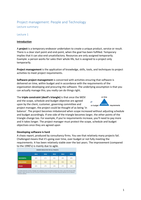
The
triple
constraint
(devil’s
triangle)
is
that
once
the
MOV
and
the
scope,
schedule
and
budget
objective
are
agreed
upon
by
the
client,
customer,
governing
committee
and
project
manager,
the
project
could
be
thought
of
as
being
‘in
balance’.
The
project
becomes
imbalanced
when
scope
increased
without
adjusting
schedule
and
budget
accordingly.
If
one
side
of
the
triangle
becomes
larger,
the
other
points
of
the
triangle
change
too.
For
example,
if
you’re
requirements
increase,
you’ll
need
to
pay
more
and
it
takes
longer.
The
project
manager
must
protect
the
scope,
schedule
and
budget
objectives
once
they
are
agreed
upon
Developing
software
is
hard
A
chaos
report,
produced
by
consultancy
firms.
You
see
that
relatively
many
projects
fail.
Challenged
means
that
it’s
going
over
time,
over
budget
or
not
fully
meeting
the
requirements.
It
has
been
relatively
stable
over
the
last
years.
The
improvement
(compared
to
the
1990’s)
is
mainly
due
to
agile.
1
,Agile
Background
The
development
of
software
programs
became
increasingly
bureaucratic.
It
limited
what
people
can
do,
while
in
projects
it’s
about
creativity.
Agile
has
uncovered
better
ways
of
developing
software
by
doing
it
and
helping
others
do
it.
Through
this
work
we
have
come
to
value:
• Individuals
and
interactions
over
processes
and
tools.
Focus
on
communication
and
interaction
is
much
more
valuable.
• Working
software
over
comprehensive
documentation.
Make
small
incremental
changes
and
show
these
to
the
client,
then
the
client
will
gain
trust
in
the
project
delivery.
• Customer
collaboration
over
contract
negotiation.
• Responding
to
change
over
following
a
plan.
You
have
to
adapt
to
changing
laws
and
regulation.
Also,
the
strategy
of
the
company
may
be
changing
and
software
may
need
to
be
changed
as
well.
That
is,
while
there
is
value
in
the
items
on
the
right,
we
value
the
items
on
the
left
more.
Starting
point:
software
development
is
a
social
process.
Use
social
mechanisms
to
improve
software
quality
(reviews;
discussions).
In
particular,
work
with
the
‘business’
in
multi-‐
disciplinary
teams.
This
provides
early
feedback
and
support
from
users
and
sponsors.
Agile
is
a
hype.
C-‐suite
are
the
executives
on
top
of
the
board,
such
as
the
CEO,
CIO,
etc.
They
often
only
do
‘half’
agile,
because
they
don’t
fully
know
what
it
is.
‘Why
Agile
now?’
–
Rgby,
Sutherland,
Takeuchi
2016
Abstract
Over
the
past
25
to
30
years,
agile
innovation
methods
have
greatly
increased
success
rates
in
software
development,
improved
quality
and
speed
to
market,
and
boosted
the
motivation
and
productivity
of
IT
teams.
Now
those
methods
are
spreading
across
a
broad
range
of
industries
and
functions
and
even
reaching
into
the
C-‐suite.
But
many
executives
don’t
understand
how
to
promote
and
benefit
from
agile;
often
they
manage
in
ways
that
run
counter
to
its
principles
and
practices,
undermining
the
effectiveness
of
agile
teams
in
their
organizations.
From
their
work
studying
and
advising
companies
that
have
successfully
employed
agile
methods,
the
authors
have
discerned
six
crucial
practices
for
capitalizing
on
agile’s
potential:
(1)
Learn
how
agile
really
works;
(2)
understand
when
it
is
appropriate;
(3)
start
small
and
let
passionate
evangelists
spread
the
word;
(4)
allow
teams
that
have
mastered
the
process
to
customize
their
practices;
(5)
practice
agile
at
the
top;
and
(6)
destroy
corporate
barriers
to
agile
behaviors.
They
expand
on
each,
providing
executives
with
a
practical
guide
for
accelerating
innovation
and
profitable
growth.
What
makes
a
good
team?
• Collaboration:
you
need
different
roles
• Supervisor
• Long
term
vision
• Strategy
2
, • Improvement
by
learning,
based
on
evidence
Why
is
developing
IT
for
government
hard?
-‐
Elias
Committee
2014
1. National
government
is
not
‘in
control’
regarding
ICT
projects
2. Politicians
do
not
realize,
but
ICT
is
everywhere
3. National
government
does
not
fulfill
her
ICT
policy
objectives
4. The
accountability
and
decision
making
structure
is
deficient
5. National
government
has
insufficient
insight
in
costs
and
benefits
of
ICT.
6. ICT
knowledge
of
the
national
government
is
lacking
7. ICT
project
management
is
weak
8. ICT
bid-‐for-‐tender
procedures
contain
perverse
incentives
9. Contract
management
in
ICT-‐projects
is
not
professional.
10. National
government
lacks
learning
ability
People
and
technology
• Technology:
information
technology
development
projects
and
tools
and
techniques
to
support
projects.
• People:
projects
are
set-‐up,
executed
and
managed
by
teams
of
people.
Agile
takes
communication
and
collaboration
seriously.
• Also
about
budget
and
scheduling.
Economics
and
business
administration.
Design
cycle
IT
involves
different
activities.
The
question
is
in
which
order
and
how
much
intertwined
are
these
activities?
All
of
these
activities
affect
each
other.
How
to
organize
this?
1. Waterfall
The
waterfall
method
stresses
a
sequential
and
logical
flow
of
software
development
activities.
A
characteristic
is
that
a
great
deal
of
time
and
effort
is
spent
in
the
early
phases
getting
the
requirements
and
design
correct
because
it
is
more
expensive
to
add
missing
requirements
in
a
later
phase.
Nobody
actually
does
waterfall
in
practice
–
it
doesn’t
exist
in
real
life.
On
the
arrows
you
have
documents.
The
delivery
of
a
document
is
a
milestone/end
point.
Advantages:
• It’s
clean
• It’s
easy
to
implement
in
a
planning,
because
it’s
step
after
step
• It’s
stable
• Easy
to
point
into
a
contract
• Suitable
when
developing
large
and
more
complex
systems
3
management:
People
and
Technology
Lecture
summary
Lecture
1
Introduction
A
project
is
a
temporary
endeavor
undertaken
to
create
a
unique
product,
service
or
result.
There
is
a
clear
start
point
and
end-‐point,
when
the
goal
has
been
fulfilled.
Temporary
implies
that
it
can
also
end
unsatisfactory.
Resources
are
only
assigned
temporarily.
Example:
a
person
works
for
sales
their
whole
life,
but
is
assigned
to
a
project
only
temporarily.
Project
management
is
the
application
of
knowledge,
skills,
tools,
and
techniques
to
project
activities
to
meet
project
requirements.
Software
project
management
is
concerned
with
activities
ensuring
that
software
is
delivered
on
time,
within
budget
and
in
accordance
with
the
requirements
of
the
organization
developing
and
procuring
the
software.
The
underlying
assumption
is
that
you
can
actually
manage
this;
you
really
can
do
things
right.
The
triple
constraint
(devil’s
triangle)
is
that
once
the
MOV
and
the
scope,
schedule
and
budget
objective
are
agreed
upon
by
the
client,
customer,
governing
committee
and
project
manager,
the
project
could
be
thought
of
as
being
‘in
balance’.
The
project
becomes
imbalanced
when
scope
increased
without
adjusting
schedule
and
budget
accordingly.
If
one
side
of
the
triangle
becomes
larger,
the
other
points
of
the
triangle
change
too.
For
example,
if
you’re
requirements
increase,
you’ll
need
to
pay
more
and
it
takes
longer.
The
project
manager
must
protect
the
scope,
schedule
and
budget
objectives
once
they
are
agreed
upon
Developing
software
is
hard
A
chaos
report,
produced
by
consultancy
firms.
You
see
that
relatively
many
projects
fail.
Challenged
means
that
it’s
going
over
time,
over
budget
or
not
fully
meeting
the
requirements.
It
has
been
relatively
stable
over
the
last
years.
The
improvement
(compared
to
the
1990’s)
is
mainly
due
to
agile.
1
,Agile
Background
The
development
of
software
programs
became
increasingly
bureaucratic.
It
limited
what
people
can
do,
while
in
projects
it’s
about
creativity.
Agile
has
uncovered
better
ways
of
developing
software
by
doing
it
and
helping
others
do
it.
Through
this
work
we
have
come
to
value:
• Individuals
and
interactions
over
processes
and
tools.
Focus
on
communication
and
interaction
is
much
more
valuable.
• Working
software
over
comprehensive
documentation.
Make
small
incremental
changes
and
show
these
to
the
client,
then
the
client
will
gain
trust
in
the
project
delivery.
• Customer
collaboration
over
contract
negotiation.
• Responding
to
change
over
following
a
plan.
You
have
to
adapt
to
changing
laws
and
regulation.
Also,
the
strategy
of
the
company
may
be
changing
and
software
may
need
to
be
changed
as
well.
That
is,
while
there
is
value
in
the
items
on
the
right,
we
value
the
items
on
the
left
more.
Starting
point:
software
development
is
a
social
process.
Use
social
mechanisms
to
improve
software
quality
(reviews;
discussions).
In
particular,
work
with
the
‘business’
in
multi-‐
disciplinary
teams.
This
provides
early
feedback
and
support
from
users
and
sponsors.
Agile
is
a
hype.
C-‐suite
are
the
executives
on
top
of
the
board,
such
as
the
CEO,
CIO,
etc.
They
often
only
do
‘half’
agile,
because
they
don’t
fully
know
what
it
is.
‘Why
Agile
now?’
–
Rgby,
Sutherland,
Takeuchi
2016
Abstract
Over
the
past
25
to
30
years,
agile
innovation
methods
have
greatly
increased
success
rates
in
software
development,
improved
quality
and
speed
to
market,
and
boosted
the
motivation
and
productivity
of
IT
teams.
Now
those
methods
are
spreading
across
a
broad
range
of
industries
and
functions
and
even
reaching
into
the
C-‐suite.
But
many
executives
don’t
understand
how
to
promote
and
benefit
from
agile;
often
they
manage
in
ways
that
run
counter
to
its
principles
and
practices,
undermining
the
effectiveness
of
agile
teams
in
their
organizations.
From
their
work
studying
and
advising
companies
that
have
successfully
employed
agile
methods,
the
authors
have
discerned
six
crucial
practices
for
capitalizing
on
agile’s
potential:
(1)
Learn
how
agile
really
works;
(2)
understand
when
it
is
appropriate;
(3)
start
small
and
let
passionate
evangelists
spread
the
word;
(4)
allow
teams
that
have
mastered
the
process
to
customize
their
practices;
(5)
practice
agile
at
the
top;
and
(6)
destroy
corporate
barriers
to
agile
behaviors.
They
expand
on
each,
providing
executives
with
a
practical
guide
for
accelerating
innovation
and
profitable
growth.
What
makes
a
good
team?
• Collaboration:
you
need
different
roles
• Supervisor
• Long
term
vision
• Strategy
2
, • Improvement
by
learning,
based
on
evidence
Why
is
developing
IT
for
government
hard?
-‐
Elias
Committee
2014
1. National
government
is
not
‘in
control’
regarding
ICT
projects
2. Politicians
do
not
realize,
but
ICT
is
everywhere
3. National
government
does
not
fulfill
her
ICT
policy
objectives
4. The
accountability
and
decision
making
structure
is
deficient
5. National
government
has
insufficient
insight
in
costs
and
benefits
of
ICT.
6. ICT
knowledge
of
the
national
government
is
lacking
7. ICT
project
management
is
weak
8. ICT
bid-‐for-‐tender
procedures
contain
perverse
incentives
9. Contract
management
in
ICT-‐projects
is
not
professional.
10. National
government
lacks
learning
ability
People
and
technology
• Technology:
information
technology
development
projects
and
tools
and
techniques
to
support
projects.
• People:
projects
are
set-‐up,
executed
and
managed
by
teams
of
people.
Agile
takes
communication
and
collaboration
seriously.
• Also
about
budget
and
scheduling.
Economics
and
business
administration.
Design
cycle
IT
involves
different
activities.
The
question
is
in
which
order
and
how
much
intertwined
are
these
activities?
All
of
these
activities
affect
each
other.
How
to
organize
this?
1. Waterfall
The
waterfall
method
stresses
a
sequential
and
logical
flow
of
software
development
activities.
A
characteristic
is
that
a
great
deal
of
time
and
effort
is
spent
in
the
early
phases
getting
the
requirements
and
design
correct
because
it
is
more
expensive
to
add
missing
requirements
in
a
later
phase.
Nobody
actually
does
waterfall
in
practice
–
it
doesn’t
exist
in
real
life.
On
the
arrows
you
have
documents.
The
delivery
of
a
document
is
a
milestone/end
point.
Advantages:
• It’s
clean
• It’s
easy
to
implement
in
a
planning,
because
it’s
step
after
step
• It’s
stable
• Easy
to
point
into
a
contract
• Suitable
when
developing
large
and
more
complex
systems
3