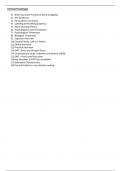
Criminal Psychology:
1) Brain injury (pre-frontal cortex & amygdala)
2) XYY Syndrome
3) Personality Trait Theory
4) Labelling Self-fulfilling prophecy
5) Social Learning Theory
6) Psychological Case Formulations
7) Psychological Treatments
8) Biological Treatments
9) Cognitive interview
10) Classical Study: Loftus + Palmer
11) Ethical Interview
12) Practical Interview
13) EWT: Stress and Weapon Focus
14) Contemporary Study: Valentine and Mesout (2009)
15) EWT – Post Event Discussion
16) Key Question: Is EWT too unreliable?
17) Defendant Characteristics
18) Pre-trial Publicity + Jury decision making
,Brain Injury (prefrontal cortex & amygdala)
Brain damage can either impact a large or small part of the brain
1) TBI à Injury (trauma) aka Traumatic brain injury
o Falling, car accidents, sports
2) ABI à Stroke (acquired) aka Acquired brain injury
o Genetic disposition, diet, exercise
3) ABI à Tumour (acquired) aka Acquired brain injury
o Genetic disposition, diet, carcinogen exposure
Prefrontal Cortex:
• Decision making
• Forward planning
• Ability to control impulses and change behaviour
• Keeps emotions balanced
• Still developing till aged 25 - responsible for risk-taking behaviour
• If damaged people can become antisocial and aggressive
Supporting evidence:
• Damasio (1994)
o Wanted to build a model of Gages' skull so they could map out how the iron rod passed
through the brain
o Created a 3D computer representation o the skill
o Could identify which areas of the brain were damaged other than the frontal lobes
o Low population validity: case study, 1 person, androcentric + ethnocentric, subjective
o Retrospective recall of events: unreliable memories
o No scientific record of personality before the injury
o Confounding variables: other events between brain injury and behaviour measurement (e.g.,
diet, disease, no. of fights)
• Orbitofrontal cortex (OFC)
o A prefrontal cortex region in the frontal loves of the brain, is involved in the cognitive process
of decision-making, controlling emotions, and imagining consequences.
o This was inferred through character referencing, where Phineas Gages personality changed,
becoming irritated and impulsive.
• Brown and Rice (2001)
o Undertook a literature review of documented brain injuries and this revealed many case studies
show anti-social personality can arise after frontal lobe injury
Amygdala:
• A small region located in the temporal lobe and is part of the limbic system
• The amygdala processes information from our senses and determines the emotional response to that
information
• It is involved in detecting, processing, and responding to environmental threats
• When activated, the amygdala overrides the rational part of our brain, so we are less likely to think in a
rational manner
, • Damage here can cause people to respond to a threatening situation in extreme ways (e.g., present
unemotional or perhaps react excessively as anger can’t be controlled
• Damage to the amygdala can lead to an individual being unable to prevent themselves from acting
spontaneously in an aggressive way
Supporting evidence:
• Yang et al. (2009): Link between the smaller volume of the amygdala and anti-social behaviour
o Investigated 27 psychotic people and 32 control and used structural MRI. To measure amygdala
activities
o Aim: to look for regions in the amygdala that are problematic in psychopaths
o The volume of the amygdala of each person was measured
o He found that people with psychopathy had volume reduction on the amygdala compared to
the controls
o They had 17.1% less volume in the left amygdala and 18.9% less in the right amygdala.
o There was also deformation in the surface of the amygdala
o There were significant correlations between the reduced volumes and the psychopathy scores,
and the strongest correlations related to emotions and interpersonal abilities and the amygdala
volume
• Pardini et al. (2013): lower amygdala volume and links to violence and aggression
o Found that men with lower volumes of the amygdala were a lot more likely to show aggressive
and violent behaviour, as well as psychopathic traits showing up 3 years late, than a control
group of men with a normal-sized amygdala
o A longitudinal study using 56 men with histories of violence when recruited
o They looked at violence and psychopathic traits in the 3 years follow-up and looked at the
association between aggression and psychopathic tendencies of the participant in childhood
and adolescence
o After the follow-up, it suggests that the volume of the amygdala might be a biomarker for
'serve and persistent aggression'
• Glenn et al. (2009): less amygdala activity in psychopaths
o Found that it was not just the size of the amygdala but the functioning that is reduced in people
with psychopathic tendencies
o Focused on moral reasoning and the neural circuitry underlying it, so not just brain structures
but also brain functioning including neurotransmitter
o They used fMRI scanning and found that more psychopathic individuals had reduced amygdala
activity during moral decision-making.
o Shows that psychopathic individuals would worry less about causing harm to others –
which linked to antisocial and criminal behaviour
Raine et al, further explanation:
o Shows that brain injury to the prefrontal and amygdala can increase criminality and anti-social
behaviour.
o Found that NGRI had less activity (1.09 compared to 1.12 in controls) in the prefrontal regions which
lead to dysfunctions in the NGRI patient (e.g., impulsive behaviour, loss of control, immaturity, and
inability to chance behaviour
o NGRI had imbalances in amygdala activity: where the left side had lower activity than control (0.94 vs
0.97) and the right side had higher activity than the control, this had an impact on the NGRI patients as
they showed unusual emotional responses (e.g., lack of fear)
, o This research support links with criminality and the brain regions: prefrontal cortex and amygdala, and
how these impacts can lead to certain behaviours which can increase certain impulsive decisions and
social behaviours
1) Brain injury (pre-frontal cortex & amygdala)
2) XYY Syndrome
3) Personality Trait Theory
4) Labelling Self-fulfilling prophecy
5) Social Learning Theory
6) Psychological Case Formulations
7) Psychological Treatments
8) Biological Treatments
9) Cognitive interview
10) Classical Study: Loftus + Palmer
11) Ethical Interview
12) Practical Interview
13) EWT: Stress and Weapon Focus
14) Contemporary Study: Valentine and Mesout (2009)
15) EWT – Post Event Discussion
16) Key Question: Is EWT too unreliable?
17) Defendant Characteristics
18) Pre-trial Publicity + Jury decision making
,Brain Injury (prefrontal cortex & amygdala)
Brain damage can either impact a large or small part of the brain
1) TBI à Injury (trauma) aka Traumatic brain injury
o Falling, car accidents, sports
2) ABI à Stroke (acquired) aka Acquired brain injury
o Genetic disposition, diet, exercise
3) ABI à Tumour (acquired) aka Acquired brain injury
o Genetic disposition, diet, carcinogen exposure
Prefrontal Cortex:
• Decision making
• Forward planning
• Ability to control impulses and change behaviour
• Keeps emotions balanced
• Still developing till aged 25 - responsible for risk-taking behaviour
• If damaged people can become antisocial and aggressive
Supporting evidence:
• Damasio (1994)
o Wanted to build a model of Gages' skull so they could map out how the iron rod passed
through the brain
o Created a 3D computer representation o the skill
o Could identify which areas of the brain were damaged other than the frontal lobes
o Low population validity: case study, 1 person, androcentric + ethnocentric, subjective
o Retrospective recall of events: unreliable memories
o No scientific record of personality before the injury
o Confounding variables: other events between brain injury and behaviour measurement (e.g.,
diet, disease, no. of fights)
• Orbitofrontal cortex (OFC)
o A prefrontal cortex region in the frontal loves of the brain, is involved in the cognitive process
of decision-making, controlling emotions, and imagining consequences.
o This was inferred through character referencing, where Phineas Gages personality changed,
becoming irritated and impulsive.
• Brown and Rice (2001)
o Undertook a literature review of documented brain injuries and this revealed many case studies
show anti-social personality can arise after frontal lobe injury
Amygdala:
• A small region located in the temporal lobe and is part of the limbic system
• The amygdala processes information from our senses and determines the emotional response to that
information
• It is involved in detecting, processing, and responding to environmental threats
• When activated, the amygdala overrides the rational part of our brain, so we are less likely to think in a
rational manner
, • Damage here can cause people to respond to a threatening situation in extreme ways (e.g., present
unemotional or perhaps react excessively as anger can’t be controlled
• Damage to the amygdala can lead to an individual being unable to prevent themselves from acting
spontaneously in an aggressive way
Supporting evidence:
• Yang et al. (2009): Link between the smaller volume of the amygdala and anti-social behaviour
o Investigated 27 psychotic people and 32 control and used structural MRI. To measure amygdala
activities
o Aim: to look for regions in the amygdala that are problematic in psychopaths
o The volume of the amygdala of each person was measured
o He found that people with psychopathy had volume reduction on the amygdala compared to
the controls
o They had 17.1% less volume in the left amygdala and 18.9% less in the right amygdala.
o There was also deformation in the surface of the amygdala
o There were significant correlations between the reduced volumes and the psychopathy scores,
and the strongest correlations related to emotions and interpersonal abilities and the amygdala
volume
• Pardini et al. (2013): lower amygdala volume and links to violence and aggression
o Found that men with lower volumes of the amygdala were a lot more likely to show aggressive
and violent behaviour, as well as psychopathic traits showing up 3 years late, than a control
group of men with a normal-sized amygdala
o A longitudinal study using 56 men with histories of violence when recruited
o They looked at violence and psychopathic traits in the 3 years follow-up and looked at the
association between aggression and psychopathic tendencies of the participant in childhood
and adolescence
o After the follow-up, it suggests that the volume of the amygdala might be a biomarker for
'serve and persistent aggression'
• Glenn et al. (2009): less amygdala activity in psychopaths
o Found that it was not just the size of the amygdala but the functioning that is reduced in people
with psychopathic tendencies
o Focused on moral reasoning and the neural circuitry underlying it, so not just brain structures
but also brain functioning including neurotransmitter
o They used fMRI scanning and found that more psychopathic individuals had reduced amygdala
activity during moral decision-making.
o Shows that psychopathic individuals would worry less about causing harm to others –
which linked to antisocial and criminal behaviour
Raine et al, further explanation:
o Shows that brain injury to the prefrontal and amygdala can increase criminality and anti-social
behaviour.
o Found that NGRI had less activity (1.09 compared to 1.12 in controls) in the prefrontal regions which
lead to dysfunctions in the NGRI patient (e.g., impulsive behaviour, loss of control, immaturity, and
inability to chance behaviour
o NGRI had imbalances in amygdala activity: where the left side had lower activity than control (0.94 vs
0.97) and the right side had higher activity than the control, this had an impact on the NGRI patients as
they showed unusual emotional responses (e.g., lack of fear)
, o This research support links with criminality and the brain regions: prefrontal cortex and amygdala, and
how these impacts can lead to certain behaviours which can increase certain impulsive decisions and
social behaviours