Cytokines
Interactions:
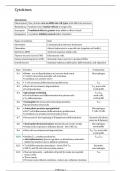
Pleiotropism One cytokine acts on different cell types with different outcomes
Redundancy Cytokines have similar effects on target cells
Synergism Combined effect is greater than additive effect of each
Antagonism A cytokine inhibits/cancels effect of another
Types of cytokines Role
Interleukin Communication between leukocytes
Chemokine Attract leukocytes to a specific site (regulate cell traffic)
Interferon (IFN) Antiviral response within cells
Tumour necrosis factor (TNF) Kills tumour cells
Colony stimulating factor (CSF) Stimulates bone marrow to produce WBCs
Growth factors stimulate cellular proliferation, differentiation, and migration
Type Function Produced by
IL1 • Fever - acts on hypothalamus to increase body temp Macrophages
• T cell, B cell and natural killer cell activation
• Contributes to cytokine storm
IL2 • T cell activation/differentiation/proliferation TH1
IL3 • Mast cell recruitment, degranulation TH2, mast cells
• B cell production eosinophils
IL4 • IgE isotype switching TH2,TFH,
• B cell activation and differentiation into plasma cells mast cells,
• TH2 differentiation eosinophils
IL5 • Eosinophil attraction/activation/degranulation TH2
• IgA production (mucosal)
IL6 • Acute phase proteins upregulation* Macrophages,
• B & T cell inflammation/differentiation/proliferation T cells, B cells
• Contributes to cytokine storm & induces fever
IL7 • Necessary for the beginning of B lymphocyte differentiation Stromal cells (bone
marrow & thymus)
IL8 • Neutrophil chemotactic factor (makes blood vessels sticky) Macrophages,
• Produced in response to inflamm stimuli - LPS, TNF, IL1 neutrophils
IL9 • Mast cell recruitment and degranulation TH2, TH9, mast cells,
eosinophils
IL10 • Inhibits TH1 cytokine production Treg, TH2
• Anti-inflammatory (down regulates co-stimulatory molecules,
inhibits production of pro-inflamm cytokines)
IL12 • T cell differentiation stimulation - forms CD4 TH1 Dendritic,
• CD8 TC and NK cell activity enhancement macrophages
IL13 • Mucosal immunity - epithelial cell prolif (to make more goblet TH2
mucus cells)
• Tissue repair
• Promotes anti-inflamm cytokines, reduces pro-inflamm cytokines
IL17 • Activates immune & non-immune cells to produce G-CSF and IL8 TH17
I^MD Page 1
Interactions:
Pleiotropism One cytokine acts on different cell types with different outcomes
Redundancy Cytokines have similar effects on target cells
Synergism Combined effect is greater than additive effect of each
Antagonism A cytokine inhibits/cancels effect of another
Types of cytokines Role
Interleukin Communication between leukocytes
Chemokine Attract leukocytes to a specific site (regulate cell traffic)
Interferon (IFN) Antiviral response within cells
Tumour necrosis factor (TNF) Kills tumour cells
Colony stimulating factor (CSF) Stimulates bone marrow to produce WBCs
Growth factors stimulate cellular proliferation, differentiation, and migration
Type Function Produced by
IL1 • Fever - acts on hypothalamus to increase body temp Macrophages
• T cell, B cell and natural killer cell activation
• Contributes to cytokine storm
IL2 • T cell activation/differentiation/proliferation TH1
IL3 • Mast cell recruitment, degranulation TH2, mast cells
• B cell production eosinophils
IL4 • IgE isotype switching TH2,TFH,
• B cell activation and differentiation into plasma cells mast cells,
• TH2 differentiation eosinophils
IL5 • Eosinophil attraction/activation/degranulation TH2
• IgA production (mucosal)
IL6 • Acute phase proteins upregulation* Macrophages,
• B & T cell inflammation/differentiation/proliferation T cells, B cells
• Contributes to cytokine storm & induces fever
IL7 • Necessary for the beginning of B lymphocyte differentiation Stromal cells (bone
marrow & thymus)
IL8 • Neutrophil chemotactic factor (makes blood vessels sticky) Macrophages,
• Produced in response to inflamm stimuli - LPS, TNF, IL1 neutrophils
IL9 • Mast cell recruitment and degranulation TH2, TH9, mast cells,
eosinophils
IL10 • Inhibits TH1 cytokine production Treg, TH2
• Anti-inflammatory (down regulates co-stimulatory molecules,
inhibits production of pro-inflamm cytokines)
IL12 • T cell differentiation stimulation - forms CD4 TH1 Dendritic,
• CD8 TC and NK cell activity enhancement macrophages
IL13 • Mucosal immunity - epithelial cell prolif (to make more goblet TH2
mucus cells)
• Tissue repair
• Promotes anti-inflamm cytokines, reduces pro-inflamm cytokines
IL17 • Activates immune & non-immune cells to produce G-CSF and IL8 TH17
I^MD Page 1