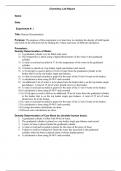
Chemistry Lab Report
Name
Date: Experiment #: 2
Title: Density Determination
Purpose: The purpose of this experiment is to learn how to calculate the density of both liquids
and solids in the chemistry lab by finding the volume and mass of different substances.
Procedure:
Density Determination of Water:
1)A graduated cylinder is to be filled with water
2)The temperature is taken using a digital thermometer of the water in the graduated
cylinder
3)A value is read and recorded in ºC for the temperature of the water in the graduated
cylinder
4)A beaker is placed on a top loader single pan balance and zeroed.
5)A 10 ml pipet is used to deliver 10 ml of water from the graduated cylinder to the beaker that is on the top loader single pan balance.
6)A value is read and recorded in grams for the mass of the 10 ml of water in the beaker.
7)A calculation is done using D=M/V and recorded.
8)An additional 5 ml of water is to be placed into the beaker that is on the top loader single
pan balance. A total of 15 ml of water should now be in the beaker.
9)A value is read and recorded in grams for the mass of the 15 ml of water in the beaker.
10)A calculation is done using D=M/V and recorded.
11)A 10 ml pipet is used to deliver an additional 10 ml of water from the graduated cylinder
to the beaker that is on the top loader single pan balance. A total of 25 ml of water
should now be in the beaker.
12)A value is read and recorded in grams for the mass of the 25 ml of water in the beaker.
13)A calculation is done using D=M/V and recorded.
14)Average deviation calculations are done.
15)Percent error calculations are done.
Density Determination of Cow Bone (to simulate human bone):
1.A graduated cylinder is filled with 40 ml of water.
2.The graduated cylinder is placed on a top loader single pan balance and zeroed
3.A piece of bone is placed inside the graduated cylinder
4.A value is read and recorded in grams for the mass of the piece of bone.
5.Volume is read by reading how much the water has increased in the graduated cylinder when the bone is placed inside (volume displacement).
6.A calculation is done using D=M/V and recorded. Chemistry Lab Report
Density Determination of Suet (to simulate human fat tissue):
1.A beaker is placed on a top loader single pan balance and zeroed.
2.A graduated tube is filled with 2.9 ml of suet.
3.The graduated tube with suet is placed inside the beaker that is sitting on a top loader
single pan balance.
4.A value is read and recorded in grams for the mass of the suet.
5.A calculation is done using D=M/V and recorded.
Density Determination of Chicken Breast Muscle (to simulate human muscle):
1.Chicken breast muscle is placed in a tube and pushed down in order to exclude as much air as possible.
2.A value is read and recorded in ml for the volume of the chicken breast muscle.
3.A beaker is placed on a top loader single pan balance and zeroed.
4.The tube with chicken breast muscle is placed inside the beaker that is sitting on a top
loader single pan balance.
5.A value is read and recorded in grams for the mass of the chicken breast muscle.
6.A calculation is done using D=M/V and recorded.
Density Determination of Nylon:
1.A cylinder of nylon is found.
2.A ruler is used to find the cylinder of nylon’s length, diameter, and radius.
3.A volume is found using the measurements above. Cylinder volume = πr2l
4.A graduated cylinder is filled with 30ml of water.
5.The cylinder of nylon is placed into the graduated cylinder with 30ml of water.
6.A value is read and recorded in ml for the volume of the cylinder of nylon.
7.The piece of nylon is placed on a top loader single pan balance.
8.A value is read and recorded in grams for the mass of the nylon.
9.A calculation is done using D=M/V and recorded.
Density Determination of Walnut Wood:
1.A cylinder of walnut wood is found.
2.A ruler is used to find the cylinder of the walnut wood’s length, diameter, and radius.
3.A volume is found using the measurements above. Cylinder volume = πr2l
4.A graduated cylinder is filled with 30ml of water.
5.The cylinder of walnut wood is placed into the graduated cylinder with 30ml of water and
pressed down using a pencil (since wood will float).
6.A value is read and recorded in ml for the volume of the cylinder of walnut wood.
7.The piece of walnut wood is placed on a top loader single pan balance.
8.A value is read and recorded in grams for the mass of the walnut wood.
9.A calculation is done using D=M/V and recorded.
Name
Date: Experiment #: 2
Title: Density Determination
Purpose: The purpose of this experiment is to learn how to calculate the density of both liquids
and solids in the chemistry lab by finding the volume and mass of different substances.
Procedure:
Density Determination of Water:
1)A graduated cylinder is to be filled with water
2)The temperature is taken using a digital thermometer of the water in the graduated
cylinder
3)A value is read and recorded in ºC for the temperature of the water in the graduated
cylinder
4)A beaker is placed on a top loader single pan balance and zeroed.
5)A 10 ml pipet is used to deliver 10 ml of water from the graduated cylinder to the beaker that is on the top loader single pan balance.
6)A value is read and recorded in grams for the mass of the 10 ml of water in the beaker.
7)A calculation is done using D=M/V and recorded.
8)An additional 5 ml of water is to be placed into the beaker that is on the top loader single
pan balance. A total of 15 ml of water should now be in the beaker.
9)A value is read and recorded in grams for the mass of the 15 ml of water in the beaker.
10)A calculation is done using D=M/V and recorded.
11)A 10 ml pipet is used to deliver an additional 10 ml of water from the graduated cylinder
to the beaker that is on the top loader single pan balance. A total of 25 ml of water
should now be in the beaker.
12)A value is read and recorded in grams for the mass of the 25 ml of water in the beaker.
13)A calculation is done using D=M/V and recorded.
14)Average deviation calculations are done.
15)Percent error calculations are done.
Density Determination of Cow Bone (to simulate human bone):
1.A graduated cylinder is filled with 40 ml of water.
2.The graduated cylinder is placed on a top loader single pan balance and zeroed
3.A piece of bone is placed inside the graduated cylinder
4.A value is read and recorded in grams for the mass of the piece of bone.
5.Volume is read by reading how much the water has increased in the graduated cylinder when the bone is placed inside (volume displacement).
6.A calculation is done using D=M/V and recorded. Chemistry Lab Report
Density Determination of Suet (to simulate human fat tissue):
1.A beaker is placed on a top loader single pan balance and zeroed.
2.A graduated tube is filled with 2.9 ml of suet.
3.The graduated tube with suet is placed inside the beaker that is sitting on a top loader
single pan balance.
4.A value is read and recorded in grams for the mass of the suet.
5.A calculation is done using D=M/V and recorded.
Density Determination of Chicken Breast Muscle (to simulate human muscle):
1.Chicken breast muscle is placed in a tube and pushed down in order to exclude as much air as possible.
2.A value is read and recorded in ml for the volume of the chicken breast muscle.
3.A beaker is placed on a top loader single pan balance and zeroed.
4.The tube with chicken breast muscle is placed inside the beaker that is sitting on a top
loader single pan balance.
5.A value is read and recorded in grams for the mass of the chicken breast muscle.
6.A calculation is done using D=M/V and recorded.
Density Determination of Nylon:
1.A cylinder of nylon is found.
2.A ruler is used to find the cylinder of nylon’s length, diameter, and radius.
3.A volume is found using the measurements above. Cylinder volume = πr2l
4.A graduated cylinder is filled with 30ml of water.
5.The cylinder of nylon is placed into the graduated cylinder with 30ml of water.
6.A value is read and recorded in ml for the volume of the cylinder of nylon.
7.The piece of nylon is placed on a top loader single pan balance.
8.A value is read and recorded in grams for the mass of the nylon.
9.A calculation is done using D=M/V and recorded.
Density Determination of Walnut Wood:
1.A cylinder of walnut wood is found.
2.A ruler is used to find the cylinder of the walnut wood’s length, diameter, and radius.
3.A volume is found using the measurements above. Cylinder volume = πr2l
4.A graduated cylinder is filled with 30ml of water.
5.The cylinder of walnut wood is placed into the graduated cylinder with 30ml of water and
pressed down using a pencil (since wood will float).
6.A value is read and recorded in ml for the volume of the cylinder of walnut wood.
7.The piece of walnut wood is placed on a top loader single pan balance.
8.A value is read and recorded in grams for the mass of the walnut wood.
9.A calculation is done using D=M/V and recorded.