Critical Care exam 1: Respiratory Practice Questions and Answers (Graded A)
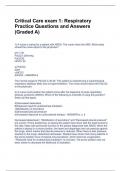
Critical Care exam 1: Respiratory Practice Questions and Answers (Graded A)Critical Care exam 1: Respiratory Practice Questions and Answers (Graded A)Critical Care exam 1: Respiratory Practice Questions and Answers (Graded A)Critical Care exam 1: Respiratory Practice Questions and Answers (Graded A) 1) A nurse is caring for a patient with ARDS. The nurse views the ABG. What value should the nurse report to the physician? pH: 7.35 PaCO2: 26mmhg PaO2:95 HCO3: 22 a) PaCO2 b)pH c)HCO3 d)PaO2 - ANSWER-a The normal range for PaCO2 is 35-45. This patient is experiencing a superimposed respiratory alkalosis likely due to hyperventilation. The nurse should report the PaCO2 to the physician. 2) A nurse must position the patient prone after his diagnosis of acute respiratory distress syndrome (ARDS). Which of the following is a benefit of using this position? Select all that apply. A)Decreased atelectasis B)Reduced need for endotracheal intubation c)Mobilization of secretions d)Decreased pleural pressure e)Increased response to corticosteroid therapy - ANSWER-a, c, d Decreased atelectasis", "Mobilization of secretions" and "Decreased pleural pressure" are correct. Prone positioning, or placing the patient face down with the head turned to the side, helps with pulmonary function in the patient diagnosed with ARDS. When the patient is placed in a prone position, the heart and diaphragm are not pressing against the lungs, which means that pleural pressure
Written for
- Institution
- Critical Care
- Course
- Critical Care
Document information
- Uploaded on
- August 22, 2023
- Number of pages
- 19
- Written in
- 2023/2024
- Type
- Exam (elaborations)
- Contains
- Questions & answers
Subjects
- a nurse mu
-
critical care exam 1 respiratory practice questio
-
critical care exam 1 respiratory practice
-
critical care exam 1 respiratory practice stuvia
-
1 a nurse is caring for a patient with ards the

Also available in package deal