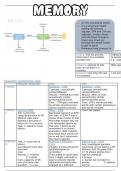
MULTI- o An info processing model
STORE o It’s a structural model
stating the sensory
register, STM and LTM are
separate, unitary stores
and info flows through a
linear way (must go
through the whole model
to get to each)
o Rehearsal loop: process to
MSM:retain info in STM or Sensory r
Coding: how we process Coding is
information to a suitable to senses
storage form e.g., icon
Capacity: amount of info High capa
that can be held in a
memory
Duration: how long info last >1/2 seco
in a memory
RESEARCH SUPPORTING MSM:
SENSORY REGISTER: STM: LTM:
CODING: Baddeley – 1966 Baddeley – 1966
2 groups – acoustically 2 groups: semantically
similar/different similar/different
Results – immediate recall Results: after 20 mins
acoustically similar semantically similar
performed the worst. performed the worst
Conc – STM gets confused Conc: LTM’s distracted with
by similar sounds so less words with similar meaning so
words recalled correctly less words recalled
CAPACIT Sperling 1960: Miller – 1956 Can’t be tested
Y: Aim: to find the Reviewed research in STM,
capacity/duration of SR can hold +/-2 for 7 and it
Method: ppts were stores small chunks of info
flashed a 3x4 grid of that helps explain why we
letters for ½ a second can remember phone no
Task 1: asked to recall that are>7 items as we
letters remember it in chunks.
evaluation: didn’t specify
how large each chunk can
be so we can’t determine
the exact capacity.
DURATIO Task 2: recall row of Peterson & Peterson – Bahrick et al – 1975
N: letters 1959 Aim: investigate duration
according to tone (low 24 ppts, 8 trials and given memories can be held in LTM
tone-last syllable/trigram to Method: 392 US grads Ohio
row) remember. 17-74 shown photos from
Results: 1: 4 letters Then asked to count back highsch yearbook
2: 3 items from 3 digits until told to 2 groups:
Conc: capacity of SR – stop to prevent mental 1: names list to match to
min of 4 items and rehearsal and each time photos 2: identify
duration – ½ a sec. stopped at a different w/o list
, thought that each time interval. Results, 48 yrs later:
the image fades during ½ Results: after 3 sec delay Grp 1: 70% accuracy
a sec/time it takes to 80% recalled the trigrams Grp 2: 30% accuracy
report back recalled but after 18 secs only 10% Conc: recognition easier than
items so could also be Conc: STM has a limited recall and supports idea of
more than 4 items. duration when rehearsal is unlimited capacity
prevented as info’s lost to
displacement
Evaluation of Baddeleys study:
Strengths: research identified a clear diff between 2 memory stores. Later research showed some
exceptions to his findings but idea that STM is mainly acoustic and LTM semantic has stood.
Important step in understanding memory leading to MSM.
limitation: artificial stimuli used instead of meaningful material as his word list didn’t mean much to
ppts so may not tell us about coding in everyday life as when processing more meaningful info,
semantic coding may also be used for STM so findings have limited application.
Evaluation of millers study:
limitation: he may have over-estimated STM capacity. Nelson Cowan reviewed other research conc
that STM capacity is only around 4 (+/- 1) suggesting the lower end of his estimate is more
appropriate. Supported by Jacobs where ppts had to repeat back numbers in the same order until it
was inc till ppts couldn’t recall them so found student had avg span of 7.3 and 9.3.
Evaluation of peterson and peterson:
Limitation: stimulus material artificial. Study isnt fully irrelevant as we do try and remember phone
numbers but recalling consonant syllables doesn’t reflect everyday memory activities where what
we try and remember is meaningful so lacks external validity
Evaluation of bahrick et al:
Strength: high external validity as reserached meaningful memories like peoples names and faces
as when meaningless pictures are remembered recall rates would be lower so gives a more realistic
estimate of furation of LTM.
EVALUATION:
STRENGTHS: WEAKNESSES:
o Evidence supporting the STM an LTM are two o MSM suggests there’s only 1 type of STM,
separate stores. but research disproves this.
o The case study of HM showed his LTM before o E.g., Shallice and Warrington studies KF
surgery was intact and STM was unaffected. He who has amnesia, a clinical memory
couldn’t form new LTM’S suggesting the STM disorder. His STM for digits was poor
and LTM are separate, and the hippocampus when they were read aloud but recall was
acted as a gateway between the two. better when digits were read to himself.
o A strength as it shows both stores work Further studies of KF showed there could
separately and independently so supports the be another short-term store for non-
assumptions of the MSM. verbal sounds e.g., noises.
o However, this was a case study so findings can’t o A weakness as it shows there’s different
be generalised past the study due to individual types of STM (visual and auditory) that
differences. aren’t recognised by MSM but are
o Furthermore, many studies supporting both accounted for by the working memory
stores being separate used material other than model.
what we’d try and remember in everyday life o MSM can be seen as incomplete
e.g., names and facts as they used digits,
letters or consonant syllable which have no
meaning to us so MSM may not be a valid model
of how memory work irl with meaningful info.
Weakness: o MSM suggests there’s 1 type of rehearsal
o MSM was based on research evidence available and prolonged rehearsal enables transfer
at the time suggesting LTM and STM to be to LTM but may not be the case.
single stores, but research suggests more than o According to MSM the amount of
one type of LTM: episodic, procedural, and rehearsal matters so the more you
semantic. rehearse something the more likely it’ll
o We have memories about facts of the world and transfer to the LTM, but Craik and
procedural memory E.g., CW who suffered from Watkins found maintenance rehearsal
retrograde amnesia and forgot past information only keeps info in the STM, to be in the
but could play the piano (procedural) and was LTM elaborative rehearsal needs to take
STORE o It’s a structural model
stating the sensory
register, STM and LTM are
separate, unitary stores
and info flows through a
linear way (must go
through the whole model
to get to each)
o Rehearsal loop: process to
MSM:retain info in STM or Sensory r
Coding: how we process Coding is
information to a suitable to senses
storage form e.g., icon
Capacity: amount of info High capa
that can be held in a
memory
Duration: how long info last >1/2 seco
in a memory
RESEARCH SUPPORTING MSM:
SENSORY REGISTER: STM: LTM:
CODING: Baddeley – 1966 Baddeley – 1966
2 groups – acoustically 2 groups: semantically
similar/different similar/different
Results – immediate recall Results: after 20 mins
acoustically similar semantically similar
performed the worst. performed the worst
Conc – STM gets confused Conc: LTM’s distracted with
by similar sounds so less words with similar meaning so
words recalled correctly less words recalled
CAPACIT Sperling 1960: Miller – 1956 Can’t be tested
Y: Aim: to find the Reviewed research in STM,
capacity/duration of SR can hold +/-2 for 7 and it
Method: ppts were stores small chunks of info
flashed a 3x4 grid of that helps explain why we
letters for ½ a second can remember phone no
Task 1: asked to recall that are>7 items as we
letters remember it in chunks.
evaluation: didn’t specify
how large each chunk can
be so we can’t determine
the exact capacity.
DURATIO Task 2: recall row of Peterson & Peterson – Bahrick et al – 1975
N: letters 1959 Aim: investigate duration
according to tone (low 24 ppts, 8 trials and given memories can be held in LTM
tone-last syllable/trigram to Method: 392 US grads Ohio
row) remember. 17-74 shown photos from
Results: 1: 4 letters Then asked to count back highsch yearbook
2: 3 items from 3 digits until told to 2 groups:
Conc: capacity of SR – stop to prevent mental 1: names list to match to
min of 4 items and rehearsal and each time photos 2: identify
duration – ½ a sec. stopped at a different w/o list
, thought that each time interval. Results, 48 yrs later:
the image fades during ½ Results: after 3 sec delay Grp 1: 70% accuracy
a sec/time it takes to 80% recalled the trigrams Grp 2: 30% accuracy
report back recalled but after 18 secs only 10% Conc: recognition easier than
items so could also be Conc: STM has a limited recall and supports idea of
more than 4 items. duration when rehearsal is unlimited capacity
prevented as info’s lost to
displacement
Evaluation of Baddeleys study:
Strengths: research identified a clear diff between 2 memory stores. Later research showed some
exceptions to his findings but idea that STM is mainly acoustic and LTM semantic has stood.
Important step in understanding memory leading to MSM.
limitation: artificial stimuli used instead of meaningful material as his word list didn’t mean much to
ppts so may not tell us about coding in everyday life as when processing more meaningful info,
semantic coding may also be used for STM so findings have limited application.
Evaluation of millers study:
limitation: he may have over-estimated STM capacity. Nelson Cowan reviewed other research conc
that STM capacity is only around 4 (+/- 1) suggesting the lower end of his estimate is more
appropriate. Supported by Jacobs where ppts had to repeat back numbers in the same order until it
was inc till ppts couldn’t recall them so found student had avg span of 7.3 and 9.3.
Evaluation of peterson and peterson:
Limitation: stimulus material artificial. Study isnt fully irrelevant as we do try and remember phone
numbers but recalling consonant syllables doesn’t reflect everyday memory activities where what
we try and remember is meaningful so lacks external validity
Evaluation of bahrick et al:
Strength: high external validity as reserached meaningful memories like peoples names and faces
as when meaningless pictures are remembered recall rates would be lower so gives a more realistic
estimate of furation of LTM.
EVALUATION:
STRENGTHS: WEAKNESSES:
o Evidence supporting the STM an LTM are two o MSM suggests there’s only 1 type of STM,
separate stores. but research disproves this.
o The case study of HM showed his LTM before o E.g., Shallice and Warrington studies KF
surgery was intact and STM was unaffected. He who has amnesia, a clinical memory
couldn’t form new LTM’S suggesting the STM disorder. His STM for digits was poor
and LTM are separate, and the hippocampus when they were read aloud but recall was
acted as a gateway between the two. better when digits were read to himself.
o A strength as it shows both stores work Further studies of KF showed there could
separately and independently so supports the be another short-term store for non-
assumptions of the MSM. verbal sounds e.g., noises.
o However, this was a case study so findings can’t o A weakness as it shows there’s different
be generalised past the study due to individual types of STM (visual and auditory) that
differences. aren’t recognised by MSM but are
o Furthermore, many studies supporting both accounted for by the working memory
stores being separate used material other than model.
what we’d try and remember in everyday life o MSM can be seen as incomplete
e.g., names and facts as they used digits,
letters or consonant syllable which have no
meaning to us so MSM may not be a valid model
of how memory work irl with meaningful info.
Weakness: o MSM suggests there’s 1 type of rehearsal
o MSM was based on research evidence available and prolonged rehearsal enables transfer
at the time suggesting LTM and STM to be to LTM but may not be the case.
single stores, but research suggests more than o According to MSM the amount of
one type of LTM: episodic, procedural, and rehearsal matters so the more you
semantic. rehearse something the more likely it’ll
o We have memories about facts of the world and transfer to the LTM, but Craik and
procedural memory E.g., CW who suffered from Watkins found maintenance rehearsal
retrograde amnesia and forgot past information only keeps info in the STM, to be in the
but could play the piano (procedural) and was LTM elaborative rehearsal needs to take