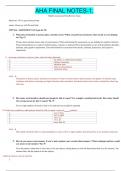
AHA FINAL NOTES-1.
AHA FINAL NOTES-1. Health Assessment Final Review Exam Must have 78% to pass between both exams Always go with the text book MENTAL ASSESSMENT (Ch 5 pgs 64-78) 1. What does orientation to person, place, and time assess? When you perform assessment, what exactly are you looking for? Pg. 67 Person, place and time assess state of consciousness. When performing this assessment you are looking for cognitive function. Person disorientation is a result of cerebral trauma, seizures, or amnesia; Place disorientation occurs with psychiatric disorders, delirium, and cognitive impairment; Time disorientation is associated with anxiety, delirium, depression, and cognitive impairment. 8. Assessing orientation to person, place, and time helps determine a. the ability to understand analogies. b. abstract reasoning. c. attention span. d. state of consciousness. e. emotional status. ANS: D Orientation to person, place, and time are measures of states of consciousness and awareness, not degrees of attention span. Analogies and abstract reasoning are higher functions than orientation. Emotional status can be better evaluated by observing behaviors. 2. How many serial numbers should most people be able to repeat? For example: counting backwards. How many should the average person be able to repeat? Pg. 70 Five to eight numbers forward or four to six backward can usually be repeated. 10.Under most conditions, adult patients should be able to repeat a series of numbers. a. two to three b. five to eight c. 10 to 15 d. 15 to 20 e. more than 20 ANS: B Most adults should be able to recall immediately a series of five to eight numbers forward and four to six numbers backward. 3. How do you assess recent memory if you’ve had a patient your worried about memory? What technique and how would you assess recent memory? Pg. 70 Give the patient a short time to view four or five test objects, telling them you will ask them about them in a few minutes. Ten minutes later, ask the patient to list the objects. 14.Recent memory may be tested by a. asking the patient to do simple arithmetic. b. asking the patient to listen to and repeat a series of numbers. c. showing the patient four items and asking him or her to list the items about 10 minutes later. d. asking the patient about verifiable past events, such as his or her mother’s maiden name. e. asking the patient to name the past four presidents. ANS: C Showing the patient four or five objects, saying you will ask about them in a few minutes, and then 10 minutes later asking the patient to list the objects is a technique to measure recent memory. The other choices are not tests of recent memory. Asking the patient to listen and then repeat tests immediate recall. 4. What pysch or mental condition is considered progressive and not reversible? Pg. 76, 78 Dementia (see differential diagnosis). 27. Which condition is considered progressive rather than reversible? a. Delirium b. Dementia c. Depression d. Anxiety e. Coma ANS: B Dementia is considered progressive and irreversible, delirium and coma have the potential for reversal, and depression and anxiety are reversible. 26. An older adult is administered the Set Test and scores a 14. The nurse interprets this score as indicative of a. depression. b. cognitive impairment. c. delirium. d. schizophrenia. e. dementia. ANS: E Scores of less than 15 on this mental function test indicate dementia. 28.Which of the following is usually related to structural diseases of the brain? ANS: B One of the distinguishing characteristics that distinguishes dementia from the others is that it is usually related to structural diseases of the brain such as abnormal deposits, or recurrent strokes. 5. If patient is delirious do they maintain orientatio
Document information
- Uploaded on
- August 18, 2023
- Number of pages
- 40
- Written in
- 2023/2024
- Type
- Exam (elaborations)
- Contains
- Questions & answers