
Nucleic acid and protein synthesis
DNA stands for deoxyribonucleic acid (one fewer oxygen molecules) and RNA
stands for ribonucleic acid. These are macro molecules and also polymers,
made of similar smaller molecules joined into a long chain. These smaller
molecules are called nucleotides, which makes DNA and RNA
polynucleotides.
Nucleotides are made up of 3 components:
A nitrogen containing base
A pentose sugar
A phosphate group
DNA bases: RNA bases:
Adenine Adenine
Cytosine Cytosine
Guanine Guanine
Thymine Uracil
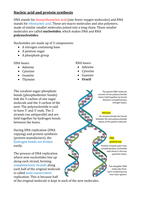
The covalent sugar-phosphate
bonds (phosphodiester bonds)
link the 5-carbon of one sugar
molecule and the 3-carbon of the
next. The polynucleotide is said
to have 5’ and 3’ ends. The 2
Helicase
strands run antiparallel and are
held together by hydrogen bonds
between the bases.
During DNA replication (DNA
copying) and protein synthesis
(protein manufacture), the DNA
hydrogen bonds are broken polymerase
easily.
The process of DNA replication
where new nucleotides line up
along each strand, forming
complimentary strands along
each half of the original molecule
is called semi-conservative
replication. This is because half
of the original molecule is kept in each of the new molecules.
DNA stands for deoxyribonucleic acid (one fewer oxygen molecules) and RNA
stands for ribonucleic acid. These are macro molecules and also polymers,
made of similar smaller molecules joined into a long chain. These smaller
molecules are called nucleotides, which makes DNA and RNA
polynucleotides.
Nucleotides are made up of 3 components:
A nitrogen containing base
A pentose sugar
A phosphate group
DNA bases: RNA bases:
Adenine Adenine
Cytosine Cytosine
Guanine Guanine
Thymine Uracil
The covalent sugar-phosphate
bonds (phosphodiester bonds)
link the 5-carbon of one sugar
molecule and the 3-carbon of the
next. The polynucleotide is said
to have 5’ and 3’ ends. The 2
Helicase
strands run antiparallel and are
held together by hydrogen bonds
between the bases.
During DNA replication (DNA
copying) and protein synthesis
(protein manufacture), the DNA
hydrogen bonds are broken polymerase
easily.
The process of DNA replication
where new nucleotides line up
along each strand, forming
complimentary strands along
each half of the original molecule
is called semi-conservative
replication. This is because half
of the original molecule is kept in each of the new molecules.


