NAPLEX Practice Questions & Answer With Complete Solution
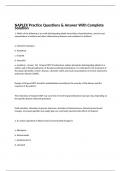
1. Which of the following is an orally disintegrating tablet formulation of prednisolone, used to treat exacerbations of asthma and other inflammatory diseases and conditions in children? a. Celestone Soluspan b. PediaPred c. Orapred d. Vasocidin e. Juvéderm - Answer 1(c). Orapred ODT (Prednisolone sodium phosphate disintegrating tablets) is a sodium salt of the phosphoester of the glucocorticoid prednisolone. It is indicated in the treatment of the atopic dermatitis, Crohn's disease, ulcerative colitis and acute exacerbations of chronic obstructive pulmonary disease (COPD). Dosage of Orapred ODT should be individualized according to the severity of the disease and the response of the patient. The initial dose of Orapred ODT may vary from 10 to 60 mg (prednisolone base) per day, depending on the specific disease entity being treated. Fluid retention, alteration in glucose tolerance, elevation in blood pressure, behavioral and mood changes, increased appetite and weight gain are commonly reported side effects of Orapred. 2. An active ingredient of Ablecet (and recommended dosage) is: a. Rifampicin b. Ketoconazole c. Amphotericin B d. Lisinopril e. Isradipine - Answer 2(c). The active ingredient of Abelcet is Amphotericin B. It is also available under the following trade names: Amphotec (a powder for injection), and Ambisome (a liposomal form). It should be given parenterally via an I.V. infusion. It is an antifungal agent. It is indicated for the treatment of invasive fungal infections caused by invasive aspergillosis. The recommended daily dosage for adults and children is 5 mg/kg given as a single infusion. Abelcet should be administered by intravenous infusion at a rate of 2.5 mg/kg/h. If the infusion time exceeds 2 hours, mix the contents by shaking the infusion bag every 2 hours. Patients should be pretreated with antipyretics, antihistamines, antiemetics and with Meperidine to reduce the signs and symptoms of shaking chills and fever. Abdominal pain, anorexia, anxiety, hypokalemia, anemia, nephrotoxicity and diarrhea are reported side effects of the drug. 5. What is the name of the active ingredient in Xolegel? a. Fluconazole b. Metronidazole c. Ketoconazole d. Itraconazole e. Clotrimazole - Answer 5(c). Xolegel contains the antifungal agent Ketoconazole 2% in a topical anhydrous gel vehicle for topical administration. It is indicated for the topical treatment of seborrheic dermatitis in immuno competent adults and children 12 years of age and older. The gel should be applied once daily to the affected area for 2 weeks. Xolegel is for topical use only, and not for oral, ophthalmic, or intra vaginal use. 9. What is the major difference between Travatan and Travatan Z? a. different active ingredient b. different potency c. different manufacturer d. different preservative e. different drug indication - Answer 9(d). Travatan Z (Travoprost) is a new formulation of Travatan solution in which benzalkonium chloride is replaced with SofZia, a robust ionic buffered preservative system that is gentle to the ocular surface. Travoprost is a synthetic prostaglandin F analogue. It is indicated for the reduction of elevated intraocular pressure in patients with open-angle glaucoma or ocular hypertension, who are intolerant of or insufficiently responsive to other intraocular pressure lowering medications. The recommended dosage is one drop in the affected eye(s) once daily in the evening. It should not be administered more than once daily since it has been shown that more frequent administration of prostaglandin analogs may decrease the intraocular pressure lowering effect. 17. A pharmacist receives a new prescription for Augmentin 500 mg. The prescription reads 1 tab po bid x 10 days. A technician in the pharmacy fills and processes the prescription using 250 mg of Augmentin instead, since the pharmacy is out of stock of 500 mg Augmentin tablets. The pharmacist who is doing the final check of the prescription should: a. Fill the prescription as it is. b. Call the physician and get approval regarding this switch. c. Not fill the prescription. d. Fill the prescription but counsel and inform the patient about this switch. - Answer 17(c). Since both the 250 mg and 500 mg tablets of amoxicillin/clavulanate potassium contain the same amount of clavulanic acid (125 mg, as the potassium salt), two amoxicillin/clavulanate potassium 250 mg tablets are not equivalentto one 500 mg amoxicillin/clavulanate potassium tablet. Therefore two 250 mg amoxicillin/clavulanate potassium tablets should not be substituted for one 500 mg amoxicillin/clavulanate potassium tablet. 18. Which of the following statements is NOT TRUE about vaccines or immunizations? a. Two live vaccines may be given at the same time. b. parenteral or intranasal administration of a live vaccine is not thought to affect the immune response of a subsequently administered oral live vaccine. c. A live vaccine and an inactivated vaccine can be administered without regard to the timing of the other. d. Antipyretics/analgesics such as acetaminophen or ibuprofen should routinely be given prior to immunization to reduce the discomfort. - Answer 18(c). If more than one non-oral live vaccine (e.g., live attenuated influenza vaccine [LAIV], varicella, mumps) needs to be administered, it is recommended that thevaccines be given on the same day. However, if this is not possible, doses of the live vaccines should be separated by at least four weeks. The four-week interval reduces the interference of immune response to the firstvaccine by the second vaccine. This rule for separation does not apply to the administration of oral live vaccines not given on the same day: typhoid and rotavirus. These vaccines can be given less than four weeks apart. However, this scenario isn't likely to occur because the age groups for which these vaccines are recommended do not overlap. In addition, parenteral or intranasal administration of a live vaccine is not thought to affect the immune response of a subsequently administered oral live vaccine. A live vaccine and an inactivated vaccine can be administered without regard to the timing of the other. Antipyretics/analgesics such as acetaminophen or ibuprofen should not routinely be given prior to immunization. They might reduce a patient's immune response. However, if needed, these meds can be used for treatment of fever and pain as needed following vaccination.
Written for
- Institution
- NAPLEX
- Course
- NAPLEX
Document information
- Uploaded on
- August 11, 2023
- Number of pages
- 13
- Written in
- 2023/2024
- Type
- Exam (elaborations)
- Contains
- Questions & answers
Subjects
- naplex
- naplex practice q
-
naplex practice questions amp answer with complete s
-
1 which of the following is an orally disintegrat

Also available in package deal