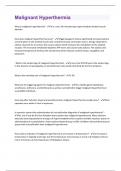
Malignant Hyperthermia exam Already Passed!!
What is malignant hyperthermia? - It is a rare, life-threatening, hypermetabolic skeletal muscle disorder. How does malignant hyperthermia occur? - Triggering agents induce significantly increased calcium concentrations in the skeletal muscle cells. Sustained muscle contraction occurs. Energy-dependent calcium channels try to remove the excess calcium which increases the metabolism of the skeletal muscles. The increased metabolism depletes ATP stores and causes lactic acidosis. The acidosis and increased temperature destroys the sarcolemma which releases creatine kinase, myoglobin, and potassium. : What is the earliest sign of malignant hyperthermia? - A rise in the ETCO2 level is the earliest sign. In the absence of capnography, an elevated heart rate would most likely be the first symptom. What is the mortality rate of malignant hyperthermia? - 1-5% What are the triggering agents for malignant hyperthermia? - The volatile agents (halothane, sevoflurane, isoflurane, and desflurane) as well as succinylcholine trigger malignant hyperthermia in susceptible individuals. How long after induction of general anesthesia does malignant hyperthermia usually occur? - Most episodes occur within 1 hour of exposure. Is masseter spasm after administration of succinylcholine diagnostic of malignant hyperthermia? - No, but it may be the first indication that a patient has malignant hyperthermia. Many clinicians advocate observing closely for any signs of hypermetabolism after a patient exhibits masseter spasm on administration of succinylcholine. Some studies indicate that up to 50% of children who exhibit masseter spasm with succinylcholine have malignant hyperthermia. How early an indicator of malignant hyperthermia is an increase in temperature? - An increase in temperature is typically a late sign, but the temperature may increase as much as 0.5 degrees Celsius every 15 minutes up to temperatures of 46 degrees Celsius.How is malignant hyperthermia transmitted genetically? - It is an autosomal dominant genetic disorder.
Written for
- Institution
- Malignant Hyperthermia
- Course
- Malignant Hyperthermia
Document information
- Uploaded on
- August 10, 2023
- Number of pages
- 4
- Written in
- 2023/2024
- Type
- Exam (elaborations)
- Contains
- Questions & answers
Subjects

Also available in package deal