Malignant Hyperthermia | Questions and Answers(A+ Solution guide)
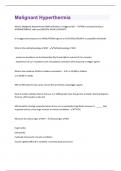
What is Malignant Hyperthermia (MH) and what is it triggered by? - MH is characterized by a HYPERMETABOLIC state and SKELETAL MUSCLE RIGIDITY It is triggered by exposure to INHALATIONAL agents or SUCCINYLCHOLINE in susceptible individuals What is the pathophysiology of MH? - Pathophysiology of MH: - numerous mutations on the Ryanodine (Ryr1) and alpha 1 subunit of Ca+ receptor - impairment of Ca+ reuptake by the sarcoplasmic reticulum when exposed to trigger agents What is the incidence of MH in children and adults? - 1 in 15,000 in children 1 in 50,000 in adults 50% of MH patients had a prior uneventful anesthetic using trigger agents Recent studies indiciate that as many as 1 in 3,000 people have the genetic mutation that predisposes them to a MH reaction under GA MH should be strongly suspected when there is an unanticipated significant increase in ______ that responds only to a very large increase in minute ventilation - ETCO2 What are the clinical signs of MH? - Clinical signs of MH: hypercarbia tachycardia markedly increased in minute ventilation muscle rigidity (difficult to ventilate, increased peak pressures)skin mottling hyperthermia (may be a late sign - d/t inc in muscle metabolism = heat production) brown urine DIC What are some laboratory findings of MH? - Laboratory findings of MH: inc PaCO2 inc CK inc plasma lactate dec PaO2 acidosis hyperkalemia (potassium leaks out of the muscle cells) myoglobin in blood or urine (from cell death and rhabdomyolysis - precipitates in renal tubules causes urinary obstruction and RF) abn coags What are some steps for treatment of MH? - Steps for treating MH:
Written for
- Institution
- Malignant Hyperthermia
- Course
- Malignant Hyperthermia
Document information
- Uploaded on
- August 10, 2023
- Number of pages
- 9
- Written in
- 2023/2024
- Type
- Exam (elaborations)
- Contains
- Questions & answers
Subjects

Also available in package deal