NURSING 112023 basic adult health Final Exam Review- Keiser University
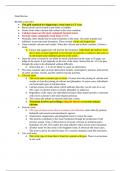
Final Review RENAL CALCULI The gold standard for diagnosing a renal stone is CT scan. Renal calculi can be found in the ureter or bladder. Stones form when calcium and oxalate in the urine combine. Calcium stones are the most commonly formed stones. Struvite stones commonly result from a UTI. Normally, there should not be stone formation in the urine. Our urine actually has inhibitors to prevent stone formation. These include citrate and magnesium. Urine contains calcium and oxalate. When the calcium and oxalate combine, it forms a stone. o Citrate and magnesium will prevent the formation. Individuals get kidneys stone due to lack of water ingestion or by increase of particles or solutes in the urine or by decreased stone inhibitors present in the urine. Once the stone is formed it can either be easily eliminated in the urine or if large, can lodge in the ureter. It just depends on the size of the stone. Stones that are 0.5 cm pass through the urine to be eliminated without difficulty. o Stones that are 1.0 cm are likely to cause an obstruction. The most common sites of stone obstruction include: ureteropelvic junction, intersection of ureter and iliac vessels, and the ureterovesicular junction. Calcium stone o This is the most common type of stone. It forms from the joining of calcium and oxalate or from the joining of calcium and phosphate. In some cases, individuals can form both types of calcium stone. o Calcium stones are radio dense which indicates that they can be seen on x-ray. The cause of calcium stones is mostly idiopathic or unknown. o Regardless of the cause, the individual becomes either hypercalcemic or presents with excess calcium in the urine (hypercalciuria). o This causes the solutes to increase and form a stone. o Treatment involves prescribing a thiazide diuretic to excrete urinary
Document information
- Uploaded on
- August 2, 2023
- Number of pages
- 72
- Written in
- 2023/2024
- Type
- Exam (elaborations)
- Contains
- Questions & answers