Legislations, regulations and how they govern safeguarding for adults
Legislation/regulation (P4) How it governs safeguarding adults (P4)
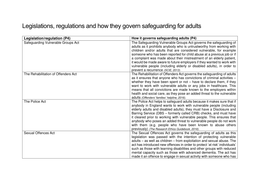
Safeguarding Vulnerable Groups Act The Safeguarding Vulnerable Groups Act governs the safeguarding of
adults as it prohibits anybody who is untrustworthy from working with
children and/or adults that are considered vulnerable, for example
someone who has been reported for child abuse at a previous job or if
a complaint was made about their mistreatment of an elderly patient,
it would be made aware to future employers if they wanted to work with
vulnerable people (including elderly or disabled adults), in order to
prevent a recurrence (SCIE, 2013).
The Rehabilitation of Offenders Act The Rehabilitation of Offenders Act governs the safeguarding of adults
as it ensures that anyone who has convictions of criminal activities –
whether they have been spent or not – have to declare them, if they
want to work with vulnerable adults or any jobs in healthcare. This
means that all convictions are made known to the employers within
health and social care, as they pose an added threat to the vulnerable
adults (Offenders’ families’ helpline, 2016).
The Police Act The Police Act helps to safeguard adults because it makes sure that if
anybody in England wants to work with vulnerable people (including
elderly adults and disabled adults), they must have a Disclosure and
Barring Service (DBS – formerly called CRB) checks, and must have
it cleared prior to working with vulnerable people. This ensures that
anybody who poses an added threat to vulnerable people do not work
with them (e.g. people who have been known to abuse others
previously) (The Research Ethics Guidebook, 2016).
Sexual Offences Act The Sexual Offences Act governs the safeguarding of adults as this
legislation was passed with the intention of protecting vulnerable
adults – as well as children – from exploitation and sexual abuse. The
act has introduced new offences in order to protect ‘at risk’ individuals’
such as those with learning disabilities and other groups with reduced
mental capacity such as those with advanced dementia. The act has
made it an offence to engage in sexual activity with someone who has
Legislation/regulation (P4) How it governs safeguarding adults (P4)
Safeguarding Vulnerable Groups Act The Safeguarding Vulnerable Groups Act governs the safeguarding of
adults as it prohibits anybody who is untrustworthy from working with
children and/or adults that are considered vulnerable, for example
someone who has been reported for child abuse at a previous job or if
a complaint was made about their mistreatment of an elderly patient,
it would be made aware to future employers if they wanted to work with
vulnerable people (including elderly or disabled adults), in order to
prevent a recurrence (SCIE, 2013).
The Rehabilitation of Offenders Act The Rehabilitation of Offenders Act governs the safeguarding of adults
as it ensures that anyone who has convictions of criminal activities –
whether they have been spent or not – have to declare them, if they
want to work with vulnerable adults or any jobs in healthcare. This
means that all convictions are made known to the employers within
health and social care, as they pose an added threat to the vulnerable
adults (Offenders’ families’ helpline, 2016).
The Police Act The Police Act helps to safeguard adults because it makes sure that if
anybody in England wants to work with vulnerable people (including
elderly adults and disabled adults), they must have a Disclosure and
Barring Service (DBS – formerly called CRB) checks, and must have
it cleared prior to working with vulnerable people. This ensures that
anybody who poses an added threat to vulnerable people do not work
with them (e.g. people who have been known to abuse others
previously) (The Research Ethics Guidebook, 2016).
Sexual Offences Act The Sexual Offences Act governs the safeguarding of adults as this
legislation was passed with the intention of protecting vulnerable
adults – as well as children – from exploitation and sexual abuse. The
act has introduced new offences in order to protect ‘at risk’ individuals’
such as those with learning disabilities and other groups with reduced
mental capacity such as those with advanced dementia. The act has
made it an offence to engage in sexual activity with someone who has