Legislation, Codes of practice and policies.
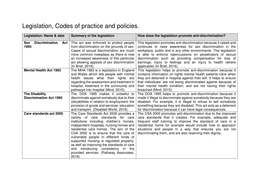
Legislation: Name & date Summary of the legislation How does the legislation promote anti-discrimination?
Sex Discrimination Act This act was enforced to protect people This legislation promotes anti-discrimination because it raised and
1995 from discrimination on the grounds of sex. continues to raise awareness for sex discrimination in the
Cases of sexual discrimination are much workplace, public and in any other environments. This legislation
more common nowadays as there is now is able to enforce repercussions on perpetrators of sexual
an increased awareness of this particular discrimination such as providing compensation for loss of
act allowing appeals of sex discrimination earnings, injury to feelings and an injury to health (where
(In Brief, 2016). applicable) (In Brief, 2016).
Mental Health Act 1983 The MHA 1983 is a legislation in England This legislation helps to promote anti-discrimination because it
and Wales which lets people with mental contains information on rights mental health patients have when
health issues what their rights are they are detained in hospital against their will. It helps to ensure
regarding the assessment and treatment in that individuals’ are not being discriminated against because of
hospital, treatment in the community and their mental health condition, and are not having their rights
pathways into hospital (Mind, 2015). breached (Mind, 2015)
The Disability The DDA 1995 makes it unlawful to The DDA 1995 helps to promote anti-discrimination because it
Discrimination Act 1995 discriminate against somebody due to their made it illegal to discriminate against somebody because they are
(dis)abilities in relation to employment, the disabled. For example, it is illegal to refuse to sell somebody
provision of goods and services, education something because they are disabled. This act acts as a deterrent
and transport. (Disabled World, 2016). for discrimination because it can have legal consequences.
Care standards act 2000 The Care Standards Act 2000 provides a The CSA 2000 promotes anti-discrimination due to the improved
variety of care standards for care care standards that it creates. For example, adequate and
institutions including children’s homes, frequent staff training to improve the standard of care in a
independent hospitals, nursing homes and residential home for example would include how to approach
residential care homes. The aim of the situations and people in a way that ensures you are not
CSA 2000 is to ensure that the care of discriminating them, and are also reserving their dignity.
vulnerable people in different kinds of
supported housing is regulated properly,
as well as improving the standards of care
and introducing consistency in the
provided services. (Pathway Associates,
2016).
Legislation: Name & date Summary of the legislation How does the legislation promote anti-discrimination?
Sex Discrimination Act This act was enforced to protect people This legislation promotes anti-discrimination because it raised and
1995 from discrimination on the grounds of sex. continues to raise awareness for sex discrimination in the
Cases of sexual discrimination are much workplace, public and in any other environments. This legislation
more common nowadays as there is now is able to enforce repercussions on perpetrators of sexual
an increased awareness of this particular discrimination such as providing compensation for loss of
act allowing appeals of sex discrimination earnings, injury to feelings and an injury to health (where
(In Brief, 2016). applicable) (In Brief, 2016).
Mental Health Act 1983 The MHA 1983 is a legislation in England This legislation helps to promote anti-discrimination because it
and Wales which lets people with mental contains information on rights mental health patients have when
health issues what their rights are they are detained in hospital against their will. It helps to ensure
regarding the assessment and treatment in that individuals’ are not being discriminated against because of
hospital, treatment in the community and their mental health condition, and are not having their rights
pathways into hospital (Mind, 2015). breached (Mind, 2015)
The Disability The DDA 1995 makes it unlawful to The DDA 1995 helps to promote anti-discrimination because it
Discrimination Act 1995 discriminate against somebody due to their made it illegal to discriminate against somebody because they are
(dis)abilities in relation to employment, the disabled. For example, it is illegal to refuse to sell somebody
provision of goods and services, education something because they are disabled. This act acts as a deterrent
and transport. (Disabled World, 2016). for discrimination because it can have legal consequences.
Care standards act 2000 The Care Standards Act 2000 provides a The CSA 2000 promotes anti-discrimination due to the improved
variety of care standards for care care standards that it creates. For example, adequate and
institutions including children’s homes, frequent staff training to improve the standard of care in a
independent hospitals, nursing homes and residential home for example would include how to approach
residential care homes. The aim of the situations and people in a way that ensures you are not
CSA 2000 is to ensure that the care of discriminating them, and are also reserving their dignity.
vulnerable people in different kinds of
supported housing is regulated properly,
as well as improving the standards of care
and introducing consistency in the
provided services. (Pathway Associates,
2016).