Operations management
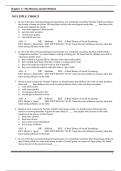
1. What activities does operations management involve? ANSWER: Operations management consists of all activities required to produce goods and services. Research and development, planning production, controlling operations, managing product quality, purchasing and monitoring inventory, managing production costs, and using technology to improve productivity are all activities of operations. POINTS: 1 DIFFICULTY: Moderate REFERENCES: pp. 207-208 LEARNING OBJECTIVES: FOBU.PRIDE.15.8-1 NATIONAL STANDARDS: United States - BUSPROG: Analytic TOPICS: What is Production? KEYWORDS: Bloom's: Comprehension 2. Briefly assess the good and bad news of the current U.S. manufacturing environment. ANSWER: The bad news is that many manufacturing jobs have been outsourced to low-wage workers in overseas countries, the cost of U.S. manufacturing is approximately 20 percent higher, and the number of unemployed factory workers increased during the recent economic crisis. The good news is that U.S. manufacturers produce approximately 18 percent of total global manufacturing output and contribute approximately $2 trillion to the U.S. economy each year. Also, manufacturing exports are nearly 60 percent of all U.S. exports, and it is anticipated that there will be 2 million job openings in manufacturing through 2018. Finally, for every manufacturing job created, there are another three jobs created in the supply chain, the trucking industry, and other related areas of the economy. POINTS: 1 DIFFICULTY: Challenging REFERENCES: pp. 208-209 LEARNING OBJECTIVES: FOBU.PRIDE.15.8-1 NATIONAL STANDARDS: United States - AACSB: Reflective Thinking TOPICS: What is Production? KEYWORDS: Bloom's: Synthesis 3. What is meant by the magnitude of a conversion process? ANSWER: The magnitude of a conversion process is the degree to which the resources are physically changed. There is a wide range of magnitude. At one extreme is taking raw materials and changing them into something completely unrecognizable when turned into a final product. At the other extreme is a service such as airline service that produces no physical change. POINTS: 1 DIFFICULTY: Moderate REFERENCES: p. 211 LEARNING OBJECTIVES: FOBU.PRIDE.15.8-2 NATIONAL STANDARDS: United States - BUSPROG: Analytic TOPICS: The Conversion Process KEYWORDS: Bloom's: Knowledge 4. Explain how the production of services is different from the production of manufactured goods. ANSWER: Customers are more involved in obtaining the services they want when compared to manufactured products. Services are consumed immediately unlike products. Most often, services are provided when and where customers desire them; products are not. Services are usually labor-intensive. Services are intangible and, therefore, it is more difficult to evaluate customer satisfaction. POINTS: 1 DIFFICULTY: Moderate REFERENCES: p. 213 LEARNING OBJECTIVES: FOBU.PRIDE.15.8-3 NATIONAL STANDARDS: United States - BUSPROG: Analytic TOPICS: The Increasing Importance of Services KEYWORDS: Bloom's: Comprehension 5. Provide an example of a product that has refined the want-satisfying capability of its product and a second product that has extended the capability of its product. ANSWER: Answers will vary. Television sets have been continually refined so that they provide a clearer, sharper picture with less dial adjusting. Computers could also be an example of a product that has been refined. Television sets have also been extended in that there are now TVs with DVDs, Blu-Ray players, and Internet streaming. Computers also come with a wide variety of attached and integrated devices. POINTS: 1 DIFFICULTY: Moderate REFERENCES: pp. 214-215 LEARNING OBJECTIVES: FOBU.PRIDE.15.8-4 NATIONAL STANDARDS: United States - AACSB: Reflective Thinking TOPICS: Where Do New Products and Services Come From? KEYWORDS: Bloom's: Application KEYWORDS: Bloom's: Knowledge 6. Define design planning. How does it differ from operational planning? ANSWER: Design planning is the development of a plan for converting an idea into an actual product or service. Design planning is a bigger, overall plan of converting an idea into a reality whereas operational planning is a smaller plan that provides finer details at a more specific level of deciding on the amount of products or services each production facility will produce during a specific time period. POINTS: 1 DIFFICULTY: Moderate REFERENCES: pp. 215; 219 LEARNING OBJECTIVES: FOBU.PRIDE.15.8-5 NATIONAL STANDARDS: United States - BUSPROG: Analytic TOPICS: How Do Managers Plan Production? KEYWORDS: Bloom's: Comprehension 7. Compare and contrast the ideas of labor-intensive and capital-intensive technology. ANSWER: Labor-intensive technology is a process in which people must do most of the work and capital-intensive technology is a process in which machines and equipment do most of the work. The contrast is between human resources or equipment and technology. Student answers may also include information about the cost of labor and capital intensive technology. Typically, capital-intensive technology has high initial costs and lower operating costs. On the other hand, labor-intensive technology has low initial costs and higher operating costs. POINTS: 1 DIFFICULTY: Easy REFERENCES: p. 216 LEARNING OBJECTIVES: FOBU.PRIDE.15.8-5 NATIONAL STANDARDS: United States - AACSB: Reflective Thinking TOPICS: How Do Managers Plan Production? KEYWORDS: Bloom's: Analysis 8. When does a firm incur holding costs? When does it incur stock-out costs? ANSWER: Holding costs, or storage costs, are incurred when a purchased item arrives and must be stored as inventory. Stock-out costs are the cost a business experiences when it runs out of inventory. That cost occurs when an item is not physically in stock in inventory. POINTS: 1 DIFFICULTY: Easy REFERENCES: p. 221 LEARNING OBJECTIVES: FOBU.PRIDE.15.8-6 NATIONAL STANDARDS: United States - BUSPROG: Analytic TOPICS: Operations Control 9. How do routing and timing affect the scheduling process for a furniture manufacturer like Drexel-Heritage? ANSWER: Routing of materials is the sequence of workstations that raw materials and work in process will follow. Operations managers route needed wood for a Drexel-Heritage chair through workstations along an assembly line, with the table finally ending up at finished goods inventory. Timing specifies when the wood, for example, will arrive at each workstation and how long it will remain there. POINTS: 1 DIFFICULTY: Moderate REFERENCES: p. 222 LEARNING OBJECTIVES: FOBU.PRIDE.15.8-6 NATIONAL STANDARDS: United States - BUSPROG: Analytic TOPICS: Operations Control KEYWORDS: Bloom's: Comprehension
Written for
- Institution
- Operations management
- Course
- Operations management
Document information
- Uploaded on
- July 5, 2023
- Number of pages
- 92
- Written in
- 2022/2023
- Type
- Exam (elaborations)
- Contains
- Questions & answers
Subjects