
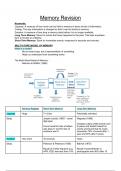
Memory Revision
Keywords:
Capacity: A measure of how much can be held in memory in terms of bits of information.
Coding: The way information is changed so that it can be stored in memory.
Duration: A measure of how long a memory lasts before it is no longer available.
Long Term Memory: Store for events that have happened in the past. This lasts anywhere
from 2 minutes to a lifetime.
Short Term Memory: Store for immediate events, measured in seconds and minutes.
MULTI-STORE MODEL OF MEMORY
What is a model?
- Not an exact copy, but a representation of something
- Helps us understand how something works
The Multi-Store Model of Memory:
- Atkinson & Shiffrin (1968)
Sensory Register Short Term Memory Long Term Memory
Capacity Huge 7+-2 bits Potentially unlimited
Study Jospeh Jacobs (1887) - serial Wagnaar (1986)
digit span
Created a diary (2400 events over
Found recall for lists of letters 6 years) and tested himself on
was about 7 and for lists of events and found that he could
numbers was 9. remember 75% of events after 1
year and 45% after 5 years.
Duration Very short 18 seconds Years
Study Peterson & Peterson (1959) Bahrick (1975)
Recall of 3 letter trigrams (e.g. Recall of schoolfriends in
HFR, PZE) was less than 10% photographs was 90% after 15
, after 18 seconds of performing years and still 80% for names
an interference task (e.g. after 48 years in participants aged
counting backwards). 17-74.
Coding Depends on the Acoustically Semantically
context
Study Baddely (1966)
4 lots of 10-word lists to 4 groups. Word lists were either
semantically similar or dissimilar (1 & 2) or acoustically similar or
dissimilar (3 & 4). He found that recall immediately was worse for
acoustically similar and recall after 20 mins were worse with
semantically similar words.
Sensory register:
- The sensory register regards the information at the senses (e.g. eyes)
- Information is retained for a very brief period of time (less than half a second) until it
is forgotten – unless we pay attention to it
- The capacity of SR is very large (e.g. all the cells on the retina of the eye)
- Coding depends of the part being used (e.g. visual coding for eyes)
Primacy effect: things that have enough time to be rehearsed
Recency effects: things that are still in your STM
Glanzer & Cunitz (1966) The serial position effect
● AIM: To provide evidence for a distinction between STM and LTM
● Procedure: Gave participants a list of 20 words, presented one at a time, and asked
them to recall words they remembered at the end.
● Findings: Participants remembered words from the beginning of the list (Primacy
effect) and words at the end of the list (Recency Effect) but were less good at
recalling words in the middle.
● + Conclusions: The primary effect occurs because the first words are best
Rehearsed and transferred to LTM. The Recency Effect occurs because these words
are in STM when you have to recall the list! This supplies evidence for a distinction
between STM and LTM stores and therefore provides evidence for Atkinson &
Shiffrin’s MSM
The Multi-Store model of memory is a structural model of memory. It is comprised of 3
unitary stores, all of which vary in terms of encoding, duration and capacity. Research
suggests that STM (short-term memory) encodes acoustically, has a duration of about 18
seconds and a capacity of around 7 items. LTM (long term memory) encodes semantically,
has a duration of many years and has a potentially unlimited capacity. Information passes
from store to store in a linear way. Environmental information (e.g. via your ears) arrives at
your Sensory memory (SM). If Attention is not paid, then the information will decay rapidly.
Paying attention causes transference of information to STM. The original model suggests
rehearsing information in STM causes it to transfer to your LTM. Insufficient rehearsal
Keywords:
Capacity: A measure of how much can be held in memory in terms of bits of information.
Coding: The way information is changed so that it can be stored in memory.
Duration: A measure of how long a memory lasts before it is no longer available.
Long Term Memory: Store for events that have happened in the past. This lasts anywhere
from 2 minutes to a lifetime.
Short Term Memory: Store for immediate events, measured in seconds and minutes.
MULTI-STORE MODEL OF MEMORY
What is a model?
- Not an exact copy, but a representation of something
- Helps us understand how something works
The Multi-Store Model of Memory:
- Atkinson & Shiffrin (1968)
Sensory Register Short Term Memory Long Term Memory
Capacity Huge 7+-2 bits Potentially unlimited
Study Jospeh Jacobs (1887) - serial Wagnaar (1986)
digit span
Created a diary (2400 events over
Found recall for lists of letters 6 years) and tested himself on
was about 7 and for lists of events and found that he could
numbers was 9. remember 75% of events after 1
year and 45% after 5 years.
Duration Very short 18 seconds Years
Study Peterson & Peterson (1959) Bahrick (1975)
Recall of 3 letter trigrams (e.g. Recall of schoolfriends in
HFR, PZE) was less than 10% photographs was 90% after 15
, after 18 seconds of performing years and still 80% for names
an interference task (e.g. after 48 years in participants aged
counting backwards). 17-74.
Coding Depends on the Acoustically Semantically
context
Study Baddely (1966)
4 lots of 10-word lists to 4 groups. Word lists were either
semantically similar or dissimilar (1 & 2) or acoustically similar or
dissimilar (3 & 4). He found that recall immediately was worse for
acoustically similar and recall after 20 mins were worse with
semantically similar words.
Sensory register:
- The sensory register regards the information at the senses (e.g. eyes)
- Information is retained for a very brief period of time (less than half a second) until it
is forgotten – unless we pay attention to it
- The capacity of SR is very large (e.g. all the cells on the retina of the eye)
- Coding depends of the part being used (e.g. visual coding for eyes)
Primacy effect: things that have enough time to be rehearsed
Recency effects: things that are still in your STM
Glanzer & Cunitz (1966) The serial position effect
● AIM: To provide evidence for a distinction between STM and LTM
● Procedure: Gave participants a list of 20 words, presented one at a time, and asked
them to recall words they remembered at the end.
● Findings: Participants remembered words from the beginning of the list (Primacy
effect) and words at the end of the list (Recency Effect) but were less good at
recalling words in the middle.
● + Conclusions: The primary effect occurs because the first words are best
Rehearsed and transferred to LTM. The Recency Effect occurs because these words
are in STM when you have to recall the list! This supplies evidence for a distinction
between STM and LTM stores and therefore provides evidence for Atkinson &
Shiffrin’s MSM
The Multi-Store model of memory is a structural model of memory. It is comprised of 3
unitary stores, all of which vary in terms of encoding, duration and capacity. Research
suggests that STM (short-term memory) encodes acoustically, has a duration of about 18
seconds and a capacity of around 7 items. LTM (long term memory) encodes semantically,
has a duration of many years and has a potentially unlimited capacity. Information passes
from store to store in a linear way. Environmental information (e.g. via your ears) arrives at
your Sensory memory (SM). If Attention is not paid, then the information will decay rapidly.
Paying attention causes transference of information to STM. The original model suggests
rehearsing information in STM causes it to transfer to your LTM. Insufficient rehearsal


