Practice Exam
MVDA
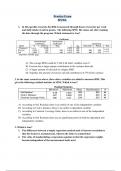
1. In this specific research, the BMI is measured through hours of exercise per week
and daily intake of salt in grams. The following SPSS file comes out after running
the data through the program. Which statement is true?
A) The average BMI would be 5.108 if all other variables were 0
B) Exercise has a larger unique contribution to the variance than salt
C) A larger amount of salt leads to a higher BMI
D) Together, the amount of exercise and salt contribute to 0.770 of the variance
2. In the same research as above, three other variables are added to measure BMI. This
gives the following residual statistics in SPSS. Which is true?
A) According to Std. Residual, there is an outlier in one of the independent variables
B) According to Cook’s distance, there is an outlier in dependent variable
C) According to Centered Leverage Value, there is an outlier in one of the independent
variables
D) According to Std. Residual, there are no significant points in both the dependent and
independent variables.
3. Which is true?
1. The difference between a simple regression analysis and a Pearson correlation is
that the former is asymmetrical, whereas the latter is symmetrical
2. The value of standardizing a regression equation is that the regression weights
become independent of the measurement units used
, A) Only 1 is true
B) Only 2 is true
C) Both 1 & 2 are true
D) Neither 1 & 2 are true
4. What is not impacted when the assumptions of a regression model are violated?
A) The estimates of coefficients
B) F values of test
C) Standard errors of coefficients
D) All of the above are impacted
5. Which two measurement levels do we find when conducting MRA?
A) Interval + Interval
B) Nominal + Interval
C) Binary + Interval
D) Ordinal + Interval
6. What does this ANOVA formula tell us?
Yij =μ+αj +εij.
A) The null hypothesis would be αi = αj
B) We are performing a two-way ANOVA
C) We are performing a one-way ANOVA
D) We are looking for large within-group variations
7. What is true about this table?
A) The F-test of age would be 8.5,
and is significant
B) The F-test of age would be 8.5,
and is not significant
C) The F-test of age would be
0.364 and is significant
D) The F-test of age would be
0.364 and is not significant
8. When still looking at the same
table as in question 6, what has the biggest effect size; age, gender, or the interaction effect
of the two?
A) Age
B) Gender
MVDA
1. In this specific research, the BMI is measured through hours of exercise per week
and daily intake of salt in grams. The following SPSS file comes out after running
the data through the program. Which statement is true?
A) The average BMI would be 5.108 if all other variables were 0
B) Exercise has a larger unique contribution to the variance than salt
C) A larger amount of salt leads to a higher BMI
D) Together, the amount of exercise and salt contribute to 0.770 of the variance
2. In the same research as above, three other variables are added to measure BMI. This
gives the following residual statistics in SPSS. Which is true?
A) According to Std. Residual, there is an outlier in one of the independent variables
B) According to Cook’s distance, there is an outlier in dependent variable
C) According to Centered Leverage Value, there is an outlier in one of the independent
variables
D) According to Std. Residual, there are no significant points in both the dependent and
independent variables.
3. Which is true?
1. The difference between a simple regression analysis and a Pearson correlation is
that the former is asymmetrical, whereas the latter is symmetrical
2. The value of standardizing a regression equation is that the regression weights
become independent of the measurement units used
, A) Only 1 is true
B) Only 2 is true
C) Both 1 & 2 are true
D) Neither 1 & 2 are true
4. What is not impacted when the assumptions of a regression model are violated?
A) The estimates of coefficients
B) F values of test
C) Standard errors of coefficients
D) All of the above are impacted
5. Which two measurement levels do we find when conducting MRA?
A) Interval + Interval
B) Nominal + Interval
C) Binary + Interval
D) Ordinal + Interval
6. What does this ANOVA formula tell us?
Yij =μ+αj +εij.
A) The null hypothesis would be αi = αj
B) We are performing a two-way ANOVA
C) We are performing a one-way ANOVA
D) We are looking for large within-group variations
7. What is true about this table?
A) The F-test of age would be 8.5,
and is significant
B) The F-test of age would be 8.5,
and is not significant
C) The F-test of age would be
0.364 and is significant
D) The F-test of age would be
0.364 and is not significant
8. When still looking at the same
table as in question 6, what has the biggest effect size; age, gender, or the interaction effect
of the two?
A) Age
B) Gender