

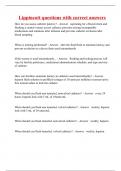
Lippincott questions with correct answers
How do you assess catheter patency? - Answer aspirating for a blood return and flushing a central venous access catheter; prevents mixing incompatible medications and solutions after infusion and prevents catheter occlusion after blood sampling When is locking performed? - Answer after the final flush to maintain latency and prevent occlusion in a device thats used intermittently If the system is used intermittently... - Answer flushing and locking process will vary by facility preference, medication administration schedule, and type and size of catheter How can facilities maintain latency in catheters used intermittently? - Answer heparin flush solution in prefilled syringes of 10 units per milliliter or preservative free normal saline to lock the catheter When should you flush non tunneled ,nonvalved catheters? - Answer every 24 hours; heparin lock with 5 mL of 10units/mL When should you flush non tunneled, valved catheters? - Answer weekly; heparin lock with 5 mL of 10 units/mL When should you flush tunneled, nonvalved catheters? - Answer weekly; heparin When should you flush tunneled, valved catheters? - Answer weekly; heparin
Document information
- Uploaded on
- June 18, 2023
- Number of pages
- 16
- Written in
- 2022/2023
- Type
- Exam (elaborations)
- Contains
- Questions & answers


