OCR GCSE 8.2 MATHS QUADRATIC EQUATIONS EXAM
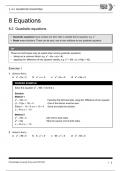
8.2 Quadratic equations ©Cambridge University Press and OCR 2021 1 8 Equations 8.2 Quadratic equations • Quadratic equations have at least one term with a variable that is squared, e.g. x2 . • Roots mean solutions. There can be zero, one or two solutions to any quadratic equation. TIP These two techniques may be useful when solving quadratic equations: • taking out a common factor, e.g. • applying the ‘difference of two squares’ identity, e.g. . Exercise 1 1 Solve to find x. a b c d WORKED EXAMPLE Solve the equation to find x. Solution Method 1 Factorise the left-hand side, using the ‘difference of two squares’. (x − 10)(x + 10) = 0 One of the factors must be zero. Either x − 10 = 0 or x + 10 = 0 Solve and state the solution. x = 10 or x = −10 Method 2 Add 100 to both sides. Take the square root of both sides. x = 10 or x = −10 2 Solve to find x. a b c d 8.2 Quadratic equations ©Cambridge University Press and OCR 2021 2 WORKED EXAMPLE Solve the equation by factorising. Solution Factorise the left-hand side. Write: (x ... ...)(x ... ...) = 0 Find pairs of factors that multiply to give + 12: 1 × 12, −1 × −12 , 2 × 6, −2 × −6 , 3 × 4 and −3 × −4 Identify which pair of factors add together to give −8: −2 and −6 (x − 2)(x − 6) = 0 One of the factors must be zero. Either x − 2 = 0 or x − 6 = 0 Solve and state the solution. x = 2 or x = 6 3 Solve by factorising. a b c d 4 Solve by factorising. a b c d e f g h WORKED EXAMPLES A rectangle with an area of 12cm2 has one side 4cm longer than the other. a If the width of the rectangle is x, use the information to write an equation. b Solve your equation to find x. c Find the length and width of the rectangle. Solution Draw a diagram and label the sides. Let the shorter side be x, so the longer side is x + 4. The area of any rectangle is length × width. a Equation: x(x + 4) = 12 b x(x + 4) = 12 First expand the brackets. Subtract 12 from both sides. Factorise the left-hand side. (x − 2)(x + 6) = 0 One of the factors must be zero. Either x − 2 = 0 or x + 6 = 0 x = 2 or x = −6 c The sides of a rectangle cannot have negative measurements, so in this case we should reject x = −6. We then use x = 2 to find the measurements. So, the width of the rectangle is 2cm and its length is 2 + 4 = 6cm
Written for
- Institution
- GCSE
- Course
- GCSE
Document information
- Uploaded on
- June 17, 2023
- Number of pages
- 3
- Written in
- 2022/2023
- Type
- Exam (elaborations)
- Contains
- Questions & answers
Subjects
- 1 solve to find x
-
82 quadratic equations
-
3 solve by factorising a b c d

Also available in package deal