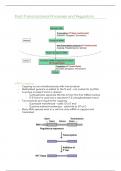
Levels of Gene Control
Gene control in eukaryotes
- Higher eukaryotes have a complex body, diverse cell types, tissues and
organs
- Have very precise spatial organisation and different functions
- All cells of a particular organism have an identical DNA content - how is
diversity possible?
- Diversity results from differences in gene expression not a difference in
DNA content
Regulation of gene expression
- Differences in appearance and function is under control of complex
regulatory processes on a molecular level
- Differential gene expression specifies when, where and how much of a
particular transcript and/or protein is formed
- It is responsible for the differentiation of organs and tissues in
embryonic development
- Is the result of responses to particular cellular signals (growth factor,
hormones etc.) as well as environmental changes (available nutrients,
exposure to heat etc.)
- Abnormalities in gene expression can lead to imbalances and genetic
diseases including cancer
- The human genome size is 3.2 billion bp of DNA
- Each cell constraints around 2 metres of DNA
- Only 1.5% encodes for proteins with the rest encoding for regulatory
and structural regions
Gene expression is controlled at different levels
- Genome level - the number of gene copies available
- Transcription level - number of mRNA copies transcribed per gene
- Post-transcription level - number of stable mRNA copies in the
cytoplasm
- Translation level - number of proteins translated per mRNA copy
- Post-translational level - number of protein copies modified after
translation
How to demonstrate gene control
- The primary gene products in the cell are mRNA, rRNA, tRNA and
proteins
- Research is focused on how and why genes are regulated
- There are many different strategies to study gene control
- Techniques to study regulation on mRNA level
- Northern blotting
- qRT-PCR
- Microarrays
, - Techniques to study control on a protein level
- PAGE
- Western blotting
- 2D PAGE
- Techniques to study control on a DNA level
- Southern blotting
- DNA sequencing
Methods to investigate protein expression
- Depends if its for an individual protein or for the total protein
composition of cells/tissue types
- Western blotting
- Is used to determine if a particular protein is expressed in a
specific tissue type
- Step 1: separate complex mixture of proteins within cells
- Is done by isolating proteins from tissues A and B
- Separate proteins by gel electrophoresis (SDS-PAGE)
- Proteins are then stained (e.g. Coomassie blue)
- Gel contains all the proteins from cells - too many to
identify a particular protein with certainty
- SDS denatures proteins
- Step 2: “probe” for a particular protein using antibodies
- Transfer the separated proteins to a synthetic membrane
- Incubate membrane with an antibody to that specific
protein
- Detect protein using autoradiography (x-ray)
- If a band appears on page - protein is expressed in tissue
- If a band does not appear - protein is not expressed in tissue
- Protein samples from various tissues analysed by SDS-PAGE are difficult
to identify a particular protein with confidence
- Protein samples analysed by western blotting are more clear and can
detect a specific protein using a protein-specific antibody
, - 2D-PAGE
- Used to investigate the total protein content in a cell
- Proteins are separated by charge and then by size
- Proteins separated by pI value
- Soaking in gel in SDS solution and fitting it onto an SDS PA gel
- 2D has a higher resolution than SDS-PAGE
- Tandem mass spectrometry (MS/MS)
- Used to identify a particular protein after 2D-PAGE
- Excise the protein spot from 2D gel
- Digest the proteins to peptides
- Analyse by mass spectrometry - converts peptides into ions and
then measure their molecular weights
- Use these weights to search
databases of known
proteins - identify protein
producing the spot
Gene control in eukaryotes
- Higher eukaryotes have a complex body, diverse cell types, tissues and
organs
- Have very precise spatial organisation and different functions
- All cells of a particular organism have an identical DNA content - how is
diversity possible?
- Diversity results from differences in gene expression not a difference in
DNA content
Regulation of gene expression
- Differences in appearance and function is under control of complex
regulatory processes on a molecular level
- Differential gene expression specifies when, where and how much of a
particular transcript and/or protein is formed
- It is responsible for the differentiation of organs and tissues in
embryonic development
- Is the result of responses to particular cellular signals (growth factor,
hormones etc.) as well as environmental changes (available nutrients,
exposure to heat etc.)
- Abnormalities in gene expression can lead to imbalances and genetic
diseases including cancer
- The human genome size is 3.2 billion bp of DNA
- Each cell constraints around 2 metres of DNA
- Only 1.5% encodes for proteins with the rest encoding for regulatory
and structural regions
Gene expression is controlled at different levels
- Genome level - the number of gene copies available
- Transcription level - number of mRNA copies transcribed per gene
- Post-transcription level - number of stable mRNA copies in the
cytoplasm
- Translation level - number of proteins translated per mRNA copy
- Post-translational level - number of protein copies modified after
translation
How to demonstrate gene control
- The primary gene products in the cell are mRNA, rRNA, tRNA and
proteins
- Research is focused on how and why genes are regulated
- There are many different strategies to study gene control
- Techniques to study regulation on mRNA level
- Northern blotting
- qRT-PCR
- Microarrays
, - Techniques to study control on a protein level
- PAGE
- Western blotting
- 2D PAGE
- Techniques to study control on a DNA level
- Southern blotting
- DNA sequencing
Methods to investigate protein expression
- Depends if its for an individual protein or for the total protein
composition of cells/tissue types
- Western blotting
- Is used to determine if a particular protein is expressed in a
specific tissue type
- Step 1: separate complex mixture of proteins within cells
- Is done by isolating proteins from tissues A and B
- Separate proteins by gel electrophoresis (SDS-PAGE)
- Proteins are then stained (e.g. Coomassie blue)
- Gel contains all the proteins from cells - too many to
identify a particular protein with certainty
- SDS denatures proteins
- Step 2: “probe” for a particular protein using antibodies
- Transfer the separated proteins to a synthetic membrane
- Incubate membrane with an antibody to that specific
protein
- Detect protein using autoradiography (x-ray)
- If a band appears on page - protein is expressed in tissue
- If a band does not appear - protein is not expressed in tissue
- Protein samples from various tissues analysed by SDS-PAGE are difficult
to identify a particular protein with confidence
- Protein samples analysed by western blotting are more clear and can
detect a specific protein using a protein-specific antibody
, - 2D-PAGE
- Used to investigate the total protein content in a cell
- Proteins are separated by charge and then by size
- Proteins separated by pI value
- Soaking in gel in SDS solution and fitting it onto an SDS PA gel
- 2D has a higher resolution than SDS-PAGE
- Tandem mass spectrometry (MS/MS)
- Used to identify a particular protein after 2D-PAGE
- Excise the protein spot from 2D gel
- Digest the proteins to peptides
- Analyse by mass spectrometry - converts peptides into ions and
then measure their molecular weights
- Use these weights to search
databases of known
proteins - identify protein
producing the spot