The Epigenome: Role of Chromatin Structure in Gene
Control
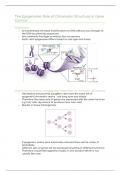
Epigenetics
- Are potentially heritable modifications to DNA without any changes to
the DNA (nucleotide) sequences
- Are commonly heritage by mitosis but not meiosis
- Each cell’s epigenome differs based on cell type and tissue
Mitotically heritability of epigenetic state helps to maintain cell identity
- Heritability ensures that daughter cells have the same set of
epigenetic/chromatin marks - are long term and stable
- Therefore the same sets of genes are expressed with the same function
e.g. liver cells reproduce to produce more liver cells
- Results in tissue homogeneity
- If epigenetic marks were mitotically removed there will be a lack of
heritability
- Different sets of genes will be expressed resulting in different functions
- Therefore tissue heterogeneity results in one location which is not
usually the case
,Heritability is countered by periods when epigenetic markers are
removed
- Epigenetic reprogramming occurs in germ cells and in very early
development
- Active remodelling of epigenetic markers also occur at other periods
during differentiation
Long-term gene control involves epigenetic changes
- Changes are stable but can be reversed
- Epigenetic changes occur before a gene becomes active
- Alters the chromatin structure from 30nm to a more open 10nm
structure
- Involves modifications to both genomic DNA and histones
- Results in a epigenomes which varies between cells and under different
conditions
- Epigenetic reversal/reprogramming facilitate transcription of particular
genes at particular times
,Chromatin structure of active vs inactive genes
- Active/potentially active genes are packaged differently than inactive
genes
- The chromatin of genes being actively transcribed or committed to
transcription has a less dense DNA conformation (open)
- Actively transcribed DNA is associated with histones as 10nm beads on
a string structure
- Nucleosomes are still present behind and in front of RNA pol while a
gene is being transcribed
- Promoter regions of genes that need to be transcribed will open up
even more - nucleosomes can be displaced/removed etc in the
promoter area
- Inactive genes have a 30nm solenoid structure
- Both states are considered euchromatin (makes up 90% of the cell)
Investigating if chromatin structure plays a role in gene regulation
- Use endonucleases to cleave DNA - are more efficient at cleaving
naked/open DNA (10nm structure)
- DNA bound by a protein (30nm and higher order chromatin
conformations) are more difficult to cleave
, - Assays:
- MNase assay
- DNase1 sensitivity assay
- DNase1 hypersensitivity assay
- MNase assay
- Is used to investigate whether nucleosomes have been displaced
or been evicted from a promoter area
- Finds physical positions of nucleosomes in the genome or at a
particular locus
- Cleaves ssDNA and dsDNA
- Cannot access DNA when certain proteins are bound (steric
hindrance)
- Is unable to cleave DNA tied up with nucleosomes - cleaves all
linker regions between nucleosomes but leave the DNA wound
around histones intact
- These regions can be sequenced to determine which regions of
the genome contain nucleosomes
- DNase1 assay
- Loosely packed chromatin is 10x more sensitive to DNase1
digestion than closed chromatin
- Increased sensitivity extends over whole genes and some
distance upstream and downstream of the transcribed region
- DNase1 sensitivity assay measures the state of readiness of a
gene to interact with proteins i.e. commitment or ability to be
transcribed in a particular tissue
- Does not necessarily measure actual transcription taking place
- An open promoter has sites that are 100x more sensitive - called
DNase1 hyper-sensitive sites (DHSs)
- Measures how the chromatin is packaged at a particular locus
e.g. naked DNA, 10nm, 30nm, solenoid, heterochromatin etc
- Cannot access DNA when certain proteins are bound
Control
Epigenetics
- Are potentially heritable modifications to DNA without any changes to
the DNA (nucleotide) sequences
- Are commonly heritage by mitosis but not meiosis
- Each cell’s epigenome differs based on cell type and tissue
Mitotically heritability of epigenetic state helps to maintain cell identity
- Heritability ensures that daughter cells have the same set of
epigenetic/chromatin marks - are long term and stable
- Therefore the same sets of genes are expressed with the same function
e.g. liver cells reproduce to produce more liver cells
- Results in tissue homogeneity
- If epigenetic marks were mitotically removed there will be a lack of
heritability
- Different sets of genes will be expressed resulting in different functions
- Therefore tissue heterogeneity results in one location which is not
usually the case
,Heritability is countered by periods when epigenetic markers are
removed
- Epigenetic reprogramming occurs in germ cells and in very early
development
- Active remodelling of epigenetic markers also occur at other periods
during differentiation
Long-term gene control involves epigenetic changes
- Changes are stable but can be reversed
- Epigenetic changes occur before a gene becomes active
- Alters the chromatin structure from 30nm to a more open 10nm
structure
- Involves modifications to both genomic DNA and histones
- Results in a epigenomes which varies between cells and under different
conditions
- Epigenetic reversal/reprogramming facilitate transcription of particular
genes at particular times
,Chromatin structure of active vs inactive genes
- Active/potentially active genes are packaged differently than inactive
genes
- The chromatin of genes being actively transcribed or committed to
transcription has a less dense DNA conformation (open)
- Actively transcribed DNA is associated with histones as 10nm beads on
a string structure
- Nucleosomes are still present behind and in front of RNA pol while a
gene is being transcribed
- Promoter regions of genes that need to be transcribed will open up
even more - nucleosomes can be displaced/removed etc in the
promoter area
- Inactive genes have a 30nm solenoid structure
- Both states are considered euchromatin (makes up 90% of the cell)
Investigating if chromatin structure plays a role in gene regulation
- Use endonucleases to cleave DNA - are more efficient at cleaving
naked/open DNA (10nm structure)
- DNA bound by a protein (30nm and higher order chromatin
conformations) are more difficult to cleave
, - Assays:
- MNase assay
- DNase1 sensitivity assay
- DNase1 hypersensitivity assay
- MNase assay
- Is used to investigate whether nucleosomes have been displaced
or been evicted from a promoter area
- Finds physical positions of nucleosomes in the genome or at a
particular locus
- Cleaves ssDNA and dsDNA
- Cannot access DNA when certain proteins are bound (steric
hindrance)
- Is unable to cleave DNA tied up with nucleosomes - cleaves all
linker regions between nucleosomes but leave the DNA wound
around histones intact
- These regions can be sequenced to determine which regions of
the genome contain nucleosomes
- DNase1 assay
- Loosely packed chromatin is 10x more sensitive to DNase1
digestion than closed chromatin
- Increased sensitivity extends over whole genes and some
distance upstream and downstream of the transcribed region
- DNase1 sensitivity assay measures the state of readiness of a
gene to interact with proteins i.e. commitment or ability to be
transcribed in a particular tissue
- Does not necessarily measure actual transcription taking place
- An open promoter has sites that are 100x more sensitive - called
DNase1 hyper-sensitive sites (DHSs)
- Measures how the chromatin is packaged at a particular locus
e.g. naked DNA, 10nm, 30nm, solenoid, heterochromatin etc
- Cannot access DNA when certain proteins are bound