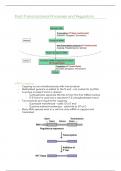
Post-Transcriptional Processes and Regulation
mRNA capping
- Capping occurs simultaneously with transcription
- Methylated guanine is added to the 5’ end - not coded for by DNA
- A unique covalent bond is utilised
- 3 phosphates separate the Me-G from the first mRNA residue
- 5’-5’ bond is used not a standard 3’-5’ phosphodiester bond
- Two enzymes are required for capping
- Guanylate transferase - adds G to 5’ end
- Guanine methyl-transferase - adds Me to N7 of G
- Many RNA species exist in a cell but only mRNA is capped and
translated
, - Capping enhances the translation of mRNA
- Only occurs in eukaryotes
- Prokaryotic mRNAs are typically polycistronic - ribosome initiates
translation internally and is guided by the SD sequence
- Eukaryotic mRNAs are typically monocistronic and lack guide
sequences
- Therefore translation is initiated by the 40S ribosomal subunit binding
to the Me-G cap
- If the mRNA is not capped, it will not be recognised and translated into
a protein
- Monocistronic - 1 RNA encodes for 1 protein
- 5’ end of all mRNAs that need to be translated into protein in the cytosol
must be recognised by the translational apparatus
- This does not occur for rRNA - do not have a 5’ cap
- 5’ cap is recognised by the 40S ribosomal subunit and translation
initiation factor elF4E - results in recruitment of additional translation
initiators
Shine Dalgarno
- Is a ribosomal binding site in prokaryotic mRNA
- Located 8 bp upstream of the start codon AUG
- Helps recruit the ribosome to the mRNA to initiate protein synthesis by
aligning the ribosome with the start codon
- SD sequence exists in both bacteria and archaea
- Also present in some chloroplast and mitochondrial transcripts
- Sequence is AGGAGG
- Was proposed by John Shine and Lynn Dalgarno
Kozak’s rules
- Proposed by Marilyn Kozak
- In eukaryotes, translation is not initiated at the first AUG triplet
- AUG triplet must be within a consensus sequence
- GCCA/GCCAUGG or ACCAUGG
, - “Scanning hypothesis” states that the ribosome moves along the mRNA
looking for GCCA/GCCAUGG sequence to initiate translation
- Rules describe the characteristics of sequences surrounding an AUG
codon that will allow initiation of translation
Capping protects the mRNA
- Uncapped mRNA have a free 5’ phosphate group that can be used by
exonucleases to degrade the mRNA
- Capped mRNA ends on an Me-G nitrogen base
- Me-G cap is recognised by cap-binding complex (CBC)
- CBC is replaced by elF4E in the cytosol to allow the initiation of
translation
Capping: a checkpoint in transcription
- Capping regulates elongation of a RNA transcript
- After the initiation of transcription, a few nucleotides of the RNA is made
and pTEF-b kinase is recruited
- Kinase phosphorylates the RNA pol II causing RNA pol to pause
- During the pause, the cap is added
- Kinase then again phosphorylates RNA pol II
- Transcription elongation can continue
- Capping and elongation occur simultaneously
- This ensures that a full mRNA transcript is not made unless correctly
capped
mRNA capping
- Capping occurs simultaneously with transcription
- Methylated guanine is added to the 5’ end - not coded for by DNA
- A unique covalent bond is utilised
- 3 phosphates separate the Me-G from the first mRNA residue
- 5’-5’ bond is used not a standard 3’-5’ phosphodiester bond
- Two enzymes are required for capping
- Guanylate transferase - adds G to 5’ end
- Guanine methyl-transferase - adds Me to N7 of G
- Many RNA species exist in a cell but only mRNA is capped and
translated
, - Capping enhances the translation of mRNA
- Only occurs in eukaryotes
- Prokaryotic mRNAs are typically polycistronic - ribosome initiates
translation internally and is guided by the SD sequence
- Eukaryotic mRNAs are typically monocistronic and lack guide
sequences
- Therefore translation is initiated by the 40S ribosomal subunit binding
to the Me-G cap
- If the mRNA is not capped, it will not be recognised and translated into
a protein
- Monocistronic - 1 RNA encodes for 1 protein
- 5’ end of all mRNAs that need to be translated into protein in the cytosol
must be recognised by the translational apparatus
- This does not occur for rRNA - do not have a 5’ cap
- 5’ cap is recognised by the 40S ribosomal subunit and translation
initiation factor elF4E - results in recruitment of additional translation
initiators
Shine Dalgarno
- Is a ribosomal binding site in prokaryotic mRNA
- Located 8 bp upstream of the start codon AUG
- Helps recruit the ribosome to the mRNA to initiate protein synthesis by
aligning the ribosome with the start codon
- SD sequence exists in both bacteria and archaea
- Also present in some chloroplast and mitochondrial transcripts
- Sequence is AGGAGG
- Was proposed by John Shine and Lynn Dalgarno
Kozak’s rules
- Proposed by Marilyn Kozak
- In eukaryotes, translation is not initiated at the first AUG triplet
- AUG triplet must be within a consensus sequence
- GCCA/GCCAUGG or ACCAUGG
, - “Scanning hypothesis” states that the ribosome moves along the mRNA
looking for GCCA/GCCAUGG sequence to initiate translation
- Rules describe the characteristics of sequences surrounding an AUG
codon that will allow initiation of translation
Capping protects the mRNA
- Uncapped mRNA have a free 5’ phosphate group that can be used by
exonucleases to degrade the mRNA
- Capped mRNA ends on an Me-G nitrogen base
- Me-G cap is recognised by cap-binding complex (CBC)
- CBC is replaced by elF4E in the cytosol to allow the initiation of
translation
Capping: a checkpoint in transcription
- Capping regulates elongation of a RNA transcript
- After the initiation of transcription, a few nucleotides of the RNA is made
and pTEF-b kinase is recruited
- Kinase phosphorylates the RNA pol II causing RNA pol to pause
- During the pause, the cap is added
- Kinase then again phosphorylates RNA pol II
- Transcription elongation can continue
- Capping and elongation occur simultaneously
- This ensures that a full mRNA transcript is not made unless correctly
capped