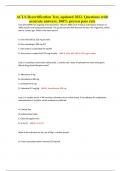
ACLS Recertification Test, updated 2022. Questions with accurate answers. 100% proven pass rate
ACLS Recertification Test, updated 2022. Questions with accurate answers. 100% proven pass rate Document Content and Description Below A pt with STEMI has ongoing chest dicomfort. Heparin 4000 units IV bolus and heparin infusion of 1000 units/hr are being administered. The pt did not take ASA because he has a hx of gastritis, which was tx 5 years ago. What is the next action? A. Give ASA 160 to 325 mg to chew B. Give clopidogrel 300 mg PO C. Give enteric-coated ASA 75 mg PO D. Give enteric-coated ASA 325 mg rectally - ANS-A. Give ASA 160 to 325 mg to chew A pt is in pulseless ventricular tachycardia. 2 shocks and 1 dose of epinephrine have been given. Which drug should be given next? A. Adenosine 6 mg B. Amiodarone 300 mg C. Epinephrine 3 mg D. Lidocaine 0.5 mg/kg - ANS-B. Amiodarone 300 mg A pt is in cardiac arrest. V fib has been refractory to an initial shock. If no pathway for medication administration is in place, which method is preferred A. Central line B. Endotracheal tube C. External Jugular vein D. IV or IO - ANS-D. IV or IO What is the indicatio for the use of Mg in cardiac arrest? A. V tach associated with a normal QT intervalB. shock-refractory monomorphic v tach C. Pulseless v tach-associated torsades de pointes D. shock-refractory v fib - ANS-C. Pulseless v tach-associated torsades de pointes You arrive on the scene with the code team. CRP is in progess. An AED previously advised "no shock indicated." A rhythm chec now finds asystole. After resuming compressions, which action do you take next? A. Call for a pulse check B. establish IV or IO access C. Insert a laryneal airway D. Perform endotracheal intubation - ANS-B. establish IV or IO access A pt is in cardiac arrest. V fib has been refractory to a second shock. Which drug should be administered first? A. Atropine 1 mg IV/IO B. epinephrine 1 mg IV/IO C. Lidocaine 1 mg/kg IV/IO D. Sodium bicarbonate 50 mEq IV/IO - ANS-B. epinephrine 1 mg IV/IO A pt with sinus bradycardia and a HR of 42/min has diaphoresis and a BP of 80/60 mg. What is the initial dose of atropine? A. 0.1 mg B. 0.5 mg C. 1 mg D. 3 mg - ANS-B. 0.5 mgA pt is in refractory V fib. CRP is in progess. One dose of epinephrine was given after the second shock. An antiarrhythimic drug was given immediate after the thirst shock. You are the team leader. Which med do you order next? A. Epinephrine 1 mg B. epinephrine 3 mg C. Sodium bicarbonate 50 mEq D. a second dose of the antiarrhythmic drug - ANS-A. Epinephrine 1 mg A monitored pt in the ICU developed a sudden onset of narrow-complex tachycardia at 220/min. The pt BP is 128/58. The PETCO2 is 38 mm Hg, and the puse Ox is 98%. There is a vascular access in the L arm, and the pt has not been given any vasoactive drugs. An ECG confirms supraventricular tachycardia with no evidence of ischemia or infarction. The HR has not responsed to vagal maneuvers. What is the next action? A. Administer adenosine 6 mg IV push B. Administer amiodarone 300 mg IV push C. perform synchronized cardioversion at 50 J D. perform synchronized cardioversion at 200 J - ANS-A. Administer adenosine 6 mg IV push A pt has a rapid irregular wide-complex tachycardia. The ventricular rate is 138/min. He is asx with a BP of 110/70. PMHx of angina. What action is recommended next? A. Give adenosine 6 mg IV bolus B. Give lidocaine 1 to 1.5 mg IV bolus C. performing s
Written for
- Institution
- ACLS
- Course
- ACLS
Document information
- Uploaded on
- June 4, 2023
- Number of pages
- 9
- Written in
- 2022/2023
- Type
- Exam (elaborations)
- Contains
- Questions & answers
Subjects
- acls recertification test
-
updated 2022 questions

Also available in package deal