

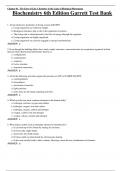
Chapter 01 - The Facts of Life: Chemistry Is the Logic of Biological Phenomena Biochemistry 6th Edition Garrett Test Bank 1. All are distinctive properties of living systems EXCEPT: a. Living organisms are relatively simple. b. Biological structures play a role in the organism's existence. c. The living state is characterized by the flow of energy through the organism. d. Living organisms are highly organized. e. Living organisms are actively engaged in energy transformation. ANSWER: a 2. Even though the building blocks have fairly simple structures, macromolecules are exquisitely organized in their intricate three -dimensional architecture known as: a. configuration. b. conformation. c. sequence. d. Lewis structure. e. structural maturation. ANSWER: b 3. All of the following activities require the presence of ATP or NADPH EXCEPT: a. osmoregulation. b. biosynthesis. c. movement of muscles. d. light emission. e. none, they are all energy -requiring activities. ANSWER: e 4. Which are the four most common elements in the human body? a. hydrogen, calcium, oxygen and sodium b. hydrogen, oxygen, iron and carbon c. hydrogen, oxygen, carbon and nitrogen d. oxygen, carbon, iron and nitrogen e. oxygen, silicon, calcium and nitrogen ANSWER: c 5. What makes carbon such an abundant element in biomolecules? a. It can form up to five bonds by sharing its electrons. b. It forms only single bonds. c. It provides low bond energy. d. It forms stable covalent bonds by electron pair sharing. e. It does not usually bond to other carbons, allowing a more diverse combination of elements. ANSWER: d Chapter 01 - The Facts of Life: Chemistry Is the Logic of Biological Phenomena 6. The major precursors for the formation of biomolecules include all EXCEPT: a. nitrate and dinitrogen. b. water. c. carbon dioxide. d. ammonium ion. e. none, all are major precursors. ANSWER: e 7. From the major precursors, the complex biomolecules are made in which sequence? a. metabolites, building blocks, macromolecules, supramolecular complexes b. macromolecules, building blocks, metabolites, supramolecular complexes c. building blocks, macromolecules, supramolecular complexes, metabolites d. metabolites, macromolecules, building blocks, supramolecular complexes e. metabolites, building blocks, supramolecular complexes, macromolecules ANSWER: a 8. The structural integrity of supramolecular complexes (assemblies) of multiple components are bonded to each other by all of the following forces EXCEPT: a. covalent bonds b. van der Waals forces c. hydrogen bonds d. hydrophobic interactions e. ionic interactions ANSWER: a 9. Organelles have what three attributes? a. Only in prokaryotic cells, membrane bound, have a dedicated set of tasks. b. Only in eukaryotic cells, membrane bound, have a dedicated set of tasks. c. Only in eukaryotic cells, seldom membrane bound, have a dedicated set of tasks. d. Only in prokaryotic cells, membrane bound, multi -functional. e. In both prokaryotic cells and eukaryotic cells, membrane bound, have a dedicated set of tasks. ANSWER: b 10. Membrane structures are maintained primarily by: a. hydrophobic interactions. b. covalent bonds. c. hydrogen bonds. d. non-spontaneous assembly. e. ionic interactions. ANSWER: a 11. All of the following are properties of membranes EXCEPT: a. supramolecular assemblies. b. define boundaries of cellular components. c. spontaneous assemblies resulting from hydrophobic interactions. Chapter 01 - The Facts of Life: Chemistry Is the Logic of Biological Phenomena d. identical protein and lipid composition in the major organelles. e. none, all are true. ANSWER: d Chapter 01 - The Facts of Life: Chemistry Is the Logic of Biological Phenomena 12. Which of the following properly ranks the non-covalent interactions in order of increasing strength? a. ionic, hydrogen bond, van der Waals b. van der Waals, hydrogen bond, ionic c. van der Waals, ionic, hydrogen bond d. hydrogen bond, van der Waals, ionic e. cannot be determined since ionic interactions and hydrogen bonds often vary in strength ANSWER: e 13. Weak forces that create constantly forming and breaking interactions at physiological temperatures, but cumulatively impart stability to biological structures generated by their collective activity include all EXCEPT: a. hydrogen bonds b. van der Waals forces c. covalent bonds d. ionic interactions e. hydrophobic interactions ANSWER: c 14. Which of the following is a true statement about non-covalent bonds? a. They are all the result of electron sharing. b. Hydrogen bonds, ionic bond and hydrophobic interactions all carry a degree of specificity while van der Waals interactions are induced. c. All noncovalent bonds are formed between oppositely charged polar functions. d. Van der Waals interactions are not affected by structural complementarity, while hydrogen bonds, ionic bonds and hydrophobic interaction are affected by structural complementarity. e. Hydrogen, van der Waals, and hydrophobic interactions do not form linear bonds. ANSWER: b 15. Electrostatic forces a. include ionic interactions between negatively charged carboxyl groups and positively charged amino groups. b. average about 2 kJ/mol in aqueous solutions. c. typically are directional like hydrogen bonds. d. require a precise fit like van der Waals interactions. e. include ionic, induced dipole and permanent dipole interactions. ANSWER: a 16. All are true about hydrophobic interactions EXCEPT: a. Hydrophobic interactions result from the strong tendency of water to exclude nonpolar groups or molecules. b. Hydrophobic interactions result because water molecules prefer the stronger interactions that they share with one another, compared to their interactions with nonpolar molecules. c. Hydrophobic interactions result from hydrogen bonds between water and the hydrophobic molecules. d. The preferential interactions between water molecules "exclude" hydrophobic substances from aqueous solution and drive the tendency of nonpolar molecules to cluster together. e. Hydrophobic interactions result in nonpolar regions of biological molecules being buried in the molecule's interior to exclude them from the aqueous milieu. ANSWER: c
Preview 4 out of 333 pages
Exam (elaborations)
Complete Test Bank Biochemistry 6th Edition Garrett Questions & Answers with rationales (Chapter 1-32)
Preview 4 out of 333 pages
Biochemistry 6th Edition Garrett Test Bank Complete Test Bank Biochemistry 6th Edition Garrett Questions & Answers with rationales (Chapter 1-32) PDF File All Pages All Chapters Grade A+
Content preview
Connected book
Document information
- Uploaded on
- June 3, 2023
- Number of pages
- 333
- Written in
- 2022/2023
- Type
- Exam (elaborations)
- Contains
- Questions & answers
$17.49

Wrong document? Swap it for free
Within 14 days of purchase and before downloading, you can choose a different document. You can simply spend the amount again.
Written by students who passed
Immediately available after payment
Read online or as PDF

Reputation scores are based on the amount of documents a seller has sold for a fee and the reviews they have received for those documents. There are three levels: Bronze, Silver and Gold. The better the reputation, the more your can rely on the quality of the sellers work.

